
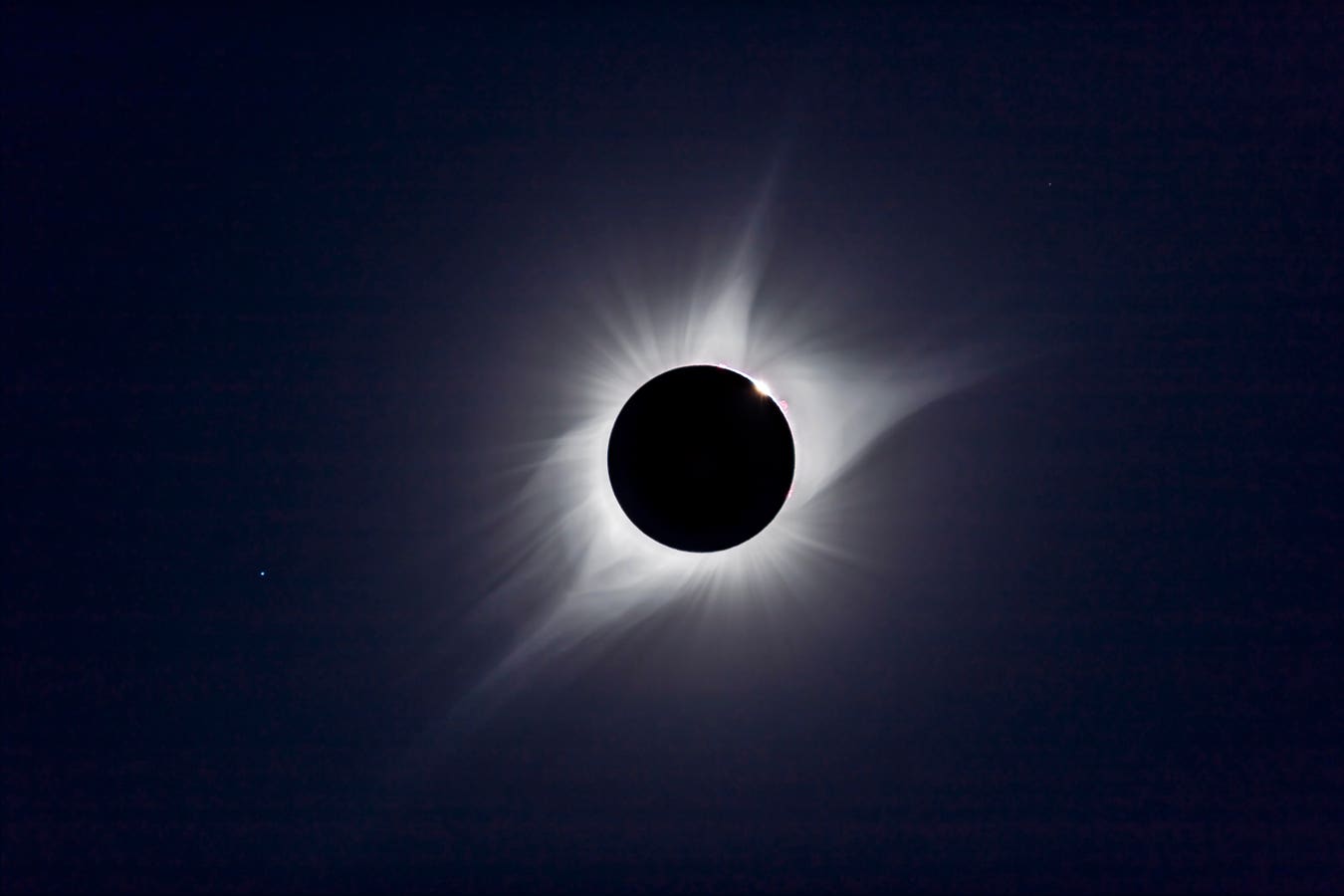
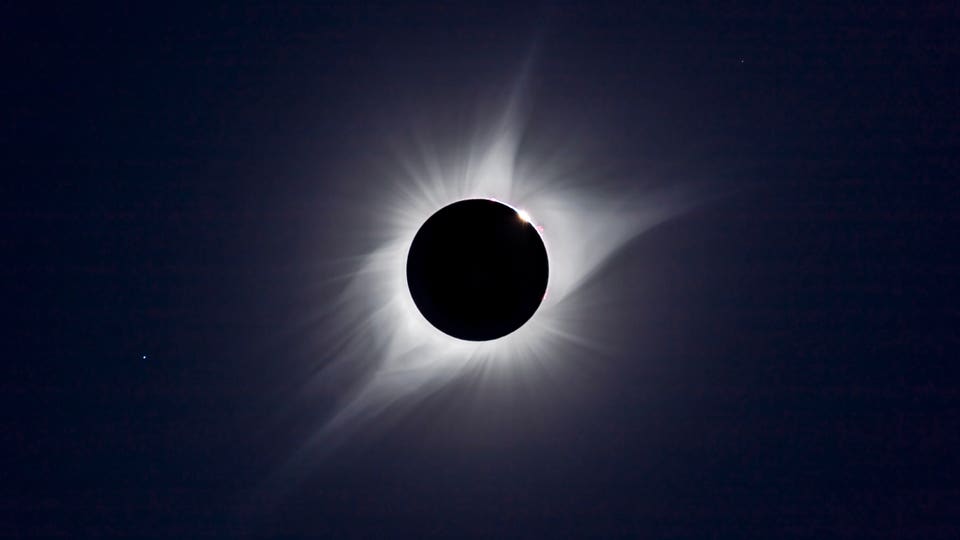
A composite of the August 21, 2017 total solar eclipse.
Getty
It’s exactly 600 days from today, and you’re standing on the banks of the Nile. Its wooden boats creak as they bob amid the golden shimmer of lantern light reflecting off the river. Families are gathered on either side of you, tourists line up with cameras on the cruise ship ahead and on the rooftops behind. Something incredible is about to occur. As the moon drifts across the sun, shadows sharpen, and the sky slowly deepens to a twilight. The last rays of sunlight vanish and, at last, darkness sweeps over Luxor as the sun’s white corona is revealed — not for a fleeting moment, but for over six astonishing minutes. This is the “eclipse of the century” — and you’re in one of the best places on Earth to see it.
Here’s everything you need to know about the total solar eclipse on Aug. 2, 2027 — including what time it happens, where to watch it, how long it lasts, and how to view it safely.
Luxor Temple is a large Ancient Egyptian temple complex on east bank of Nile river in Luxor (ancient Thebes). View from Nile river
gettyWhat Is A Total Solar Eclipse?
When the moon moves precisely between the Earth and the sun, it causes a total solar eclipse, blocking sunlight for a few brief minutes. During totality, the sky darkens to a dusk, the temperature drops and stars and planets can become visible in daytime. Most stunning of all, the sun’s wispy white corona — its outer atmosphere — becomes visible to the naked eye. It’s a jaw-dropping sight — the sight of your life.
How Long Will The Eclipse Last?
There’s a reason that the total solar eclipse on Aug. 2, 2027, is being touted as the “eclipse of the century.” It will bring the longest totality of the rest of the 21st century. At its peak near Luxor, Egypt, totality will last 6 minutes and 23 seconds, close to the maximum possible on Earth. That’s long enough to see the sun’s corona — visible to the naked eye only during totality — in exquisite detail. This extraordinary length is due to a perfect cosmic alignment: the moon will be near its closest point to Earth (perigee) and the sun near its farthest (aphelion), making the moon appear large enough to block the entire disk of the sun for a longer-than-usual time.
Aug. 2, 2027, will see the longest totality since 6 minutes 39 seconds on Jul. 22, 2009, near Ishinomura-Kitaio Island, Japan, and until 6 minutes 6 seconds off Florida’s Port Lucie on Aug. 12, 2045. The next totality to exceed this won’t occur until 2132.
The path of totality on Aug. 2, 2027, during a total solar eclipse, by eclipse cartographer Michael Zeiler at EclipseAtlas.com.
Michael Zeiler/EclipseAtlas.comWhat Is The Path Of Totality For The 2027 Eclipse?
About 89 million people live in the path of totality on Aug. 2, 2027, according to TimeandDate, making it one of the most widely visible of the 21st century. That day, a path of totality 9,462 miles (15,227 kilometers) in length will cross southern Spain, northern Morocco, northern Algeria, northern Tunisia, Egypt, southwest Saudi Arabia, Yemen, and Somalia.
Many eclipse chasers will head to Egypt for the bragging rights of the longest totality possible in anyone’s lifetime — something that most will find hard to resist, though prices and temperatures will be high. Key viewing locations in Luxor will include Karnak and Luxor Temples, the Nile and, on the west bank, the Colossi of Menmon and the vast Hatshepsut Temple.
Other great locations to experience about five minutes of totality (which is an incredibly long time, relatively speaking) include Tunisia and ships in the Mediterranean off Tunisia and Libya. For a short, cooler, more affordable way to experience it, head to Morocco or southern Spain.
Nine successive solar eclipses in Saros 136 all resemble each other.
Michael Zeiler/EclipseAtlas.comWhy Is Totality During The 2027 Eclipse So Long?
Moon shadows come in families. The total solar eclipse in 2027 is part of Saros 136, which produces long totalities every 18 years, 11 days, and 8 hours (the time it takes the moon to orbit the Earth 223 times). After Aug. 2, 2027, it next repeats on Aug. 12, 2045, when another long total solar eclipse passes over the U.S., the Caribbean, and South America. It will bring darkness to the day at Arches National Park in Utah, the Kennedy Space Center, and Disney World in Florida. At maximum, totality will last 6 minutes and 6 seconds off the southeast coast of Florida. The place to be in the U.S. is Chastain Beach in Stuart, Florida, for a 6-minute 4-second totality.
The path of totality sweeps near Iceland and over Spain on August 12, 2026, during a total solar eclipse. By eclipse cartographer Michael Zeiler at EclipseAtlas.com.
Michael Zeiler/EclipseAtlas.comWhen Is The Next Eclipse?
Although excitement is building for the total solar eclipse in 2027, the next one is on Aug. 12, 2026. On that day, a path of totality will sweep across eastern Greenland, western Iceland and northern Spain, with 1-2 minutes of totality occurring late in the day. For Spain, it will be the first of two total solar eclipses in under a year — an incredible opportunity for European eclipse chasers.
Wishing you clear skies and wide eyes.