
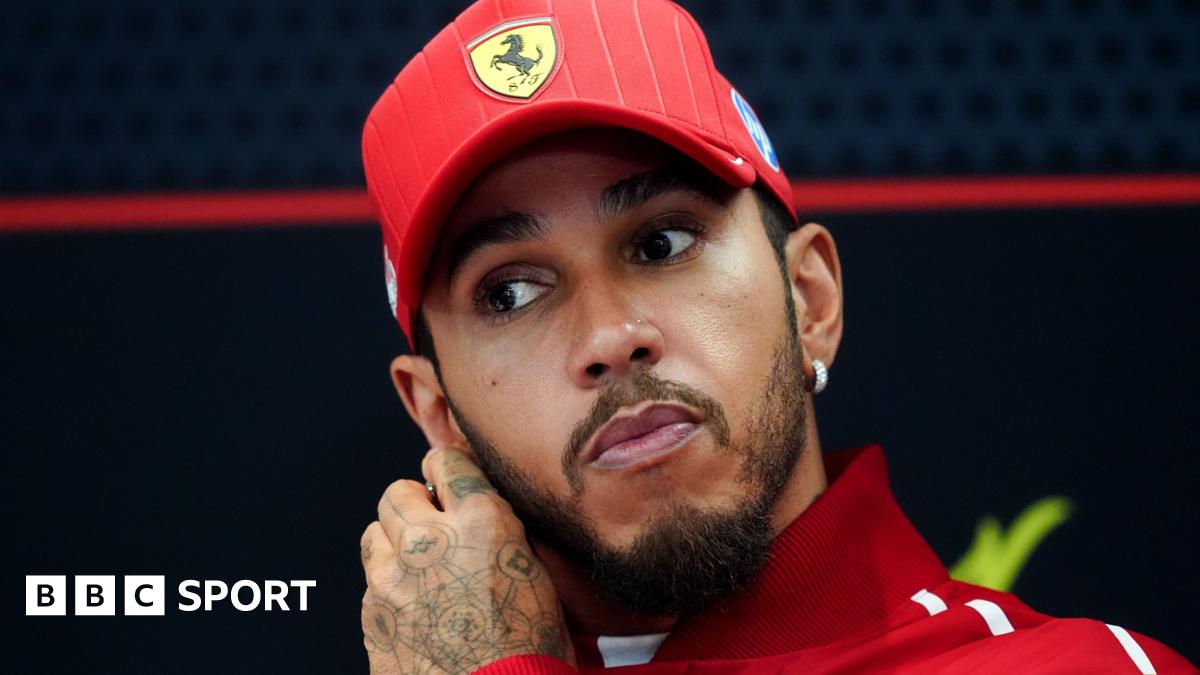
The 40-year-old Briton joined Ferrari with the ambition of winning that elusive eighth world title, which he – and a good number of others – believes he should already have won in the controversial 2021 title decider.
It had been a long-time ambition, and the move created a sensation.
The sport’s most famous driver joining its most iconic team, right at a time when Ferrari seemed to be on an upward trajectory after ending 2024 narrowly missing out on the constructors’ championship at the final race of the year. It seemed set up perfectly.
But the script went off course. Ferrari’s car was not competitive at the start of the year, while Hamilton struggled to adapt to its characteristics, and had questions about the way the team worked.
Although a sprint-race victory for Hamilton at the second race of the season in China was a promising start, reality set in with a bump the following day, when both cars were disqualified from the grand prix.
In Hamilton’s case, the reason for the disqualification was an early indication of a problem that would blight much of Ferrari’s season.
He was disqualified for excessive skid wear. To be vaguely competitive, Ferrari had to run the car so low that it risked wearing out its skid plates. Run it higher, and it was slow.
Ferrari fell foul of this issue at least twice more in the season. In Spain, the Ferrari pace dropped off significantly in the final stages after a promising first two-thirds of the race as the team tried to manage skid wear, in this case by increasing their tyre pressures for the final stint.
In Hungary, his team-mate Charles Leclerc qualified on pole and appeared to be competing for the win with the McLarens for the first two-thirds of the race, only to slow significantly in the final stint as he limited his top speed to reduce the load on the car.
It was in Hungary that the first real signs of the strain on Hamilton showed.
He could manage only 12th on the grid, and the stark comparison between him and Leclerc resulted in him saying he was “just useless”, and suggesting the team “probably need to change driver”.
The second part of the season was littered with similarly downbeat comments, always uttered in the heat of the moment when the adrenaline was still pumping after a difficult time out on track.
Team principal Frederic Vasseur has been brushing them aside.
“I don’t pay attention to the reaction in the TV pen,” he said in Abu Dhabi last weekend. “Honestly. Or the reaction that sometimes they add on the microphone in the car, on the radio.
“In the TV pen, they are jumping out of the car five minutes after the session. Sometimes they have bad results for a couple of hundredths (of a second). And you are asking them questions.
“I can understand that sometimes the guy is a bit emotional and to say, ‘OK, yes, no.’ All he wants is to go back to the engineering office and to discuss with the engineer to understand why.”
In that answer Vasseur touched on another common theme he has used to downplay Hamilton’s difficulties.
When Hamilton has missed out in qualifying, Vasseur often points out that it’s usually by tiny margins. The field is so tight, he says, that any error, whether in driving or tyre preparation or whatever, is punished.
As Vasseur said after the race in Abu Dhabi: “We struggled all the season with details, because what we have to keep in mind is that yesterday in Q1, you moved from P6 to P16 for less than 0.1secs.”
The margin between sixth and 16th last Saturday was actually 0.216secs, but the fundamental point stands – Hamilton missed out on getting through by 0.009secs.
Nevertheless, it overlooks the fact that there are two Ferrari drivers, and Leclerc has not been as badly affected.
He has out-qualified Hamilton, the sport’s all-time pole position record holder, 22 times to seven at an average advantage of 0.15 seconds a lap. Leclerc’s average grid position is 5.6, Hamilton’s is 9.5.