
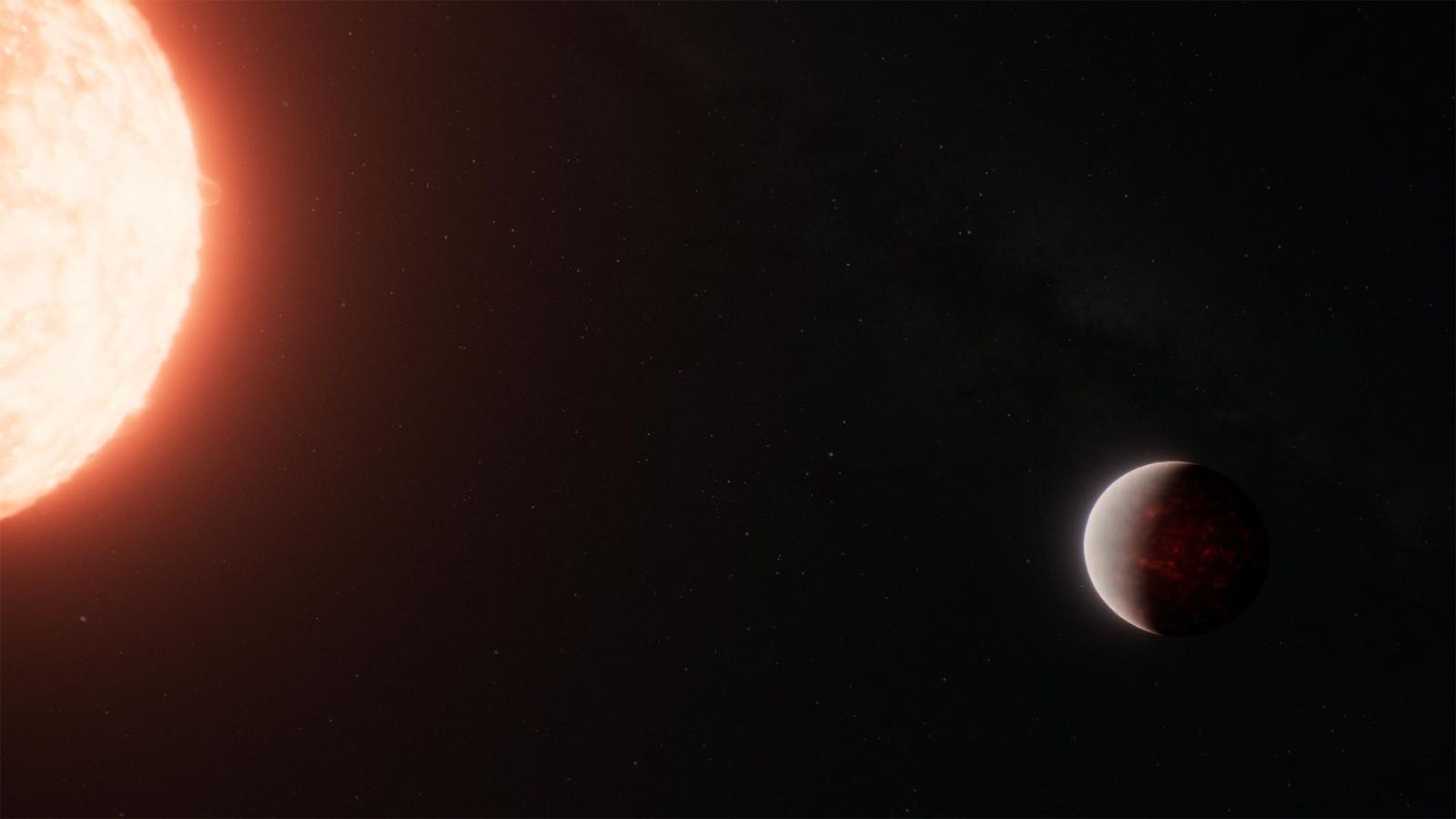
This artist’s concept shows what the ultra-hot super-Earth exoplanet TOI-561 b could look like based on observations from NASA’s James Webb Space Telescope and other observatories. Webb data suggests that the planet is surrounded by a thick atmosphere above a global magma ocean.
NASA, ESA, CSA, Ralf Crawford (STScI)
NASA’s James Webb Space Telescope has found the most compelling evidence to date that a rocky planet beyond the solar system may have an atmosphere. Although it’s not Earth-like, a planet called TOI-561 b, about 280 light-years from the solar system, appears to be a lava-covered world shrouded in a thick layer of gases. It was thought to be too small and too hot to retain an atmosphere, as intense radiation from its host star was expected to strip it away.
Surprising Discovery
“Our observations suggest it is surrounded by a relatively thick blanket of gas, upending conventional wisdom about ultra-short-period planets,” said Nicole Wallack, a Carnegie Science Postdoctoral Fellow, and second author of a paper published today in The Astrophysical Journal Letters. The surprising observation came from JWST data on surface temperature at TOI-561 b, where a year lasts only 11 hours because it orbits so close to its host star.
Hints Of Thick Atmosphere
Using the James Webb Space Telescope’s Near-Infrared Spectrograph (NIRSpec) instrument to measure the planet’s dayside temperature — based on its brightness in the near-infrared — the researchers discovered that it’s cooler than expected based on bare rock models. This temperature drop strongly suggests the presence of a volatile-rich atmosphere capable of absorbing heat and redistributing energy.
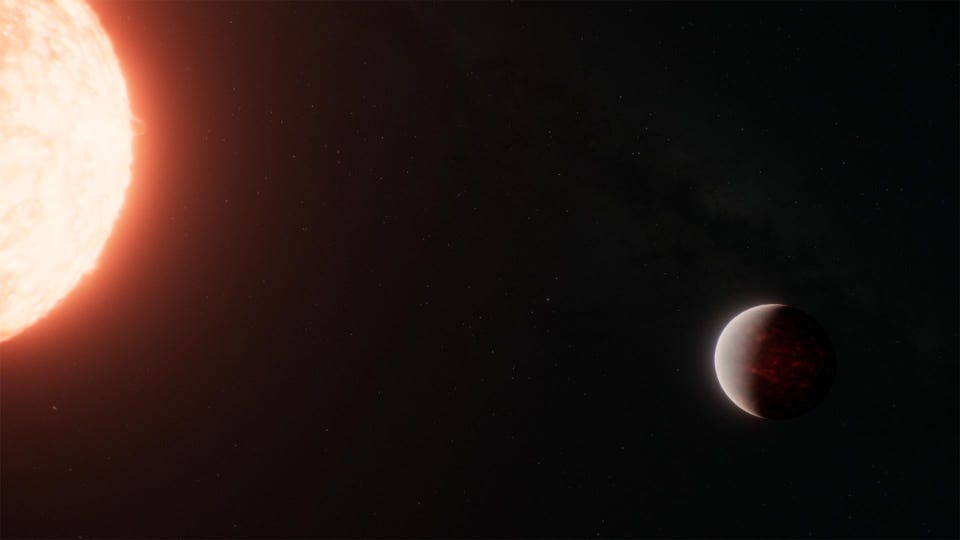
This artist’s concept shows what a thick atmosphere above a vast magma ocean on exoplanet TOI-561 b could look like. Measurements of light captured from the planet’s dayside by NASA’s James Webb Space Telescope suggest that in spite of the intense radiation it receives from its star, TOI-561 b is not a bare rock.
NASA, ESA, CSA, Ralf Crawford (STScI)
“Gases like water vapor would absorb some wavelengths of near-infrared light emitted by the surface before they make it all the way up through the atmosphere,” said co-author Anjali Piette at the University of Birmingham, U.K. The paper proposes a dynamic exchange between the magma ocean and the atmosphere: while gases escape into space, others are continuously replenished from the interior, creating a long-lasting equilibrium on this “wet lava ball.”
An Ancient World
This is not the first time TOI-561 b has been in the news. About 1.45 times the size of Earth and about three times its mass — a “super-Earth” — its density suggests that it’s very old. Back in 2021, researchers revealed that it may have existed since almost the dawn of the Milky Way galaxy — potentially demonstrating that the universe has been forming rocky planets for at least 10 billion years.
Wishing you clear skies and wide eyes.