
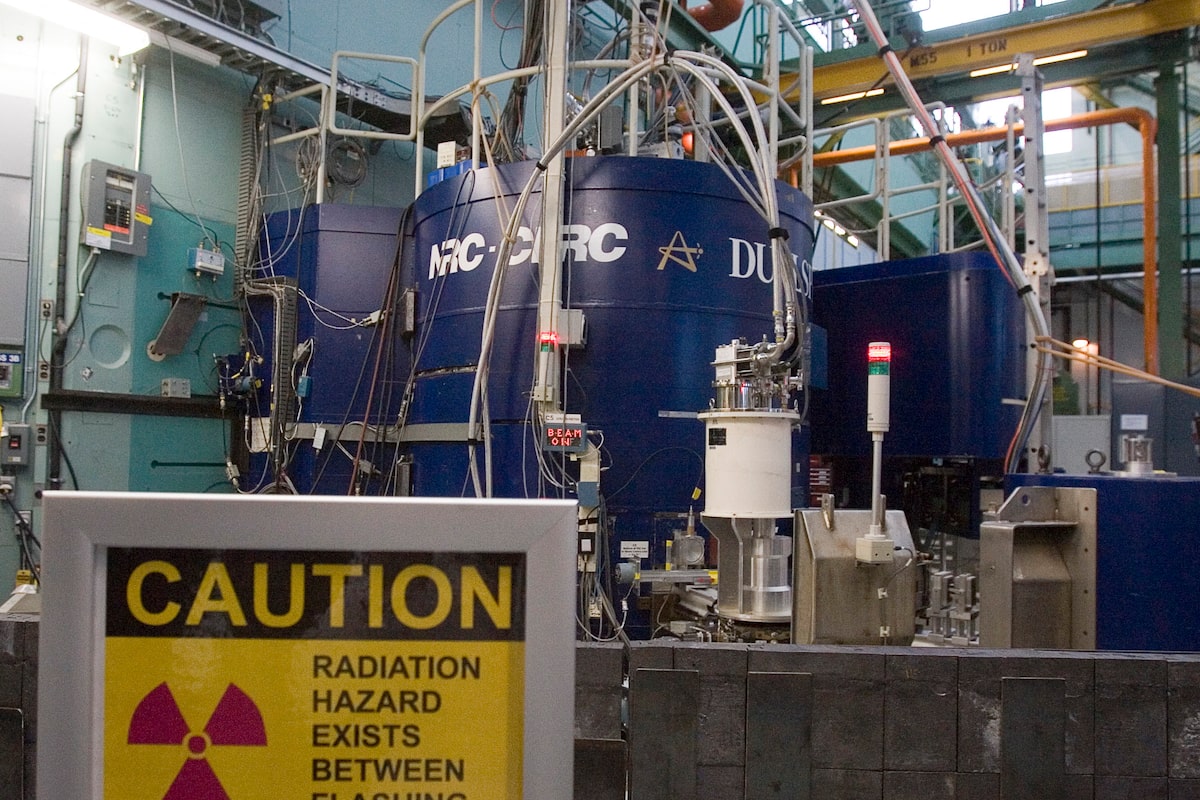
A nuclear reactor in Chalk River, Ont., in December, 2007. The consortium’s responsibilities will include modernizing the facilities at Chalk River Laboratories.FRED CHARTRAND/The Canadian Press
An American-owned consortium has assumed responsibility for managing Canada’s premier nuclear research facility, Chalk River Laboratories, along with cleaning up the federal government’s sizable inventory of radioactive waste spread across the country.
After a three-month delay, Nuclear Laboratory Partners of Canada Inc. formally took control on Thursday of the organization that runs Chalk River, known as Canadian Nuclear Laboratories.
CNL manages the assets and liabilities of a federal Crown corporation called Atomic Energy of Canada Ltd. under an arrangement Ottawa describes as a “government-owned, contractor-operated” model.
Dating from the 1940s, Chalk River Laboratories is Canada’s largest science and technology research compound. It served as the birthplace of Canada’s Candu power reactor and conducted much of the nation’s work on medical isotopes, and stores much of the federal government’s extensive collection of radioactive waste.
Earlier this year, AECL said the consortium’s contract is worth about $1.2-billion annually. It has been called the federal government’s largest contract at the moment, although key federal authorities – including the Treasury Board Secretariat, Auditor-General and AECL – have been unwilling or unable to confirm that. The term of the contract will be six years but it can be extended for up to another 14 years.
The consortium’s American ownership has provoked controversy. Since assuming office, Prime Minister Mark Carney has espoused a Buy Canadian policy – a key part of his government’s response to mounting conflict with its dominant trading partner, the United States.
Corey Tochor, a Conservative member of Parliament for Saskatoon-University, accused AECL of “selling out our nuclear secrets” to American interests, during the first of three scheduled hearings held before the House of Commons standing committee on natural resources to examine the consortium’s American ownership.
“What we have real deep concerns [about] is that we’re letting a foreign country manage our medical isotopes,” Mr. Tochor said.
Earlier this month, Conservative MP Cheryl Gallant from Renfrew-Nipissing-Pembroke characterized the awarded contract as an “elbows-down” approach that left Americans in control of Canadian intellectual property.
AECL president and chief executive Fred Dermarkar said he had no concerns about the U.S. ownership. He told the committee that the government-owned, contractor-operated model was introduced in 2015 specifically to tap American talent.
“The concept was that the U.S. had extensive expertise, owing to their vast experience in nuclear waste management, and lab operations at the U.S. Department of Energy’s 17 nuclear labs,” he said.
“If there’s a particular project that’s going on that has a particularly unique aspect to it, those parent companies can reach back into their stable of expertise and experience, and bring those resources to Canada.”
Chalk River is considered Canada’s premier nuclear research facility. Government officials say the consortium’s leadership will be based in Canada.Canadian Nuclear Labratories/Supplied
The American-owned consortium is led by a large nuclear specialty manufacturer focused on military equipment and nuclear fuel called BWX Technologies Inc. It also performs nuclear site restoration work and holds a large U.S. government contract to perform environmental work at Hanford, a decommissioned nuclear production complex in the state of Washington. (BWXT has 1,900 employees in Canada.)
The consortium also includes BWXT’s recently acquired Canadian subsidiary Kinectrics Inc., along with Virginia-based Amentum Environment & Energy Inc. Another organization, Battelle Memorial Institute, based in Ohio, has been described as a “key subcontractor.”
The consortium’s responsibilities include modernizing Chalk River’s facilities and decontaminating and demolishing old buildings. It must also manage AECL’s collection of long-retired research and demonstration nuclear reactors and radioactive waste stored temporarily across the country, including the decommissioning of defunct facilities such as Whiteshell Laboratories in Manitoba.
CNL shut down its only research reactor in 2018, leaving a major gap in Chalk River’s research capabilities. CNL and AECL are considering options to acquire a new one.
The U.S.-led consortium takes over from another partnership known as Canadian National Energy Alliance, which held the contract for a decade. Its members recently included Montreal-based AtkinsRéalis Group Inc. and two American companies, Jacobs Engineering Group Inc. and Fluor Corp.
Government officials have said that the procurement of the contract was conducted by AECL, independently of Ottawa, and that the consortium’s leadership will be based in Canada.
The American consortium was declared the winner of a competitive procurement process in June and had originally been scheduled to take over in September. The transfer was delayed pending a review by the Competition Bureau, which is responsible for enforcing federal antitrust rules. Late last month the Competition Bureau issued a “no-action letter” confirming it will not oppose the contract, which allowed the transfer to proceed.