
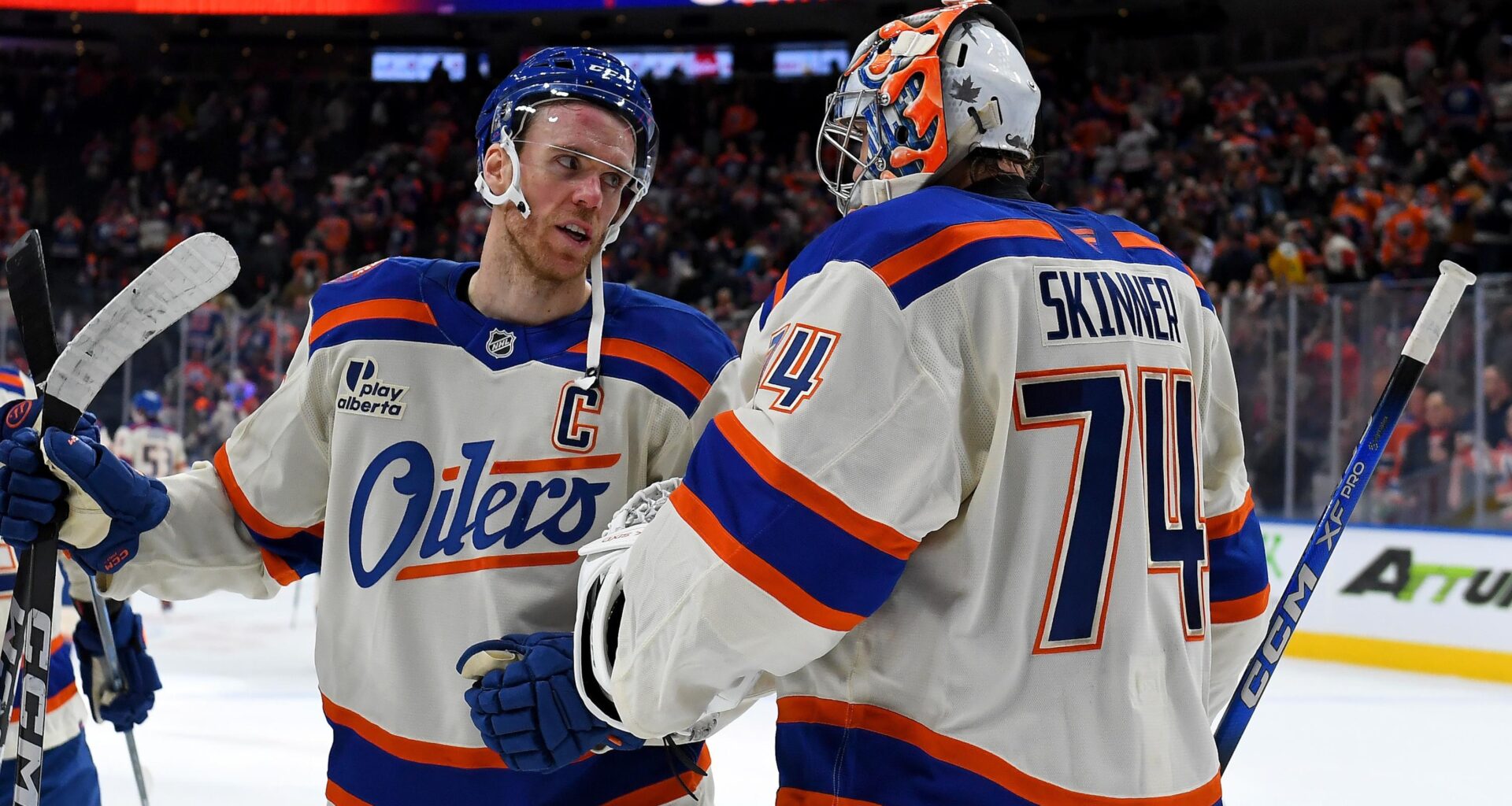
Stop me if you’ve heard this before: It’s the middle of an NHL season and the Oilers are in trouble in part due to spiraling goaltending.
The Oilers rank 26th among 32 NHL teams in goals against per 60 minutes. There’s plenty of blame to go around, but goaltending is undeniably where the discussion starts. With Stuart Skinner and Calvin Pickard between the pipes, the Oilers rank dead last in the NHL by save percentage.
In theory, Tristan Jarry is one of the better solutions to a chronic problem Edmonton has tried to solve for a decade now. Jarry was an uber-talented goaltender as far back as his junior hockey days, and at various points in his 307 regular-season NHL games, he has looked like one of the top 10 goaltenders in the NHL. He was twice an NHL All-Star (2020 and 2022). He’s played well in 13 starts this season and has saved 9.1 goals above expected, per Evolving Hockey.
The problems for Jarry are inconsistency and an inability to take on significant workloads. Jarry has started more than 50 games just once in his NHL career, and though COVID-shortened seasons may have something to do with it, the rest of his career hardly earns that benefit of the doubt. Jarry has endured numerous injuries in his NHL career. Even during his best NHL seasons, he was expected to split the workload with a tandem partner, whether it was Matt Murray, Casey DeSmith, Alex Nedjelkovic, or, this year, Artūrs Šilovs.
Jarry’s career lows also match his upside. He’s had some truly brutal stretches of play, and his limited playoff record is underwhelming. The 30-year-old was so bad last season that the Penguins put him on waivers — which he cleared — and sent him down to the AHL for 12 games.
There is no doubt that Edmonton needed to try something new in net, and Jarry is just that. How much more confident can anyone really be in him to address their problems? The Oilers need a stabilizing force who can handle a heavy workload, both in terms of per-game scoring-chance intensity and in stringing together several starts.
Jarry is an injury-prone goaltender who’s played his best hockey when splitting duties behind defensively stringent Penguins teams. Talk to any NHL goaltender, and they’ll tell you there’s a huge difference between playing well for 40 starts versus playing well for 60.
The risk involved here is quite significant. Jarry holds a $5.375 million cap hit through the 2028 season. No team wanted to touch that via waiver claim last season. Now, the Oilers are moving a second-round pick plus veteran defenseman Brett Kulak for the pleasure, as well as a third-round pick for Spencer Stastney to replace Kulak, who was a necessary inclusion to make the math work.
Stastney is a nice depth defenseman. He’s a capable skater who moves the puck proficiently from the defensive zone. He’s 26 years old and under team control for the rest of this season.
This is the prototypical Edmonton Oilers goaltending move. They’re operating from a position of desperation, and everyone else knows it, so they give up what is effectively a second-round pick and two third-round picks (Kulak’s deadline value plus Stastney) for a volatile goaltender whose value is largely predicated on recent success over a small sample.
Is there a world where it all aligns for Jarry and he can stay healthy and consistent enough to justify a true starting goaltending role in Edmonton? Yes. Is that a reliable forecast? Absolutely not. Even if he can give them good tandem minutes, the Oilers are still a goaltender short.