
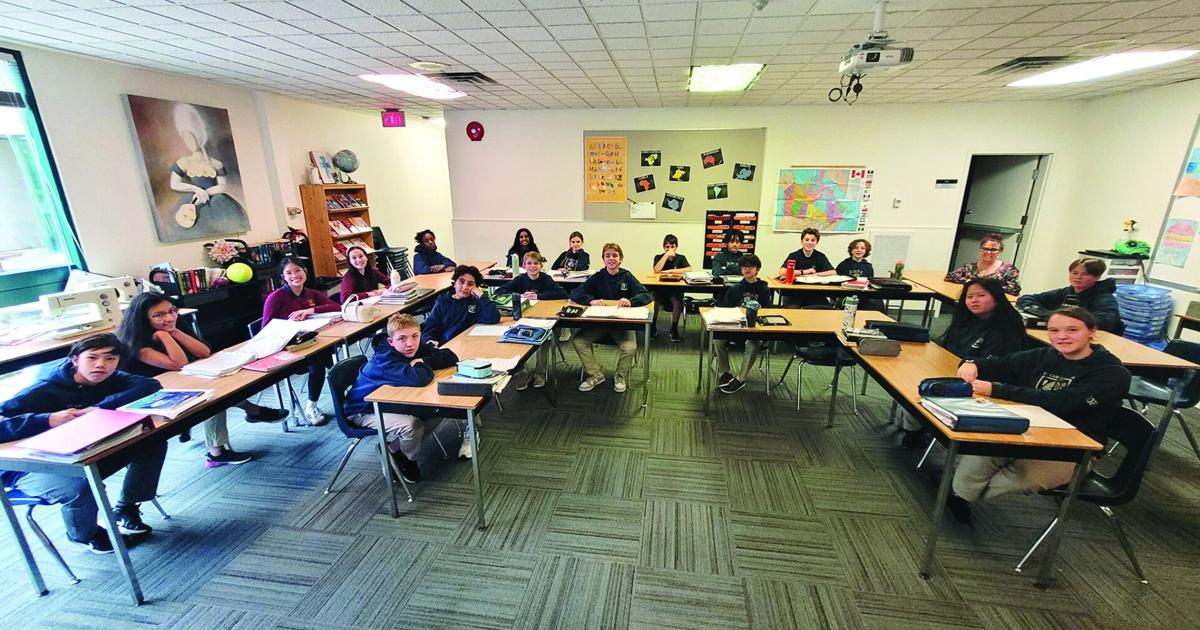
Even with a mission to the moon on the horizon, Canadian astronaut Jeremy Hansen still made time for a Q&A with St. Carlo Acutis Legacy Academys Grade 8 and 9 students in Penticton.
Hansen will be joining three other NASA astronauts on Artemis II, which will launch in February and return humans around the moon for the first time since 1972. And Hansen will be the first Canadian to pay a visit.
The students from Penticton got to meet the astronaut via video chat earlier this month. Hundreds of other students were watching, but the St. Carlo Acutis Legacy Academy kids were among the lucky few to ask questions. They gained an understanding of how monumental of a challenge it truly is to launch a spacecraft to the moon and back. The plan for Artemis II is to spend 10 days traveling over 1-million kilometres.
And the crew has backup plans, just in case things don’t go accordingly.
“There’s a chance they won’t get enough acceleration so they might have to go around the earth more than once,” said David, who’s in Grade 8.
“It’s incredible how many people have to work on this project just to get someone even around the moon,” Grade 8 student Daniel said.
“Our generation has someone that will impact history quite a bit,” said Grade 8 student Farbod.
The class gained an appreciation for how the Artemis II astronauts – who have families, and some of the most impressive resumes on the planet — are willing to risk it all to take a trip to the moon.
“He might die in front of millions of people,” Grade 8 student Joaquin said.
One thing that stood out to Joaquin was the diversity of the crew, which includes a female astronaut, Christina Koch, and a Black astronaut, Victor Jerome Glover.
Joaquin also joked about how if NASA discovers oil on the moon, it will get exploited by corporate interests.
The students got to see how much spaceships have evolved since the Apollo missions. And they had fun thinking about how Artemis is a stepping stone towards future missions to Mars.
But after wrapping their minds around the reality of travelling to another planet, students like Jayden in Grade 8 have doubts about it happening in their lifetime.
“Mars has more problems than you might think,” Jayden said.
Farbod pondered the possibility of reducing pollution on earth by blasting waste deep into outer space.
Hansen told the class that he doubts any intelligent life exists in the Milky Way. It quite possibly exists deeper into the universe, but the next closest galaxy — Andromeda — is more than 2.5 million lightyears away. So even if intelligent aliens from Andromeda are observing earth, right now they would be looking at the planet as it was 2.5 million years ago.
That concept left Farbod fascinated by the possibility of viewing earth from lightyears away, with a powerful-enough telescope, to watch how the earth’s ancient history truly unfolded. But while Hansen doubts sentient life in the local galaxy, he believes microbial life is much more likely, possibly even on the moon — assuming water exists there in one form or another.