
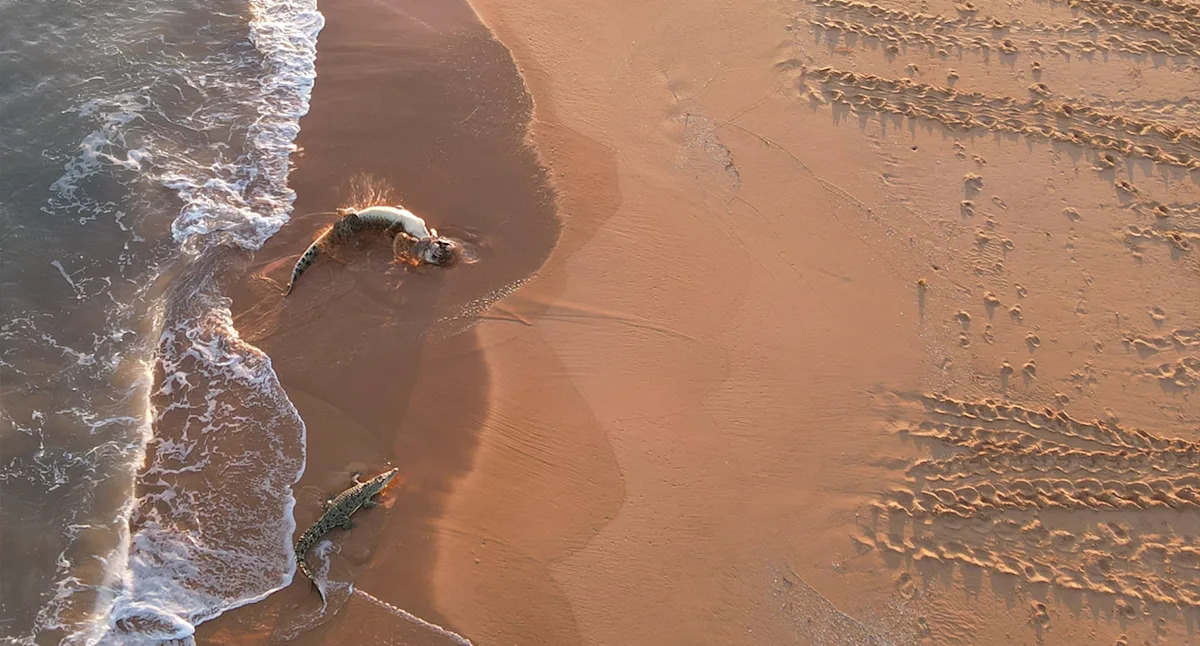
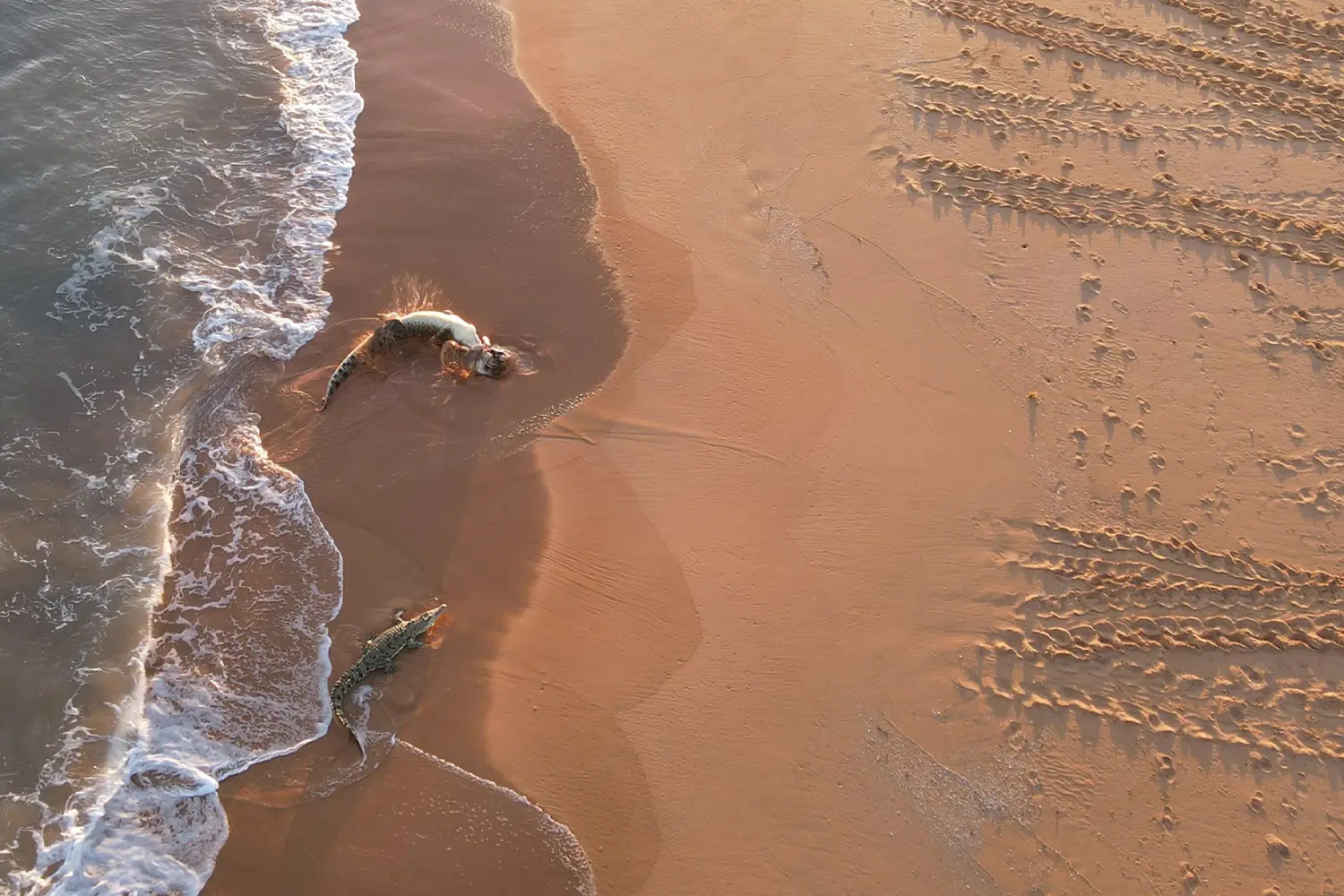
A large saltwater crocodile completes a death roll to kill a turtle at Cape Domett. Source: Casper Avenant, DBCA.
An image shot high above a deserted beach on Australia’s remote East Kimberley shows a crocodile completing a “death roll” with a flatback turtle in its jaws. The unfortunate animal is one of the 3,250 flatback turtles that nest on the sands of Cape Dommett every year.
These turtles faced few threats on this Western Australian beach until their old foe returned in recent years in higher numbers.
Another picture hints at the battles that are now unfolding, as large saltwater crocodiles force the turtles to run a gauntlet as they head to the water after laying their eggs.
Both were taken during research by Western Australia’s environment department (DBCA), as its scientists investigated the impact of predation following a steady increase in crocodile numbers.
Using drones, beach patrols and infrared videography, its fearless staff completed an extraordinary study which was published in the journal Pacific Conservation Biology, giving new insights into the techniques used to catch these 75 to 90kg turtles.
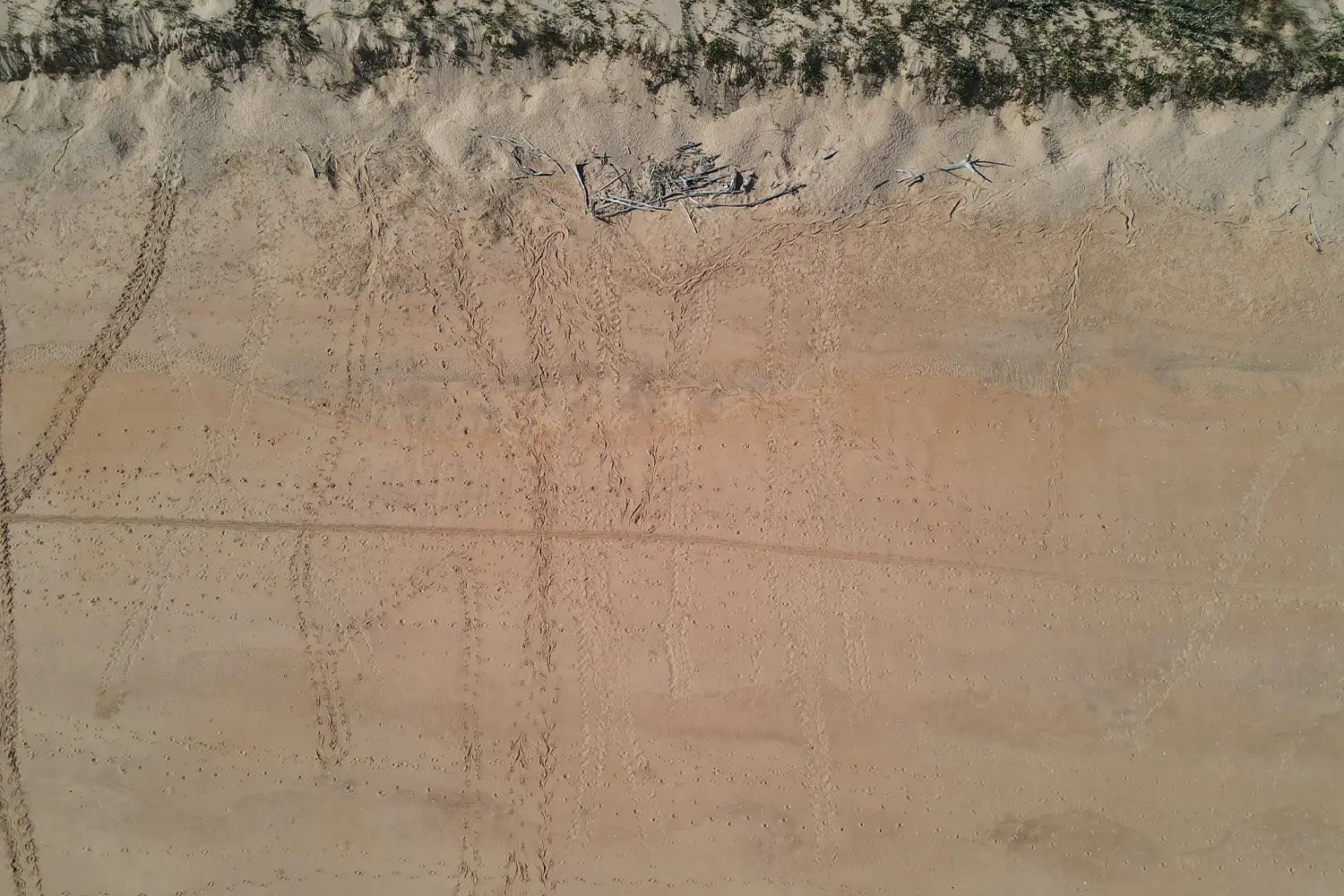
Cutting between hundreds of sea turtle footprints at Cape Domett are those of a large saltwater crocodile. Source: Casper Avenant, DBCA
Vision shared with Yahoo News further highlights the incredible power of one of these crocodiles as it uses its massive jaws to kill a turtle.
Subsequent footage shows it being eaten on the beach, and with the sound on, you can hear its shell being punctured.
Researchers dropped into crocodile territory
Venturing into this ancient ecosystem is fraught with danger, and one of the few people to have witnessed this incredible crocodile behaviour is DBCA’s principal research scientist Dr Scott Whiting, who has been studying the animals for over 30 years.
“They have different strategies; they’ll either sit and wait in the water for the turtles to come down, or they’ll walk up the beach and attack them on the nest,” he told Yahoo.
Because mature turtles return to the same nesting grounds they were born in every season, over generations crocodiles have learned to regard them as a food source.
Most of the attacks occur in the early morning, sometimes they’re actually observed, but most times scientists only see the aftermath — an empty shell, flippers, and guts on the sand.
Whiting wasn’t directly involved in the recently published DBCA research, but he has witnessed encounters between the two species at Cape Dommett as well as the Tiwi Islands.
“You’re usually dropped off for one or two weeks — you just have your food and your camp — and there’s a rawness to seeing the huge size of a crocodile and what it can do to a 90kg hard-shell animal,” he said.
“We haven’t got that hard shell.”
Shock discovery after sleeping in crocodile territory
He doesn’t worry as much about sharks, because you can avoid them by stepping out of the ocean, but when it comes to crocodiles, there are few places that are safe.
On one occasion, his team woke up to find large tracks between their two tents, that headed all the way down to the water.
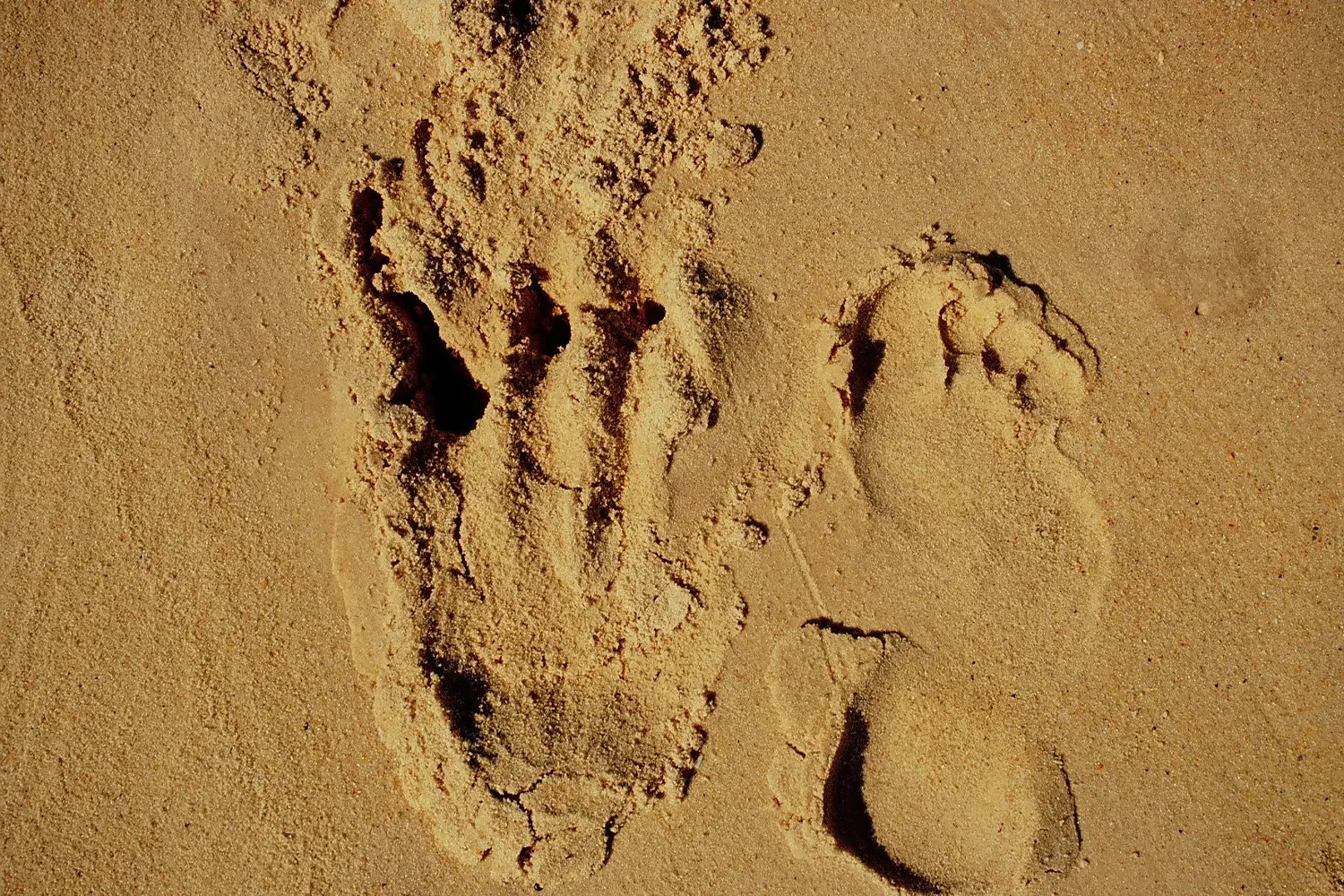
A picture taken on the Tiwi Islands show Dr Scott Whiting’s footprint next to that crocodile. Source: Scott Whiting
No one had heard anything in the night, but the next morning they moved the tents further from the water, and constructed a make-shift fence around their camp, with bells, cans, and rocks attached to it to sound the alarm if the crocodile returned.
Although the animals can travel hundreds of metres over land, what gives Whiting comfort in these remote locations is the abundance of food, making it less likely they’ll attack a human.
Why crocodiles don’t need to be culled
Saltwater crocodile numbers have increased in recent years, and they are now more conspicuous in the wild.
But just 50 years ago the species was in serious trouble — numbers plummeted due to unregulated hunting between 1945 and 1970, and around 300,000 were shot across the Northern Territory and Western Australia.
Saltwater crocodile eating a turtle
1 of 5
A crocodile eating a turtle off the Tiwi Islands. Source: Scott Whiting
The Cape Dommett research has found the rebound in numbers has led to one mature turtle being killed by a large dominant crocodile every week over the three-month nesting period.
Hatchlings are being regularly eaten by juveniles, as incredible infrared footage taken at night highlights.
Although flatback turtles are federally listed as vulnerable to extinction, Whiting does not think culling crocodiles is the answer.
“Crocodiles are territorial, so it’s not like we’ll end up with 400 of them on the beach because there is food,” he said.
“There are dominant animals, so they keep things regulated.”
Wild environment unchanged for hundreds of years
Most turtles are caught on the sand, taken to the water’s edge, where they’re drowned, and then brought back to land before their shells are crushed and their flesh is eaten.
Reptiles have a slow metabolic rate and can survive for an extended period after heavy blood loss, meaning death at the jaws of a crocodile can be slow.
“Generally, the flippers will be taken off, and there will be puncture wounds in the shell, but the turtle can still be alive,” Whiting said.
“Some of them are quick, minutes, and some of them are a long time, maybe hours.”
While this may seem unpalatable to those who live in environments removed from nature, this predator/prey relationship evolved millennia ago.
Sketches made 200 years ago by early explorers show many of the remote areas the DBCA teams visit are largely unchanged.
“The same boab trees are there, the bays look the same,” Whiting said.
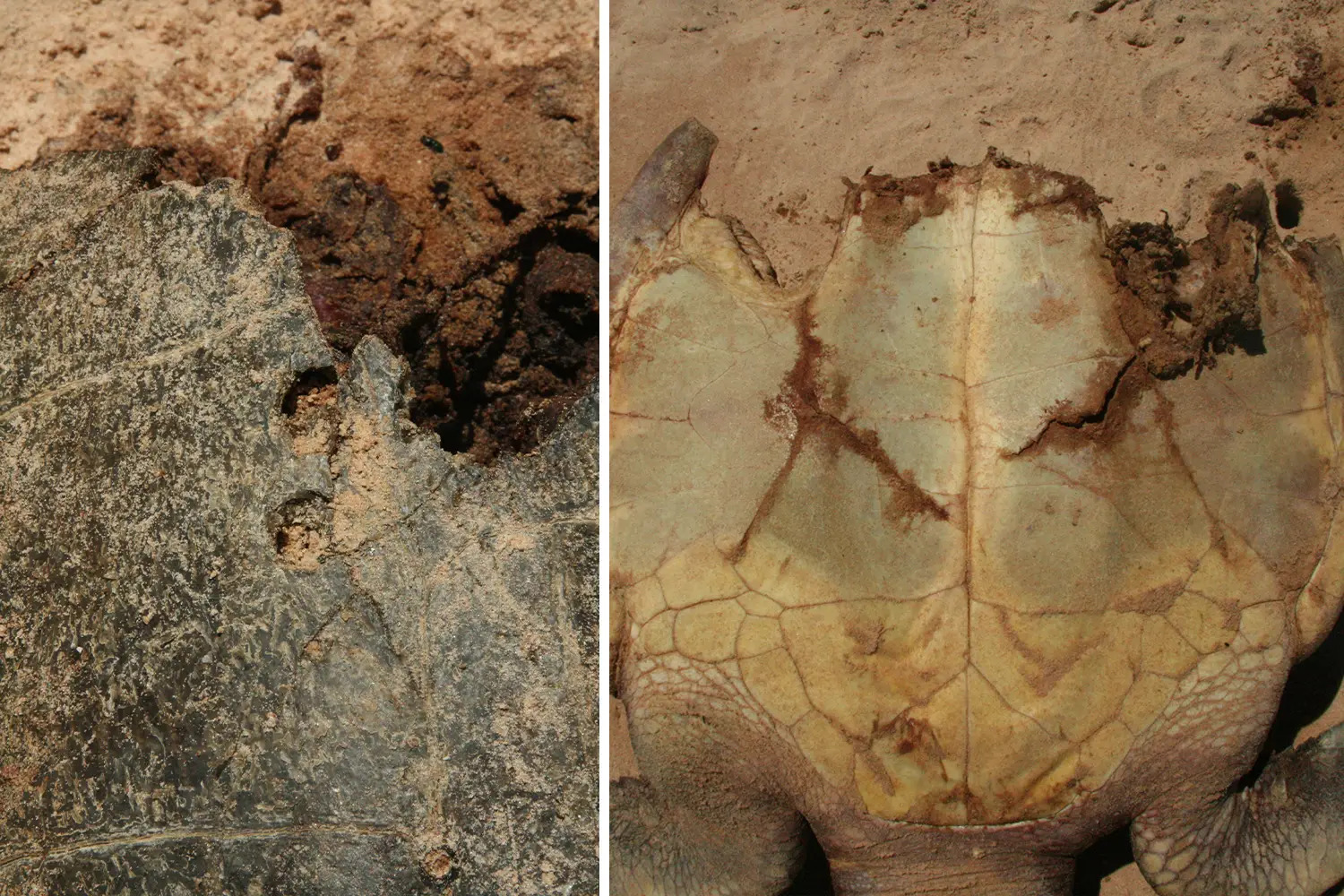
Puncture and bite marks in turtle shells highlight the power of crocodile jaws. Source: Scott Whiting
What has evolved is the ability to research animal behaviours using advanced technologies, giving scientists new insights.
“You go back 30 years, what we had was quite basic,” Whiting said.
“Now we have satellite transmitters, we can stick a camera onto a turtle and see underwater, and even just using drones provides new insights into how the world operates.”
The DBCA research was a collaboration between Rob Davis, Casper Avenant and James Gee.
Love Australia’s weird and wonderful environment? 🐊🦘😳 Get our new newsletter showcasing the week’s best stories.
