
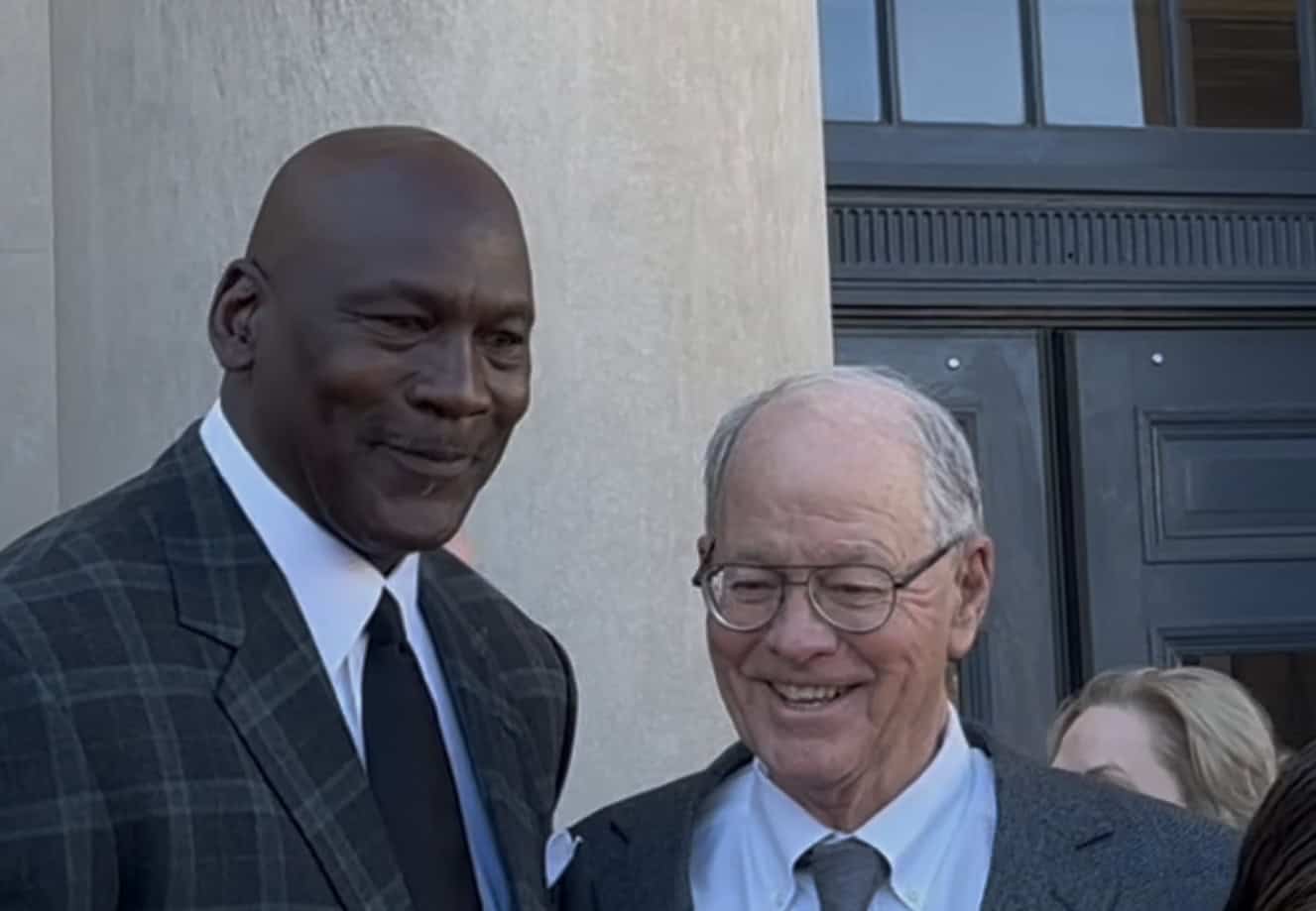
The antitrust case between NASCAR and 23XI Racing/Front Row Motorsports finally came to end this week, with a settlement between the two sides being reached on Thursday. Here’s what happened this week leading up to the settlement.
On Monday (Dec. 8), economist Edward Snyder took the stand along with Race Team Alliance Executive Director Jonathan Marshall.
Marshall said that the U.S. Racing League, first proposed in 2024, was unsuccessful because teams did not want to form a rival league to NASCAR. Marshall then acknowledged that no other racing series uses a permanent charter system.
A text message revealed during Marshall’s cross-examination revealed that Marshall called the 2025 charter agreement a “win in his book.”
During his testimony, Snyder said that track exclusivity agreements, IP protections for the Next Gen car and the 12-month “idle period” for outgoing team owners as proof of anticompetitive measures from NASCAR.
Snyder also said that exclusivity was the reason that NASCAR would pay tracks.
Snyder claimed that the new charter agreement is below the market value for Cup Series teams. The total damages for the teams came out to a combined $364.7 million, split between lost profit from reduced revenue, lost revenue from the teams running unchartered and the reduction in the teams’ market value from the teams running unchartered.
Snyder said that without the non-compete clause in the 2016 charter agreement, NASCAR could face a potential new series.
NASCAR Vs. 23XI/FRM Lawsuit Day 6 Recap
On Tuesday (Dec. 9) Snyder completed his testimony. Richard Childress, Steve Phelps, Jim France and accountant Anthony Smith all took to the stand as well.
Judge Kenneth D Bell requested a one-hour extension to court for the following days of the trial.
NASCAR attorney Lawrence Buterman said that a majority of the $400 million in revenue that the France family had received over the past three years going to the paying of taxes.
Smith presented a chart in which it was revealed that a Cup Series team had lost $246,272,000 in sponsorships from 2020-24.
Phelps echoed Buterman’s earlier claim, but team attorney Jeffrey Kessler said that the money the Frances supposedly paid in taxes did not go to the Internal Revenue Service, but rather, back to the family. It was later revealed that in 2015, the teams considered starting a dirt racing stock-car series.
NASCAR was opposed to the idea of that series existing in 2015, strongly opposing it.
Kessler later questioned Phelps, who answered a majority of questions with “I don’t know.”
Phelps also re-expressed his concern about the Superstar Racing Experience (SRX) “looking” like NASCAR.
Phelps later said that it was determined that the SRX was not “crossing the line” in regard to looking too much like NASCAR.
Phelps also said that NASCAR could give teams permanent charters, but that Jim France did not want permanent charters.
Phelps said that NASCAR still hopes to build a short track on the property of what used to be Auto Club Speedway. He also touted the safety and racing quality of NASCAR’s Next-Gen car.
Childress, who was only on the stand for about 45 minutes, talked about the perceived need for permanent charters, saying that teams would rise and fall with NASCAR if there continued to be no permanent charters.
During France’s testimony, it was revealed that the France family owns roughly 54% of NASCAR, with Lesa France Kennedy’s family owning the other 43.5%. Like Phelps, France also answered a plethora of questions with “I don’t know.”
France resumed his testimony on Wednesday.
NASCAR Vs. 23XI/FRM Lawsuit Day 7 Recap
On Wednesday (Dec. 10), it was revealed that Action Express Racing, France’s IMSA team, is sometimes profitable and sometimes not, per France.
France said that NASCAR’s history is his reasoning for not wanting permanent charters.
France also said that he was not involved in negotiations with all teams during 2023-24 charter negotiations.
John Probst took the stand after France, saying that NASCAR worked with a Canadian-based company to determine what a “good race” was.
Probst said that a star driver winning a race is deemed more exciting than a race where a not as popular driver wins.
NASCAR then revealed that it spent $4.5 million testing the safety of the Next Gen car.
Probst said that NASCAR’s development of the Next Gen car was about safety more than anything else.
NASCAR estimated that it would cost $19 million to field a car in the Cup Series without a charter or other startup costs. Probst also said that NASCAR is “fine” with having rival competitive series exist.
NASCAR CFO Greg Motto then took the stand to discuss finances. Motto said that higher beta profit margins were due to NASCAR completing several large products, including the new NASCAR Productions facility and adding WiFi to tracks.
NASCAR economist Mark Zmijewski said that Formula 1 could not be used as a benchmark for NASCAR’s finances.
NASCAR Vs. 23XI/FRM Lawsuit Day 8 Recap
The final day of the trial was Thursday (Dec. 11).
On Thursday, Judge Bell said that court would begin with a one-hour recess. Just after 10 a.m. ET, Kessler said that both sides had officially agreed to a settlement.
The settlement includes permanent charters for teams in the future. 23XI and FRM will get their charters back for the 2026 season as well.


A member of the National Motorsports Press Association (NMPA), Samuel also covers NASCAR for Yardbarker, Field Level Media, and Heavy Sports. He will attend the University of Arkansas in the fall of 2025.