

Saturday December 13, 2025
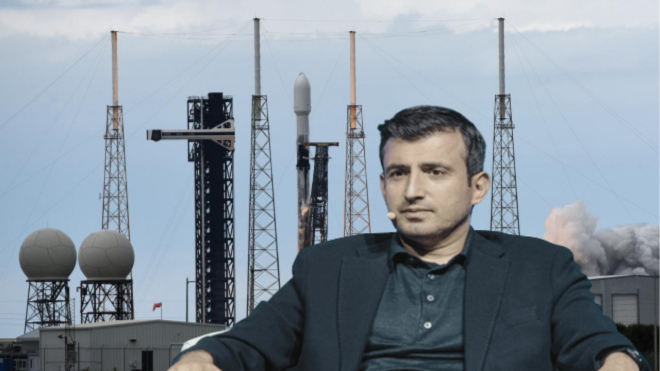
Selçuk Bayraktar, chairman of Turkish defence and aerospace firm Baykar, is seen in a composite image over a launch facility backdrop. Baykar and other Turkish companies are backing Turkey’s planned spaceport project in Somalia, part of Ankara’s push to expand its satellite launch and space capabilities.
Mogadishu (HOL) — Turkey has begun construction of a satellite and rocket launch site on Somalia’s Indian Ocean coast, a project officials say will advance Ankara’s space ambitions and that analysts say is already attracting heightened scrutiny from major world powers.
The spaceport, backed by Baykar chairman Selçuk Bayraktar, is being developed under Turkish state authority on a coastal area measuring about 30 by 30 kilometres. Turkish officials say the facility will give the country its first platform for orbital launches and strengthen its ability to conduct independent space missions.
Bayraktar announced the project at the Take Off İstanbul 2025 conference, calling Somalia’s coastline a “strategic” site with the open-ocean access required for safe launch and recovery operations. He said only a small number of locations worldwide offer the combination of geography and coastal conditions needed for full-scale spaceflight.
The site is expected to be used by several Turkish defence and aerospace companies, including Roketsan and Baykar. Turkish engineers are overseeing early construction and technical planning.
Somalia’s proximity to the equator is a key factor in the project. Equatorial launch locations benefit from the Earth’s rotation, reducing fuel consumption and increasing payload capacity, an advantage long sought by major spacefaring states.
Analysts say the spaceport would place Somalia on the global space map for the first time and give Turkey a rare launch position along a corridor linking the Red Sea with the wider Indian Ocean, an area of growing strategic competition.
International interest has followed the project. France-based Intelligence Online reported that U.S., French and Chinese reconnaissance satellites have repeatedly imaged areas believed to overlap with the planned launch zone. Analysts say the frequency of surveillance suggests global powers are monitoring the project for possible military or dual-use implications.
Bayraktar has tied the Somalia initiative to wider efforts to expand Turkey’s space and navigation capabilities. Through its Fergani venture, Turkey is developing new launch vehicles designed to place satellites into low Earth orbit and is building an indigenous global positioning network known as Uluğ Bey. He said dependence on foreign navigation systems poses operational risks due to jamming and spoofing reported in conflict zones.
Regional experts say any launch complex can support both civilian and military applications depending on state policy. Turkish officials describe the Somalia project as part of a long-term push for technological independence and export-driven growth.
During a recent trip to Israel, Rashid Abdi, research director at the Nairobi-based Sahan Global think tank, said Turkey’s expanding footprint in Somalia, which includes military training, construction projects and security cooperation, should be seen in a wider strategic context.
“If I were Israel, I would certainly be worried,” he said at a regional forum, arguing the spaceport could eventually support advanced missile development.
Turkey has deepened its ties with Somalia since 2011 through aid initiatives, infrastructure work, defence partnerships and trade. Somali and Turkish officials say the spaceport is the most advanced collaboration to date and could broaden cooperation in technology, security and investment.
If completed, the launch site would give Turkey an equatorial position in the global space sector and anchor its aerospace ambitions in a strategically significant region.