
‘This is an extraordinary achievement,’ says the University of Oxford lead after his team successfully recorded one of the most elusive interactions in physics: a high-energy solar neutrino striking carbon-13 and producing radioactive nitrogen
Another neutrino breakthrough for SNOLAB and University of Oxford in the United Kingdom as they succeeded in detecting neutrinos, often called ‘ghost particles,’ in a way that no other scientist has before.
Once again it is the international laboratory’s location, two kilometres underground and housed in one of Vale’s working mines, a release from SNOLAB states their deep location was “crucial to shield the lab from cosmic rays and background radiation that would mask the faint neutrino signals.”
As described by SNOLAB, Neutrinos are one of the most mysterious particles in the universe, often called ghost particles because they rarely interact with anything else. Trillions stream through our bodies every second, yet leave no trace. They are produced during nuclear reactions, including those that take place in the core of our sun. Their tendency to not interact often makes detecting neutrinos notoriously difficult.”
The breakthrough by the researchers at Oxford was focused on the neutrinos found in the core of the sun.
“Neutrinos from the Sun have only been seen to interact on a handful of different targets,” reads the SNOLAB release. “Now, for the first time, scientists have succeeded in also observing them transform carbon atoms into nitrogen inside a vast underground detector.”
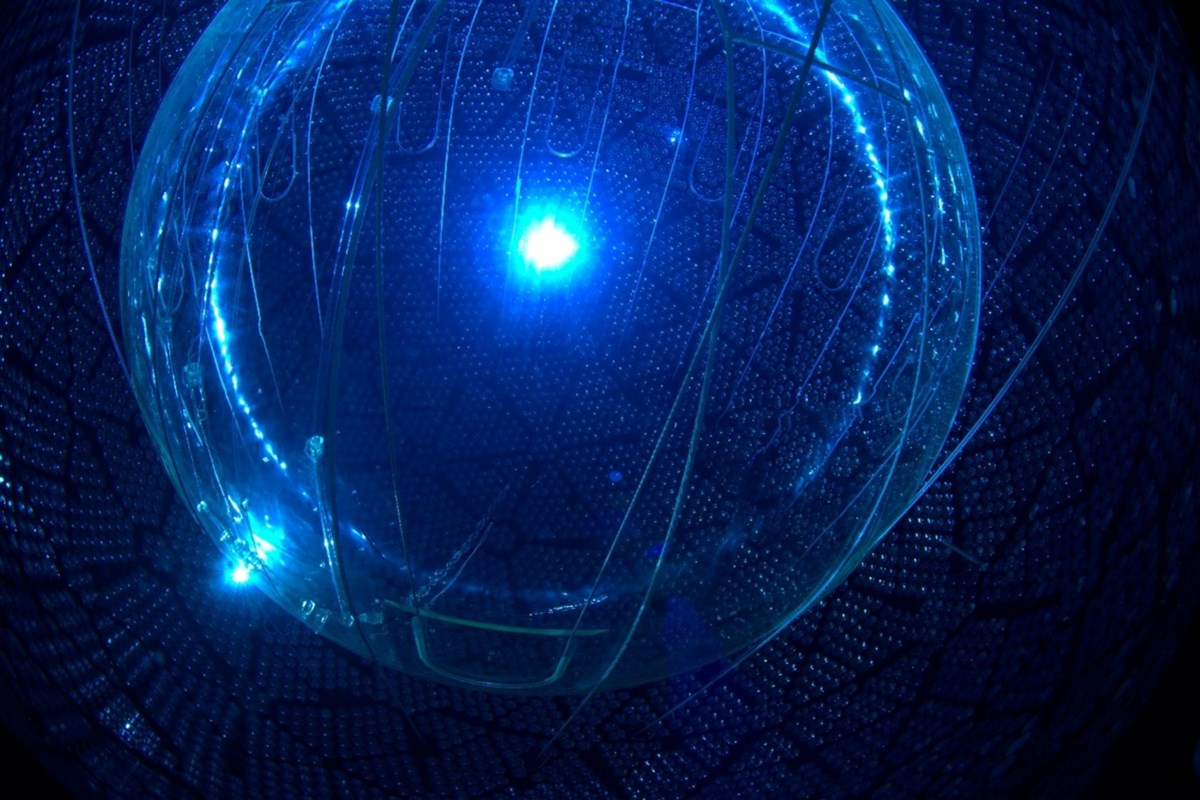
The discovery was made using the SNO+ detector in SNOLAB.
SNO+ repurposes the SNO experiment, which showed that neutrinos oscillate between three types: electron, muon, and tau neutrinos on their journey from the Sun to the Earth. SNO’s lead investigator, Dr. Arthur B. McDonald, shared the 2015 Nobel Prize in Physics for solving the solar neutrino problem, opening the door for new research into neutrino properties and their role in the universe, says SNOLAB Research Scientist Dr Christine Kraus.
“This discovery uses the natural abundance of carbon-13 within the experiment’s liquid scintillator to measure a specific, rare interaction,” Kraus said. “To our knowledge, these results represent the lowest energy observation of neutrino interactions on carbon-13 nuclei to date and provides the first direct cross-section measurement for this specific nuclear reaction to the ground state of the resulting nitrogen-13 nucleus.”
The team from Oxford then searched for events where a carbon-13 nuclei is “struck by a high-energy neutrino and transformed into radioactive nitrogen-13, which decays about ten minutes later,” reads the release. “They used a ‘delayed coincidence’ method, which looks for two linked signals: an initial flash from a neutrino striking a carbon-13 nucleus, followed several minutes later by a second flash from the resulting radioactive decay. This distinctive pattern allows researchers to confidently separate real neutrino interactions from background noise.”
The release states that the analysis found 5.6 observed events over a 231-day period, May 4, 2022 to June 29, 2023 and that this is statistically consistent with the 4.7 expected to be generated by neutrinos during this time.
“Neutrinos are bizarre particles that are essential for understanding stellar processes, nuclear fusion, and the evolution of the universe,” reads the release. “According to the researchers, this discovery lays the groundwork for future studies of similar low-energy neutrino interactions.”
Lead author Gulliver Milton, a PhD student at the University of Oxford’s Department of Physics, said in the release that “Capturing this interaction is an extraordinary achievement. Despite the rarity of the carbon isotope, we were able to observe its interaction with neutrinos, which were born in the Sun’s core and travelled vast distances to reach our detector.”
You can find more information about Sudbury’s world-class lab here.