
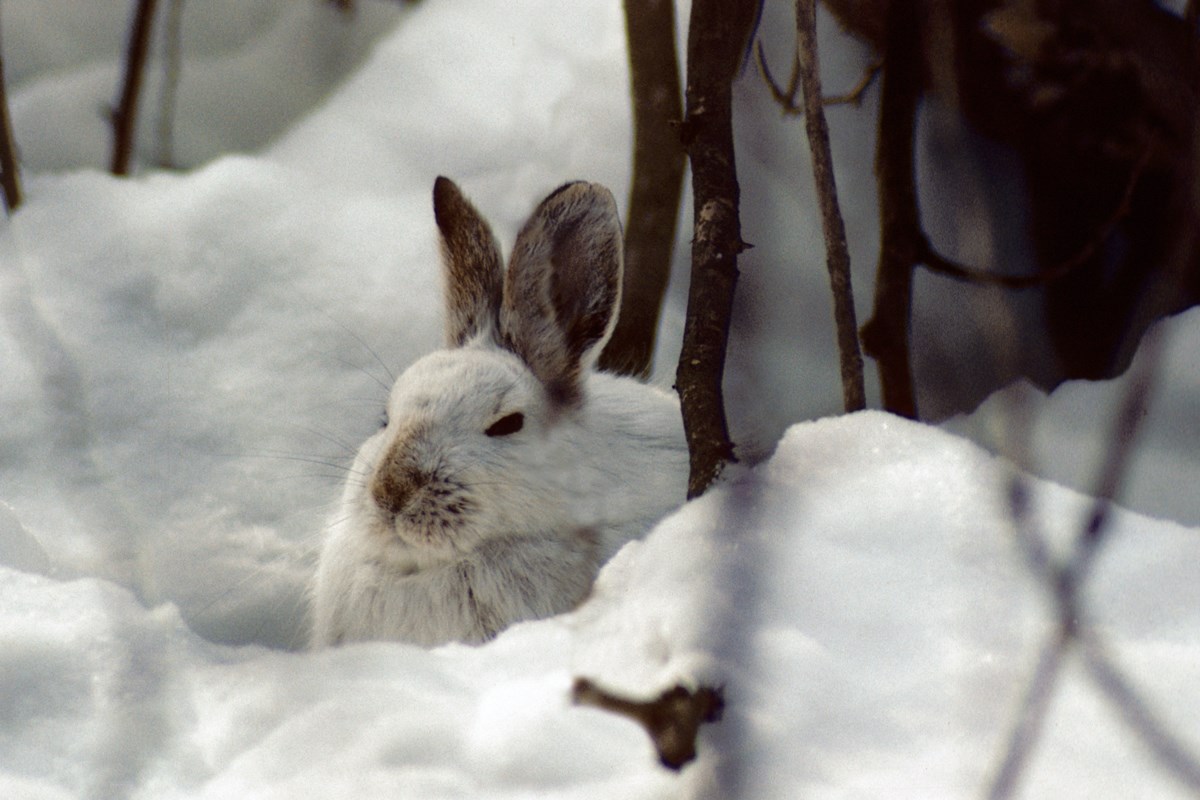
In a quiet cedar swamp blanketed by fresh snow, subtle paw prints tell a story of survival, stealth, and strategy, says columnist
The paw prints in the snow crossed the road and disappeared into a willow and alder thicket. And then they came back again. And then they retraced their route back to the thicket yet again.
This made for a challenge in determining just what kind of critter it was, as there was no single print left to identify.
However, the size of the pathway, the habitat we were in, and the fact that a pathway was made by retracing its route, all indicated that a snowshoe hare was lurking nearby … perhaps watching us even as we stood there on the roadway.
As anyone who has ventured forth with camera in hand can tell you, actually seeing wildlife in the wild can be frustrating, as they always seem to know that we are coming and hide themselves well in advance. However, the wintertime snow, especially the fresh stuff, somewhat thwarts their nefarious scheme to stay hidden.
Sometimes, but not always, a visual scan of the thickets will reveal a large, shiny black eye staring at you from the underbrush. A refocusing of your vision may then reveal the white form of a hare tucked quietly around said big black eye.
Snowshoe hares, also called varying hare in the text books, love a cedar swamp. An easy food source, lots of hidey-holes, and thick branches for protection from attacks from a great horned owl or coyote, all add up to hare utopia.
Since their fur colour has changed (varied, get it?) from brown to white, thanks to a thick winter growth of extra fur, they have the added advantage of camouflage to escape detection from those whom it has no desire to meet.
For hares, one of the downsides to a mild winter is that when the snow melts away in mid-winter, these white fur balls now stand out like a snowball hit against a brick wall. Which makes the whole hide-and-seek game of life or death a tad more interesting. No complaints from the owls about mild winters.
One of the other bouncy little creatures we may find on a woodland walk is the eastern cottontail rabbit, also known as “aww-lookit-a-bunny rabbit”.
Cottontail populations rise and fall rather dramatically, so if a woodlot is full of them this year there may not be any the next year. One of the best places to look for cottontail rabbits is around your bird feeder, as they will visit in search of seeds spilled to the ground.
These “bunny rabbits” are very adept at finding a home in urban areas. Whereas hares like to be out in the wildlands, cottontails prefer to burrow under garden sheds or overwinter beneath that tarp you threw over the yard tools last fall.
This trait holds true even in the spring, as while hares give birth to fuzzy young on the bare ground, cottontails produce naked little guys in an underground burrow (which, if you hail from England, is called a warren; which, if you be from around these here parts, is called a ‘rabbit hole’. Woe, the demise of the English language).
Because cottontail rabbits stay brown year-round, they can be a bit easier to see by a hawk, owl or coyote; which may be a factor in their fluctuating populations. And rabbits tend to be a bit more skittish than their white-furred cousins the hares, and movement is a dead giveaway to one’s location … the emphasis being on the word ‘dead’.
Perhaps this is why snowshoe hare tend to have a rather smug look upon their face, sensing they are better evolved at predator deception by just sitting still
To move about their home territory both rabbits and hares will traverse the area in detail, locating every little hiding spot and place to find food. If a good feeding area is found near a good hiding spot, a trail between them is soon packed into the snow. Back in the day, when the native peoples, settlers and trappers grew hungry, a neck snare set on a rabbit runway often provided a nutritious meal.
Also observed in the snow may be the tracks of foxes or coyotes, who love to dine of fresh lagomorphs (the fancy collective name for rabbits and hares, which differentiates them from rodents).
These wild canines usually hunt in pairs and for good reason. When Coyote One flushes a rabbit and the chase begins, Coyote Two sits down to watch the action. As the rabbit flees to another hiding place, One relentlessly pursues the rascally rabbit. Eventually the rabbit reaches the edge of its known world, and not sure of where the next hiding place may be found, turns around to return to its known world.
And now Coyote Two sits up and tenses its body. As the very tired rabbit hops back to the original place, good old Two, being well rested, moves in for a quick kill. Et voila, supper is served: hasenpfeffer, again.
So the next time you find yourself traversing a thick cedar swamp, and you get that uneasy feeling that you are not alone in the woods, cast your eyes around for a smug little hare eyeballing you from its hiding place.
David J. Hawke is a freelance writer and naturalist who lives in rural North Simcoe County. He has been continuously creating weekly nature stories since 1989… and thinks that there are still many more topics to cover!