

Listen to this article
Estimated 3 minutes
The audio version of this article is generated by AI-based technology. Mispronunciations can occur. We are working with our partners to continually review and improve the results.
Niamh Gavin and her four kids usually walk their dogs on Sweet Nellie’s Beach in Greencastle in the Irish county of Donegal.
Most of the time it’s an uneventful outing, but last month they came across something unusual. Gavin’s son thought at first it was a seal.
“Even from a distance, I thought, ‘that’s a large seal,’” Gavin said.
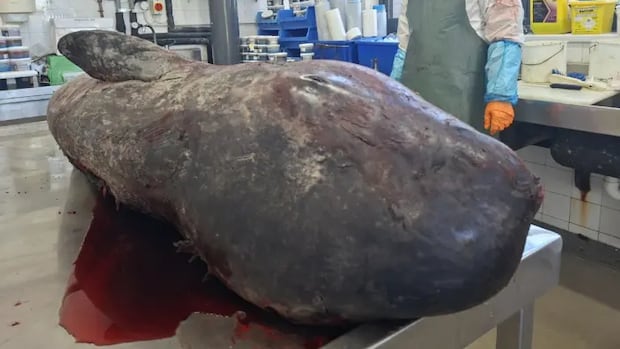
It turned out to be a female narwhal.
Ireland’s National Parks and Wildlife Service (NPWS) recovered the animal a day later, and, along with scientists from the Irish Whale and Dolphin Group (IWDG), conducted a post-mortem examination of the animal.
Simon Berrow of the IWDG, an advocacy group, says it appears the animal may have died after it became stranded on shore.
“She wasn’t in very good condition, but she wasn’t emaciated. So maybe she was diseased and that ultimately led to her live stranding, and then the live stranding killed her,” Berrow said.
Regardless of what caused the narwhal’s death, Gavin was shocked to see it on an Irish beach.
 Niamh Gavin and her four kids discovered a narwhal on a beach in northern Ireland while walking their dogs. Her son initially thought it was a seal. (TJ Dhir/CBC)
“It’s just mad to know how it ended up there, and why,” she said.
Whales ‘triggers of wider changes in our marine environment,’ advocate says
Narwhals typically inhabit Arctic waters, though some have reportedly been seen elsewhere in Europe, including in Belgium in 2016 when a dead male narwhal washed up on the shore of a river.
Berrow believes the animal found last month in Ireland could indicate that narwhals may be moving into new areas. That’s something the IWDG has seen with other species it tracks.
Berrow says that another Arctic marine mammal — a bowhead whale — was also seen northeast of Ireland in 2016.
“I think that is really scary because when we look at whales and dolphins, they are triggers of wider changes in our marine environment,” he said.
 Simon Berrow, the CEO of the Irish Whale and Dolphin Group, believes more narwhals could make their way to Ireland in the future. (TJ Dhir/CBC)
“It’s important to monitor them because they will probably give us insights into things that are happening.”
Moses Koonoo, a hunter from Arctic Bay, Nunavut, says he’s not surprised a narwhal made its way to Ireland because the animals can travel long distances. He also believes it’s related to climate change.
“It’s [because] of global warming that they travel to different places,” said Koonoo.
However, Marianne Marcoux, a researcher with Fisheries and Oceans Canada (DFO), says the narwhal found in Ireland is “not too much of a panic.”
“They’ve been found before to go outside their normal range,” said Marcoux.
Marcoux points to narwhals that have been found in the St. Lawrence River, from 2016 to 2023.
Still, one Irish cabinet minister says the discovery last month is a significant event.
Christopher O’Sullivan, Ireland’s minister for nature, heritage and biodiversity, called it “a stark reminder of the vulnerability of wildlife in the face of a changing climate, and the need to protect them.”
As for Niamh Gavin, she says her kids are ready for the next strange visitor to their favourite beach.
“We go to that beach regularly, but every time we go, they’re currently like the narwhal hunters,” Gavin said, jokingly.
“They think they are going to find live narwhals living in the sea.”