
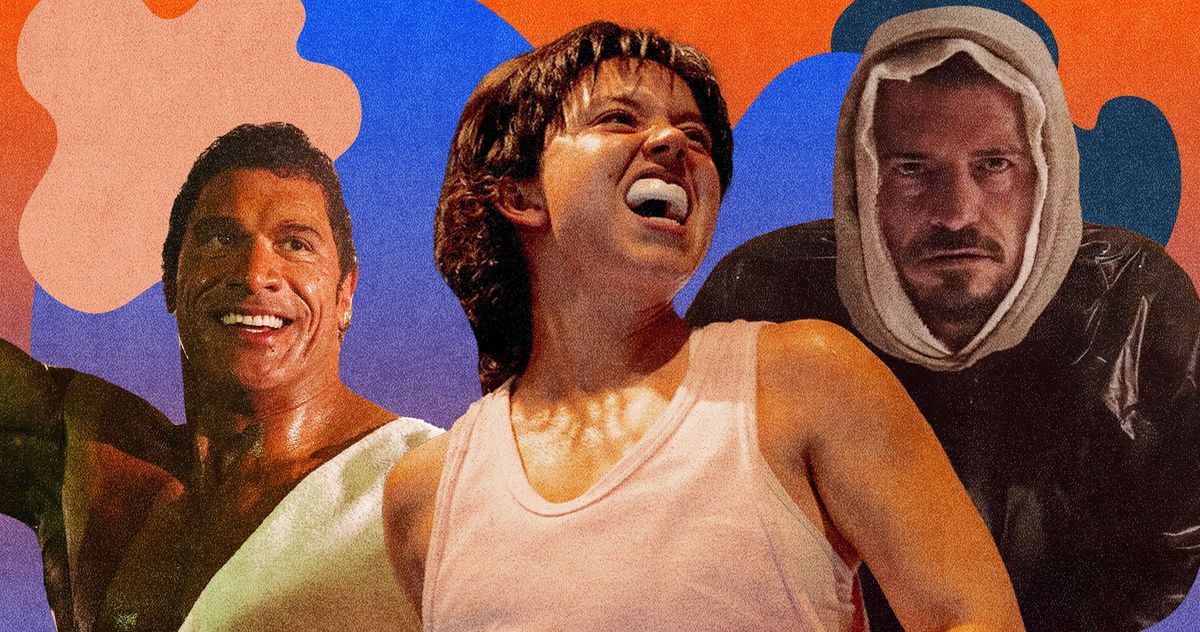
Photo-Illustration: by The Cut; Photos: A24, Everett Collection
On the latest cover of Sports Illustrated, the boxing titan Christy Salters Martin leans against the perimeter of a prize ring, the American flag hanging behind her. It is a full-circle moment; in 1996, she became the first female boxer to be featured on the magazine’s cover. Trailblazing wasn’t easy — Salters Martin, a butch lesbian, endured rampant sexism, homophobia, and even attempted murder on her rise from small-town West Virginia to the International Boxing Hall of Fame. She now stands as an American hero. Posed in front of her on the SI cover is Sydney Sweeney, the blonde bombshell who plays Salters Martin in the 2025 biopic Christy. She is notably styled so her cleavage pops.
In 2025, the Hollywood fight movie swung back into fashion. This feels appropriate for times defined by aggressive machismo, open cruelty, and nostalgia for a simpler past. Distortional algorithms and AI make it easy to idealize a man who makes a living with his two hands and the struggle against a single, concrete opponent. In addition to the aforementioned Christy, this year saw biopics of the Olympic boxer Claressa “T-Rex” Shields (The Fire Inside, technically released on Christmas Eve in 2024) and the mixed-martial-arts fighter Mark Kerr (The Smashing Machine) as well as fictional psychodramas orbiting in the ring (The Cut). There are several boxing movies in production, like Netflix’s Fight for ’84, in which an Olympic boxing coach (Jamie Foxx) must rebuild his entire team after a fatal plane crash.
These films work off a classic formula, perfected over a century. Boxing is not the most popular sport in America — that’s football — but it’s the most foundational to Hollywood. The world’s first-ever feature film, released in 1897, was a 100-minute documentary of a match between James J. Corbett and Bob Fitzsimmons. Since then, Hollywood has produced hundreds of boxing movies, including Rocky, Raging Bull, and Million Dollar Baby. A reliable narrative template has emerged: A working-class underdog enters the world of professional boxing. What he doesn’t have in money, name recognition, or healthy relationships, he makes up for in raw talent and grit. There are setbacks, of course — cue the training montages of our hero sprinting across the city and pummeling a speed bag. Or a shot of him collapsed in the corner of the boxing ring, coach barking in his face, before he staggers forward to win his championship.
The familiarity is part of the charm. “We love boxing because it stays the same as the decades pass. We love boxing films for the same reason,” the writer Benjamin Nugent proclaimed in a 2015 essay about the sport’s continual onscreen presence. But over the past century, professional boxing has transformed from scrappy underground prizefights into a multi billion-dollar commercial industry. It is now a lucrative attention scheme for belligerent influencers and washed-up celebrities: One of America’s highest-grossing boxers is the Jake Paul, roguish YouTuber whose real talent is converting controversy into cash. Combat has become a billionaire hobby: Mark Zuckerberg and Elon Musk notably agreed to a cage match in 2023 before the latter backed out, and Zuckerberg has appointed UFC president Dana White to the head of Meta’s board. President Donald Trump is former boxing promoter. Next year, for America’s 250th anniversary — and his 80th birthday — he is bringing UFC fighters to brawl on the White House South Lawn.
This is the cultural backdrop for this year’s fighting movies, which attempt to complicate the classic American boxing story. Some draw attention to the ways the sport damages its male superstars, both physically and psychologically. The Benny Safdie–directed A24 biopic The Smashing Machine follows Mark Kerr (played by former WWE fighter Dwayne “the Rock” Johnson) during his MMA ascent between 1997 and 2000. (At the time, American cable-news outlets refused to show UFC fights; U.S. fighters flocked to Japan.) On the surface, Kerr is a paragon of masculinity: a stoic Hulk who chugs protein shakes. But his physical strength masks an inner fragility — he is broken, sobbing in his hospital bed after a brutal match and numbing his pain with opioids. “I just need you to treat me like a man,” he sniffles, head hung after a blowup argument with his girlfriend, Dawn Staples (Emily Blunt), after ripping a door in half.
The Cut, directed by Sean Ellis, also trains its lens on a man in crisis. It follows a retired Irish boxer (played by Orlando Bloom for some reason) staging a comeback. A YouTuber with half a billion followers accidentally killed a Vegas title-fight contender, giving our unnamed protagonist another shot at victory. There’s a catch: To make the weight class, he must lose 26 pounds in six days. The movie’s subject is actually his extreme weight-cutting regimen. He eats virtually nothing — two halves of a boiled egg with the yolks scooped out and a forkful of chicken — then binges a chocolate bar in a fit of weakness, rushing to the bathroom to vomit it back up.
In heavy-handed flashbacks, we see the boxer in The Cut as a defenseless young boy, picked on in school and raised by a single mother who has resorted to prostitution to pay the bills. “Boxing is fundamentally about anger,” the novelist Joyce Carol Oates wrote in a 1985 essay. “Because, for the most part, [boxers] belong to the disenfranchised of our society, to impoverished ghetto neighborhoods in which anger is an appropriate response.” The sport is a response to powerlessness under a political system whose all-encompassing cruelty we attempt to forget through individual discipline. In the end, the boxer makes weight — at the expense of his sanity, marriage, and even a limb. Even if you win, you still lose.
Claressa Shields would know. In 2012, Shields became the first American woman to win an Olympic gold medal in boxing at the age of 17, but she returned home to no national sponsorships or endorsements. “Everybody was just saying, you know, ‘You should be signing with Nike. You should be on the Wheaties box. How come? Aren’t you in this magazine?’” she told NPR. Shields grew up poor in Flint, Michigan; her father was incarcerated and her mother an alcoholic. But her athletic excellence apparently was not enough to compensate for the unpalatable image of a woman who actually likes to fight. “You seem like a bully,” a condescendingly polite USA Boxing media representative tells a young Claressa (played by Ryan Destiny) in The Fire Inside. “I box — I am a bully. Floyd a bully, Ward a bully, even Ali was a bully,” Shields protests. She’s insulted by the meager offer of $1,000 per month to join the USA Boxing team; she can’t afford to leave her struggling family. “Money is recognition,” she growls.
Boxing is a barbaric sport, a gladiatorial blood battle in which human suffering is the point, not an accident. We may find it abstractly beautiful. But the reality is that boxers suffer traumatic brain injuries, broken limbs, and even death for what is usually meager pay. As independent contractors, they must patch together basic medical care and navigate financial interests that care more about views than lives. The only film that fully recognizes this is The Cut. But it also asks its talent to put his body on the line for ambiguous reward. To prepare for the movie, Bloom shed 52 pounds in three months, subsisting on tuna and cucumber. “I sort of still have a bit of PTSD, to be honest, when I think about it and see the film,” he confessed.
Really, the ultimate prize for a star athlete is not a championship belt but a winning media narrative that one can repackage over and over for some semblance of financial security. It’s telling that the majority of this year’s Hollywood boxing movies are biopics. Their real-life subjects — Christy Salters Martin, Claressa Shields, and Mark Kerr — have already mined their life stories in documentaries and memoirs. Though these films question the American Dream at the center of boxing movies, they can’t resist a triumphant conclusion, skipping forward to the present day, when all is okay. (Kerr even makes a cameo at the end of The Smashing Machine.) Details are pruned in service of obvious points, and the end product is boring to watch.
Despite the herculean effort powering them — the extreme physical transformations, hours sitting for press — this year’s fight films bombed at the box office. The Cut appeared and went as if it never existed; I don’t know anyone besides me who watched it. The Smashing Machine became the worst opening of the Rock’s career, ultimately recouping only about a fifth of its $50 billion budget. Johnson had taken a hefty pay cut to star in it. Christy premiered to only $1.3 million in its first weekend, one of the worst openings of all time for its size. It was passed over for Golden Globes.
Christy was a shot at redemption for Sweeney, the embattled main character of the year. Growing up, she was determined to succeed. Her high school’s valedictorian, she professes to have never partied. She’d decided to pursue the long-shot dream of acting when she was 13. So her family gave up their home in small-town Washington for a motel in Los Angeles. Sweeney shared a bed with her mom. Their financial struggles put a strain on her parents’ marriage, which rattled her. “I thought that if I made enough money, I’d be able to buy my parents’ house back and that I’d be able to put my parents back together,” she said in a 2022 Hollywood Reporter interview. “But when I turned 18, I only had $800 to my name.”
Though she got a big break from HBO’s Euphoria and then The White Lotus, Sweeney couldn’t shake her financial anxiety. “If I just acted, I wouldn’t be able to afford my life in L.A. I take deals because I have to,” she revealed, justifying the many advertising campaigns she’s done. TV doesn’t pay as much as it used to, she said, and a cut of her paycheck went to lawyers, accountants, and hairstylists; her publicist’s fee costs more than her mortgage.
Sweeney has said that she begged director David Michôd to work on Christy, working out twice a day and putting on 35 pounds for the role. “This is the most important film I’ve ever made,” she wrote in an Instagram caption sharing her Sports Illustrated cover. Its commercial failure is a shame because Christy was the best of the lot this year, partially because of the unbelievable nature of Salters Martin’s story: She survived an attempted murder in 2010 after a heated argument with her manager-husband, Jim Martin, who stabbed and then shot her. But Sweeney’s solid performance in the movie — and Salters Martin’s own harrowing life story — has been overshadowed by endless controversy. Sweeney is better known for her American Eagle denim ad and the awkward GQ interview during which she did not denounce white supremacy. She is hated and she is everywhere, dominating the news cycle in this dog-eat-dog society in which basic survival has never seemed more like a fight.
Stay in touch.
Get the Cut newsletter delivered daily
Vox Media, LLC Terms and Privacy Notice
Related