
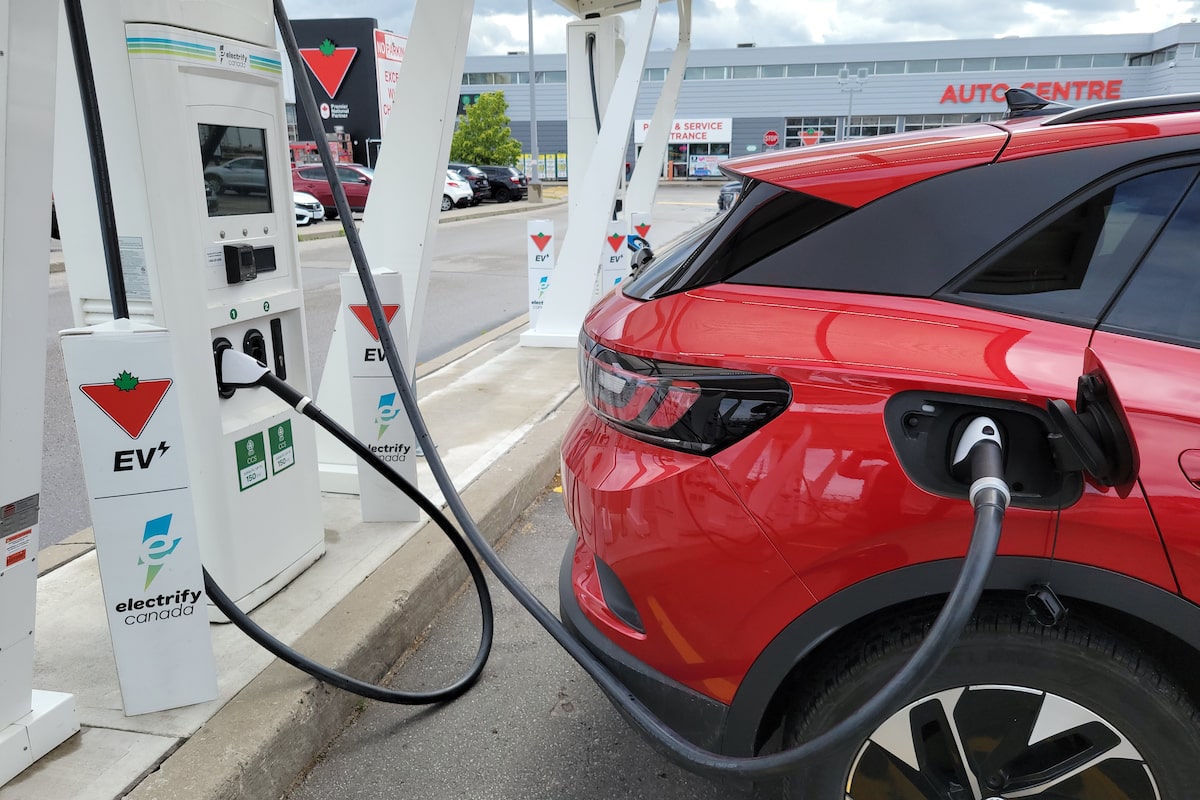
A survey last year on EVs by Pollara Strategic Insights found Canadians feel generally positive about EVs and are open to buying one, but are still concerned about cost and technology.Doug Ives/The Canadian Press
Dr. Arvind Gupta is a professor and academic director of professional programs in the Department of Computer Science at the University of Toronto.
Electric-vehicle sales have softened. Ottawa has paused its zero-emission vehicle mandate. The federal rebate program has run out of money and several provinces are pulling back on their EV incentives. From the outside, it is easy to conclude that Canada is losing interest in electric vehicles altogether.
But look under the hood and a different picture emerges. This is not a retreat – it is a transition away from short-term consumer subsidies toward a long-term plan focused on innovation and commercial strength across the entire EV supply chain. What will help us become leaders in the industry is investing in research and development, otherwise we risk losing out to other countries.
The challenges facing EV adoption in Canada right now are practical, not ideological. Used EVs account for a growing share of Canada’s used-vehicle market, a clear signal Canadians still want the technology but are watching their budgets.
A survey last year on EVs by Pollara Strategic Insights found Canadians feel generally positive about EVs and are open to buying one, but are still concerned about cost and technology. A survey by the Canadian Automobile Association in the same year found the top concerns for EV drivers include winter performance and charging reliability. In this context, a temporary scaling back of incentives and rebates gives consumers and the auto sector time to address these barriers to adoption.
Editorial: B.C. and Ottawa need to shift gears on EVs
What matters more is what governments are doing behind the scenes. Canada is investing in building the long-term infrastructure needed for an EV economy. Governments have directed capital toward critical minerals, EV battery plants, clean-electricity generation and a rapidly expanding charging network. Since 2020, more than $46-billion in industry and government investments have been announced across the EV supply chain. Follow the money and the pattern is clear: This is not an exit strategy, it is an industrial strategy.
Canada has everything it needs to be a dominant player in the booming global EV market: A trusted brand as a country, abundant critical minerals, one of the cleanest electricity grids anywhere, more than a century of automotive manufacturing experience and universities that have strong programs for engineering, chemistry and computer science.
But the country faces a structural contradiction that prevents these strengths from translating into economic advantage. We ranked second in the G7 for university research spending in 2022, yet we ranked close to last in business spending on research and development the same year. The consequences are visible: Lower productivity, slower innovation and too many Canadian ideas commercialized elsewhere.
Other countries have spent decades closing this research-to-commercialization gap. Germany’s Fraunhofer Institutes link applied research directly to industrial needs. The U.K. trains industrial PhD candidates inside firms. France aligns public research bodies with major industrial clusters. The U.S. uses DARPA – the Defense Advanced Research Projects Agency – to push ideas from concept to market. These systems differ in structure but share one essential feature: They bring academia and industry together to innovate.
Opinion: The moment of truth has dawned for the electric-vehicle industry
Signs of a shift are already emerging in Canada. The Electric Vehicle Innovation Ontario initiative is one example, with a $2.5-million investment from the federal government. The program embeds top researchers from universities directly inside EV firms to work on bottlenecks and develop technologies that make EVs easier to build, more affordable and more trustworthy. It closes the long-standing gap between world-class Canadian research and commercialization. If Canada wants a larger share of the global EV economy, this is the model that will get us there.
Canada’s place in the global EV market will depend not on what we extract or install but on whether we build an innovation system that turns ideas into globally competitive industries. Expand that system and we can be a leader in the next generation of EV technology. Fail to do so and we become a repository of raw materials for others who commercialize the breakthroughs that begin here. The choice is simple: Build the research and development engine of a competitive EV economy or supply the inputs for someone else’s.