It’s a pastime like no other in the Great White North: Making a Team Canada Olympic roster. Whether or not there’s an actual Olympic Games on the horizon (or NHL players are even going) doesn’t matter — the roster debate is part of our national heritage.
Canada’s roster will be announced on New Year’s Eve and until then, the debate rages on.
Before it’s announced, I wanted to give a by-the-numbers take on who should make the team.
The Numbers™ (and for that matter, The Model™) are not infallible and there are plenty of non-analytical reasons for roster construction. But they are a strong starting point and they’ve become even better over the last couple of years with a more robust understanding of usage. When it comes to the best-of-the-best with razor-thin margins on the bubble, that context matters a great deal and gives us an even better starting point.
Based on an average of each player’s projected Net Rating and his Net Rating pace this season, here’s what a roster based purely on The Numbers™ looks like.
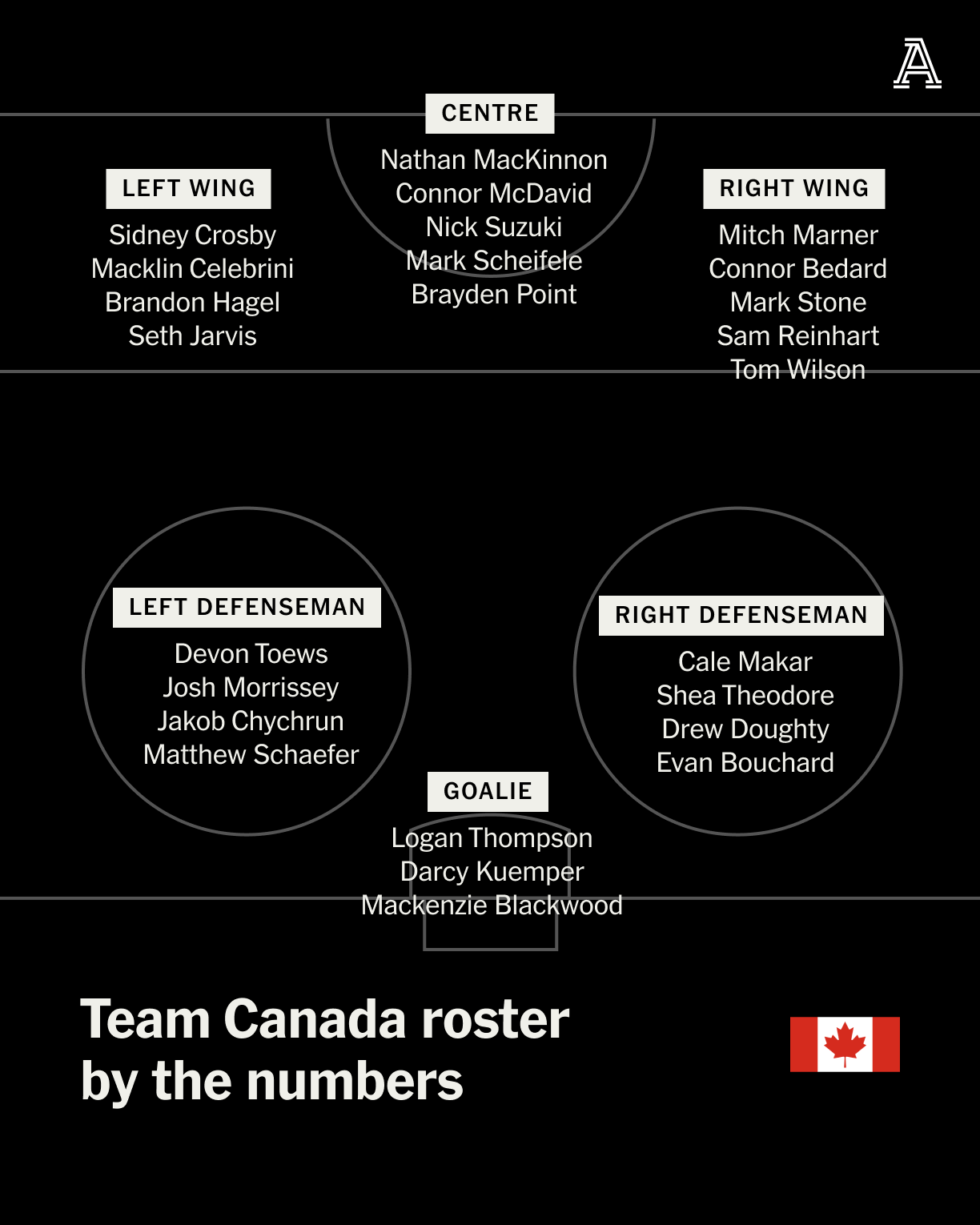
That’s not bad at all, considering the only decision made was clicking “sort by Net Rating,” but we can obviously go further than that.
With that in mind, here are the tweaks I’d make and the thought process to get there.
Forwards

The locks
Already made it: Connor McDavid, Nathan MacKinnon, Sidney Crosby, Sam Reinhart, Brayden Point
Very likely locks: Mitch Marner, Brandon Hagel
The first forwards on the list are obvious, and while Brayden Point is having a difficult season, he’s still Brayden Point. Adding to that list are two guys who feel very difficult to leave off. Mitch Marner is one of the best wingers in hockey and is great defensively, and Brandon Hagel carries one of the strongest five-on-five impacts in the league while being a tenacious player who can kill penalties.
The debates
Can you really bring both youngsters?
Yes, you can and should — although after doing the work, I can see why Connor Bedard’s case might be a little softer.
What Bedard and Macklin Celebrini are doing this year on two otherwise terrible teams has been out-of-this-world good. On a per-game basis, there’s an argument to be made that the only two Canadian forwards who bring more impact offensively are McDavid and MacKinnon. What they’ve done with so little help shouldn’t be ignored; it’s firepower that shouldn’t be left at home.
The question for both regards their defensive game. Their numbers aren’t great, but Celebrini has the tools while Bedard has made serious strides this season. Their defensive numbers would probably look a lot better if they had a single legit top-four defenseman to play with. On Team Canada, that obviously won’t be a problem and a shift to the wing also lessens their defensive load.
The other concern is where they fit in this lineup. I think the argument that they “can’t play in the bottom six” is genuine, but also silly considering who Canada’s other wingers are.
The luxury of having some of the best two-way wingers in the world — Marner, Reinhart, Hagel as well as Mark Stone, Seth Jarvis and even Tom Wilson — is that Team Canada can create a defensive powerhouse without sacrificing any offense. The Shayne Corson days are over; there is absolutely no need for Canada to play it safe like it usually does, not with the wealth of defensive ability at its disposal. Move those other guys down and put the two of the best offensive weapons available next to McDavid and MacKinnon.
There’s probably room for both Bedard and Celebrini, though there’s a bit more to discuss with Bedard.
Who’s playing left wing?
Canada’s left-wing depth is not nearly as strong as its right-wing depth. It’s why both Crosby and Celebrini are playing on the left side and it’s why Hagel is probably a lock. The gap between him and the next best left winger is vast. His average Net Rating sits at plus-20; no one else is north of 10 unless you count Jarvis (plus-13.2), who can play on the left but is a right shot.
That’s where Brad Marchand comes in: A true left-winger, a Canadian icon and the epitome of ratty snarl that wins games. He looked a step behind at 4 Nations, but he’s been on a tear ever since. Marchand’s work in the playoffs and his play this season have put him back on track to the point that I’d probably lean him over Jarvis. I wouldn’t be mad either way, but while my brain says Jarvis, my heart says Marchand for that 4LW slot. His winning pedigree and ability to elevate in big moments feel real, even if his defensive game has lost a step (funny how that’s a big sticking point for the youngsters, but not the veterans).
Who’s going to kill penalties?
Someone has to kill penalties. MacKinnon, Crosby and Point don’t. Neither do Celebrini nor Bedard if Canada brings both (this is one reason they might only bring one). Team Canada is set with winger options — Hagel, Wilson, Reinhart, Stone, Marner and Marchand or Jarvis — but are lighter down the middle. McDavid kills penalties, but I’m not sure that’s the best way to use him. That means the 3C and 4C have to be able to.
At 3C, I’m keeping Nick Suzuki. He may not get much PK usage, but based on his defensive utility at five-on-five, I have high confidence in him working well there as the secondary option. He has some history in the role and this year he’s one of the Selke front-runners. Suzuki’s plus-3.4 Defensive Rating is tied with Marner for the highest among forwards who play tough minutes this season. He feels like the obvious choice as the team’s shutdown center. Suzuki has arguably been one of Canada’s five best forwards this season thanks to his two-way ability.
The 4C question is spicier. By pure value, Mark Scheifele has made an incredible impression this season, but if Canada needs defense and a guy who kills penalties, he’s a tough fit. Enter Bo Horvat.
In all likelihood, this spot probably still goes to Anthony Cirelli. I was a big fan of his inclusion at 4 Nations, but I’m less convinced he’s earned his spot this season. If the goal is defensive responsibility without sacrificing offense, Horvat makes more sense than Cirelli.
Horvat kills penalties, takes on tough minutes, and can put the puck in the net. Cirelli kills penalties, but his defensive game has waned this season (minus-0.7 Defensive Rating on the year). He’s allowing significantly more chances than usual (3.19 xGA/60 compared to 2.07 last year, 0.61 more per 60 than team average) and has been sharing matchup duties with Yanni Gourde. On a line with Hagel and Nikita Kucherov, I think the other guys are doing a lot of the heavy lifting.
That’s not the case with Horvat, who looks more like an individual driver. He’s not exactly a world-beater defensively, but he’s above average and has been stronger than Cirelli in that regard this season. He’s closed the true-talent gap enough that I’ll take him with the additional offense being an added bonus. He’s better on draws, too.
Sleeper pick: Quinton Byfield. His projected plus-3.6 Defensive Rating ranks third among Canadian centers behind Suzuki and MacKinnon. If he could win a faceoff, he’d probably earn more buzz.
Who’s the last cut?
Look, if even the numbers say Wilson is one of Team Canada’s 14 best forwards, he’s going. And for once, he actually deserves it as a guy who now scores with the best of them and drives play well in a matchup role. Consider that, along with his intangibles, he’s a tough cut. Stone has also been unbelievably good this season, albeit in just 15 games. He belongs, too.
That leaves Scheifele as the odd man out, which does pain me to say because he’s been amazing over the last two years. With all the roles decided, the best case for Scheifele is next to McDavid instead of Bedard (where Celebrini’s style and handedness make him a little safer).
That’s a really tough call and there’s an argument for both. Scheifele has the longer track record and does technically carry more value than Bedard, but I’m willing to give Bedard the benefit of the doubt that his extreme environment might not be fully captured by the model’s usage adjustments. Doing what he’s doing on that Chicago team with that blue line feels a lot more substantial. His game-breaking upside and dynamic offense give him the edge, but it’s close enough that the Scheifele case has validity. With Bedard out until at least January, the choice is even more interesting.
Other considerations
Mathew Barzal: Great speed and really underrated defensively. Doesn’t play tough minutes or kill penalties, which is why I leaned Horvat, but he should be in the mix for that top-six spot with Bedard and Scheifele. I’d prefer a scorer next to McDavid, though Reinhart can also slide up to fill that role. Barzal deserves more love.
Wyatt Johnston: A lot of his value comes on the power play, where there isn’t a spot for him on the top unit.
John Tavares: Great start that made things momentarily interesting, but tailed off considerably over the last month.
Sam Bennett: We’ve got Marchand, Hagel and Wilson — all set on the pugnacity. After a rough start, Bennett has been a lot better of late, but he doesn’t kill penalties and he’s not trusted in a matchup role even with Aleksander Barkov out. Aside from the lore of his big-game ability, it’s hard to find a home for him. Being a left shot helps, but if it’s between him and Marchand, I’m taking the original rat.
Robert Thomas: Great player who could fill that 4C role well, but he’s having a tough season in St. Louis, which is hard to reward.
Zach Hyman: Too many right-wingers and while he’s played on the left in the past, I’d still probably prefer Marchand or Jarvis.
Morgan Geekie: Great story, but his improbable surge toward being a 50-goal scorer feels tough to depend on. That he’s even mentioned at all should be a big enough win.
Travis Konecny: Congrats on making the 4 Nations team, but the emergence of a lot of other players leaves a log jam that he’s at the bottom of.
Defensemen

The locks
Already made it: Cale Makar
Very likely locks: Josh Morrissey, Shea Theodore, Devon Toews
This top four feels pretty set in stone. Josh Morrissey is probably Canada’s second-best defenseman, while Shea Theodore’s emergence as a shutdown force (and versatility to play either side) makes them easy choices. Toews, being one of the top eight defensemen by Net Rating, along with his chemistry with Makar, makes him a safe bet, too.
The debates
Can you really bring an 18-year-old defenseman?
A month ago, I looked into Matthew Schaefer’s case for Team Canada, concluding he had to show more in a matchup role. In a best-on-best tournament, that’s a big deal.
At that time, 28 percent of his minutes were against the other team’s star, and in those minutes, he was up 5-4 with a 35 percent xG. Not great, but just getting the opportunity as an 18-year-old defenseman was high praise — and it sure seemed like it was a role he could grow into. That’s exactly what happened. Since that date, 53 percent of Schaefer’s minutes were against the other team’s star (10 of 13 games at home helped) and he’s once again up 5-4, only this time he’s earning a 48 percent xG. That’s a big difference that shows Schaefer holding his own against the league’s best, especially considering the quality of the team around him.
Compare those results against stars to his competition and it’s clear Schaefer belongs — an average xG against tough competition is what most shutdown defensemen earn. (Note: Figures are a little lower due to some star injuries not being accounted for over a full season.)
Colton Parayko: 45% star percentage, outscored 15-5, 50 percent xG
Noah Dobson: 42% star percentage, outscoring 12-10, 47 percent xG
Travis Sanheim: 40% star percentage, outscored 10-6, 51 percent xG
Drew Doughty: 37% star percentage, tied 6-6, 53 percent xG
Evan Bouchard: 37% star percentage, outscored 11-8, 52 percent xG
Thomas Harley: 31% star percentage, outscored 8-3, 40 percent xG
Jakob Chychrun: 29% star percentage, outscoring 7-4, 61 percent xG
Since Nov. 8, Schaefer’s first game in a matchup role, his pair with Ryan Pulock has played the third toughest minutes in the league. In that time, Schaefer has a 52 percent xG rate, is up 16-6 in goals and is still scoring at a 52-point pace — good for an average Game Score of 1.51. Among Canadians, only Cale Makar and Jakob Chychrun have been better.
Because Schaefer continues to shine in an elevated role, his projected value keeps climbing to unheard of levels — in line with McDavid’s rookie value. He’s now projected to be a top-10 defenseman league-wide, third among Canadians behind only Makar and Morrissey. It may sound wacky, but age be damned: Team Canada should not leave arguably its third-best defenseman at home.
Who’s going to defend?
Like the forwards, Team Canada’s potential options on defense are also stacked with defensive upside. That starts with a top four loaded with off-puck ability, where Makar, Morrissey and Toews all have a projected Defensive Rating of plus-3.5 or higher. The big surprise, though, is Theodore, who has emerged as one of the game’s strongest defensive defensemen this season. In the wake of Alex Pietrangelo’s injury, he’s stepped up in a massive way and now projects to deliver a plus-5.3 Defensive Rating, good for 10th among all defenseman.
The fact that all four can defend well and kill penalties is a luxury for Team Canada, giving the team a bit more freedom down the lineup.
Still, it doesn’t hurt to max out elite shutdown ability and that’s where Canada can create an overwhelming strength. Colton Parayko is the only Canadian defenseman with a higher projected Defensive Rating than Theodore at plus-5.5 and he has a lot of experience playing tough minutes. He would be a perfect partner for Schaefer — or a full-out shutdown pair with Theodore if he plays his strong side. The venerable Drew Doughty still has the two-way sauce as well and he notably had the strongest xG against tough comp amongst the five defensemen who played top-pair minutes. Pairing him with Schaefer would be a nice full-circle moment, considering Doughty was once in a similar boat 16 years ago.
Who’s going to kill penalties?
Everyone can, but that doesn’t mean everyone should. I’d probably keep Schaefer away from that role and Morrissey isn’t exactly used heavily on the PK either. In an ideal world, I’d probably save Makar for five-on-five and power-play usage, too.
All of that is to say that Chychrun finds himself in a similar boat to Scheifele up front. He’s having a terrific season, but the fact that he rarely kills penalties makes him tough to bring. There’s not a lot of room left for a pure five-on-five player, and though he has a case to be the next man up, there’s probably a better choice for that.
Who’s the last cut?
After the top four, I like the idea of a Schaefer-Doughty pair and I like the idea of having Parayko on standby as a pure defensive fill-in. The natural foil to that is a pure offensive fill-in. Chychrun could fit the bill there, but Evan Bouchard makes more sense.
Though Theodore predominantly plays the right side, Canada could use a fourth right-shot just in case. In terms of offensive upside, Bouchard has a much longer track record of delivering, has a booming shot like Chychrun and has chemistry with one of the team’s top players. He also has more experience in a matchup role; as good as Chychrun’s numbers in tough minutes are, it’s very notable that he plays the least of them among Canadian hopefuls. He also has a history of being sheltered. Chychrun is a defensive risk like Bouchard, only Bouchard is at least more proven.
At his worst, Bouchard can be a liability. But he also has the big-game mentality that many seem to covet elsewhere but ignore with him. His ability to elevate his game to incredible heights in the last two playoffs has been outstanding. At his best, few tilt the ice like Bouchard.
For the eighth spot, I want the best Makar-insurance for the power play. That’s Bouchard, not Chychrun. With how stacked the team is defensively otherwise, it’s a worthwhile risk.
Other considerations
Noah Dobson: He had a strong start playing matchup minutes with Mike Matheson, but has tapered off lately. He might offer a little more safety defensively than Bouchard, but it’s not enough to compensate for the massive difference with the puck.
Travis Sanheim: If Canada wants to choose Sanheim over Parayko or Doughty, that’s probably fine, but they really don’t need three of the same guy. Sanheim is steady and underrated, but the emergence of Theodore’s defense and the presence of Schaefer make him a difficult inclusion. If Canada picks Sanheim over Schaefer, they’d be leaving a lot of value at home.
Thomas Harley: I’m a big Harley fan, but he played his way off the team to start the season. Maybe that’s because of injury, but his recent return leaves a very short window to change minds. He was a savvy inclusion at 4 Nations as an injury replacement, but Schaefer has taken over as Canada’s best option for a smooth-skating leftie.
Goaltenders

This decision may have been difficult a year ago, but it’s anything but now. There are three extremely obvious choices in net: Logan Thompson, Darcy Kuemper and Mackenzie Blackwood. All three are the best options by both track record and current level of play this season, and it’s not particularly close (unless you are a part of the Jet Greaves fan club to the level the model is).
Unfortunately, it seems very likely that Team Canada will commit malpractice by including Jordan Binnington on the roster. I don’t think the guy who’s last in GSAx with an .869 save percentage this year should be anywhere near this team. That’s a year removed from being 31st in GSAx, indicating a below-average starter rate. This year, he’s allowed almost a goal above expected per game and while I don’t think he’s that bad, I have a hard time imagining he’s even starter quality anymore. By projected GSAx per game, Binnington currently ranks 45th.
Compare that to Thompson (second behind only Connor Hellebuyck), Kuemper (sixth) and Blackwood (14th) and it’s clear that Canada no longer has a goalie problem. They might still have a “choosing the right goalie” problem, though.
Hopefully, the choice is made a lot easier for them after the last two seasons Thompson has had. He’s been unbelievably good and he has company with Kuemper and Blackwood re-surging over the same time period. All three were notably not on the 4 Nations roster.
There will be some who argue the mythos of Binnington as a big-game goalie because of that tournament, while ignoring last year’s playoffs, where Thompson was an ace, or that Kuemper has a far more recent Stanley Cup win. I wouldn’t risk Olympic gold on a one-game sample from the 4 Nations, where he was great during the championship game, when he’s been one of the league’s worst over the last 77 NHL games.
The final roster
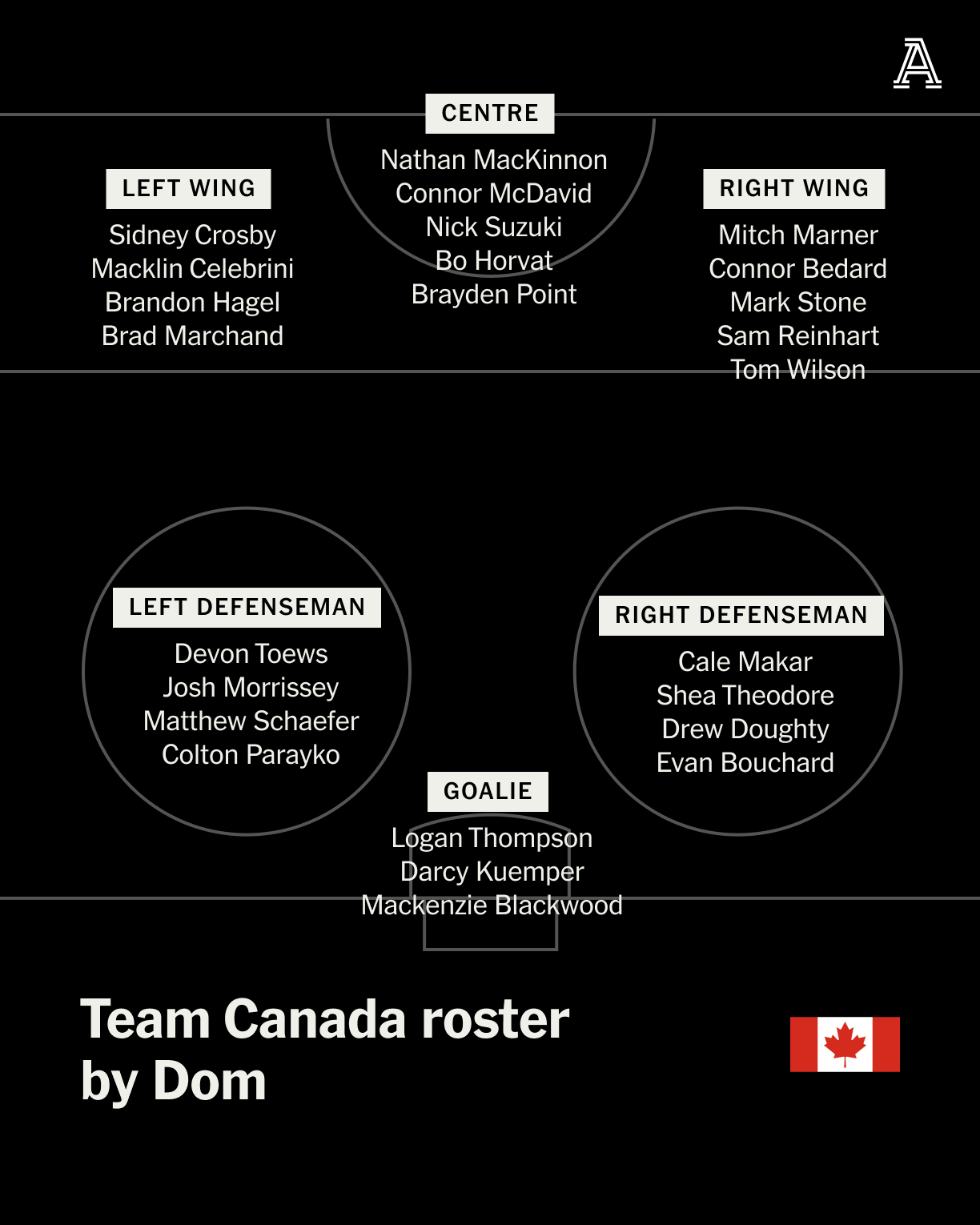
In all, I made three switches. Marchand for Jarvis, Horvat for Scheifele and Parayko for Chychrun. There are arguments to be made for others, but overall, The Numbers™ created a strong baseline to work off of. We’ll see how close it ends up to the real thing on New Year’s Eve.