
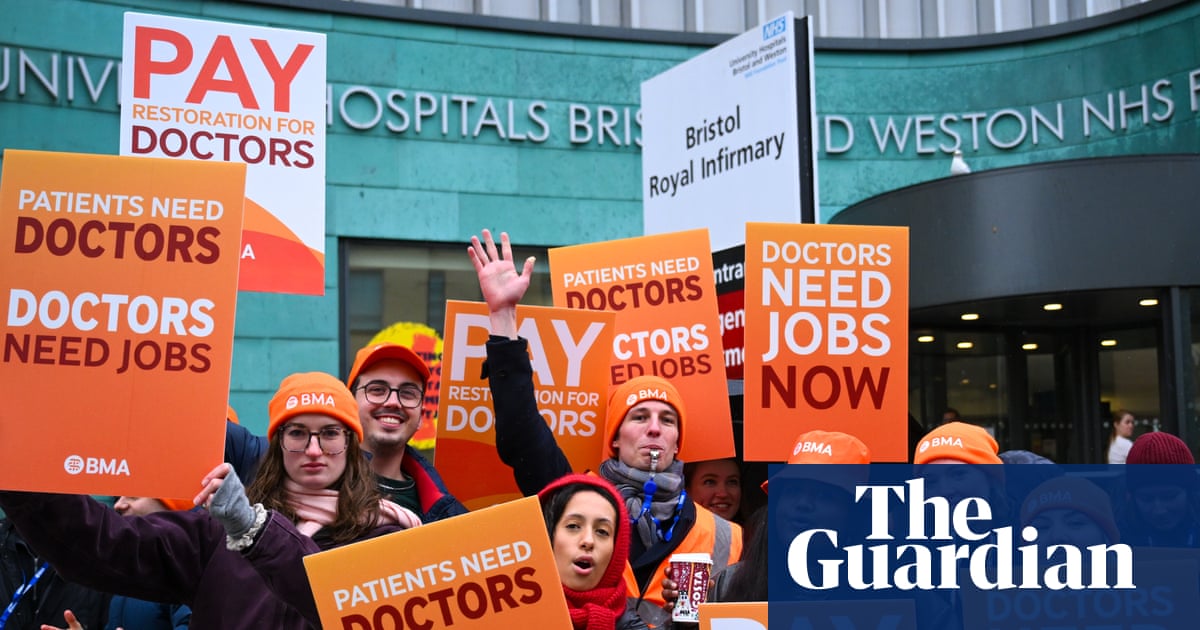
“Striking resident doctors are digging in. History suggests this will go on and on” says the headline on Denis Campbell’s analysis piece (16 December). As a retired public health research and policy adviser and the parent of a doctor currently in core training, I agree that it is likely to go on and on – but not because doctors are stubborn. It will persist because the numbers do not add up and too much of the response has been political posturing rather than workforce planning.
This year, around 30,000 doctors competed for just 10,000 specialty training posts, leaving thousands unable to progress. Promised increases of around 1,000 posts from 2026 may help at the margins, but will leave large numbers with no route into registrar training.
Medical students graduate with debts close to £100,000. In their early NHS years, with earnings around £17 an hour, interest pushes debts towards £120,000.
Public unease about strikes during a flu surge is understandable. But evidence from previous strikes found no rise in mortality, reflecting mitigation such as consultant cover and emergency care. Meanwhile, each round of strikes is estimated to cost the NHS – and taxpayers – hundreds of millions of pounds.
Until training capacity and retention are addressed together, this dispute will continue – by necessity, not design.
Karen Ford
Highbury, London
As a consultant in an NHS trust in the north-east, I am dismayed that resident doctors have again voted to strike. Aside from the impact on patients and the NHS, I worry about the effect on relationships between consultants and resident doctors.
Before the first strike in 2023, consultants in my trust wrote an open letter of support and vowed to provide additional cover on strike days to ensure patient safety. But since then, resident doctors have received a pay rise and been offered an increase in training post numbers and reimbursement of exam fees.
Many of the consultants I work with no longer feel able to support industrial action. In the past week I have heard them describe resident doctors as “foolish”, “unprofessional” and “tone deaf” for striking again. We want to support them, but repeated strike action is driving a wedge between us. Providing extra cover on strike days is exhausting, and is at a cost to our personal lives. As we prepare – yet again – to provide strike cover, we question why resident doctors repeatedly put us in this position.
I urge resident doctors to recognise the impact that their action has on the whole profession. We see the significant issues in their training, such as inadequate training posts and an exodus of UK doctors. But these are complex issues and striking is a very blunt instrument to try to tackle them.
The loss of support and goodwill from their consultant colleagues will probably be more damaging in the long run than any political leverage they may hope to achieve. Goodwill is disappearing, and fast.
Name and address supplied
Dr Jack Fletcher of the British Medical Association wisely does not refer to calls to prioritise UK medical graduates for postgraduate training posts (Why did doctors reject Wes Streeting’s offer? It still fails to treat us with respect, 15 December). Unfortunately, such sentiment does exist among some resident doctors, with suggestions for policies to discriminate against overseas doctors put forward by the BMA and Wes Streeting.
I urge all resident doctors and the BMA leadership to reject the fallacy that immigration is a fundamental cause of the difficulties they face. Decades of underinvestment offers a better explanation. To scapegoat an integral immigrant workforce reflects the wider troubling sociopolitical narrative on immigration and public services, and distracts from political failings.
Long-term workforce planning is vital to resuscitating the NHS. Legislating for the large number of extra postgraduate training posts required over many years will ensure a far better NHS for the country.
John Sowerby
Resident doctor, Shatterford, Worcestershire
I am a final-year medical student at the University of Manchester. I do not believe Keir Starmer and Wes Streeting have made a good faith offer to the BMA. The ongoing disputes between the BMA and the government have been of great concern not only to doctors, but also medical students looking towards a future in the NHS.
There is a severe lack of morale across the country’s medical schools and hospitals, and record numbers are leaving the country or profession. Labour has refused to match a foundation year 1 doctor’s pay with a freshly graduated physician assistant’s pay – a slap in the face considering the hard work it takes to become a physician. It have dangled the carrot of UK graduate prioritisation. This is something that it announced in July, but has slid into this offer as though it was new.
Perhaps most egregious, however, is the misrepresentation of the “4,000 training posts”. These posts are just a repurposing of non-training posts that already exist. There is also no guarantee that they will stay training posts after three years, meaning the same crisis will flare up again. No matter how Kier Starmer and Wes Streeting try to spin it, this does nothing for doctor unemployment.
The rhetoric used by the government through this whole debacle, throwing out phrases like “juvenile delinquency”, is unprecedented considering it is directed at people who have spent most of their adult lives working for a life dedicated to helping the public and saving lives. Any semblance of good faith negotiations was broken by remarks like Streeting’s “moaning minnies”. The ghost of Tory austerity only goes so far when the government shows such a profound incapability to enact meaningful change for doctors.
Name and address supplied
I am a retired doctor and I do not want resident doctors to strike, but it would be much wiser if the prime minister and health secretary were to refrain from using pejorative terms and be honest. The formula is simple.
First, acknowledge that doctors have been hard done by over the years. Acknowledge their years of rigorous training. They are not aware how much unpaid work doctors do, juniors and seniors. They cover staff shortages or sick leave at a moment’s notice for which they do not get paid. The NHS is running on its staff’s goodwill. Do not forget doctors’ role and sacrifices during the pandemic.
A new MP, without any training, now earns £93,904 a year, with subsidised food, expenses paid for a second home, a provision to have a second job, and no obligation to attend parliamentary sessions, while a junior doctor goes through years of rigorous training and a job for which they get not even half of an MP’s pay and have to spend a third of it to rent just a room in London.
It does not finish here. They are moved around during their training for about 10 years, reducing their chances of settling in life in the years that matter, with potentially deleterious impacts on their physical and mental health.
Second, be honest that what the government is offering is not sufficient, but agree a plan and a timeframe over which to achieve that plan. Doctors know it will take time. They just need to be given an honest plan.
Dr Mussaddaq Iqbal
Burnaston, Derbyshire
I’ve worked in local authorities for over 10 years and only get 3% pay rises if any, so I constantly battle with my bills. Doctors have got nearly 30% in recent years. How much are our nurses and midwives getting? To strike during a NHS flu crisis is sickening.
Gill Kelly
New Longton, Lancashire
Have an opinion on anything you’ve read in the Guardian today? Please email us your letter and it will be considered for publication in our letters section.