
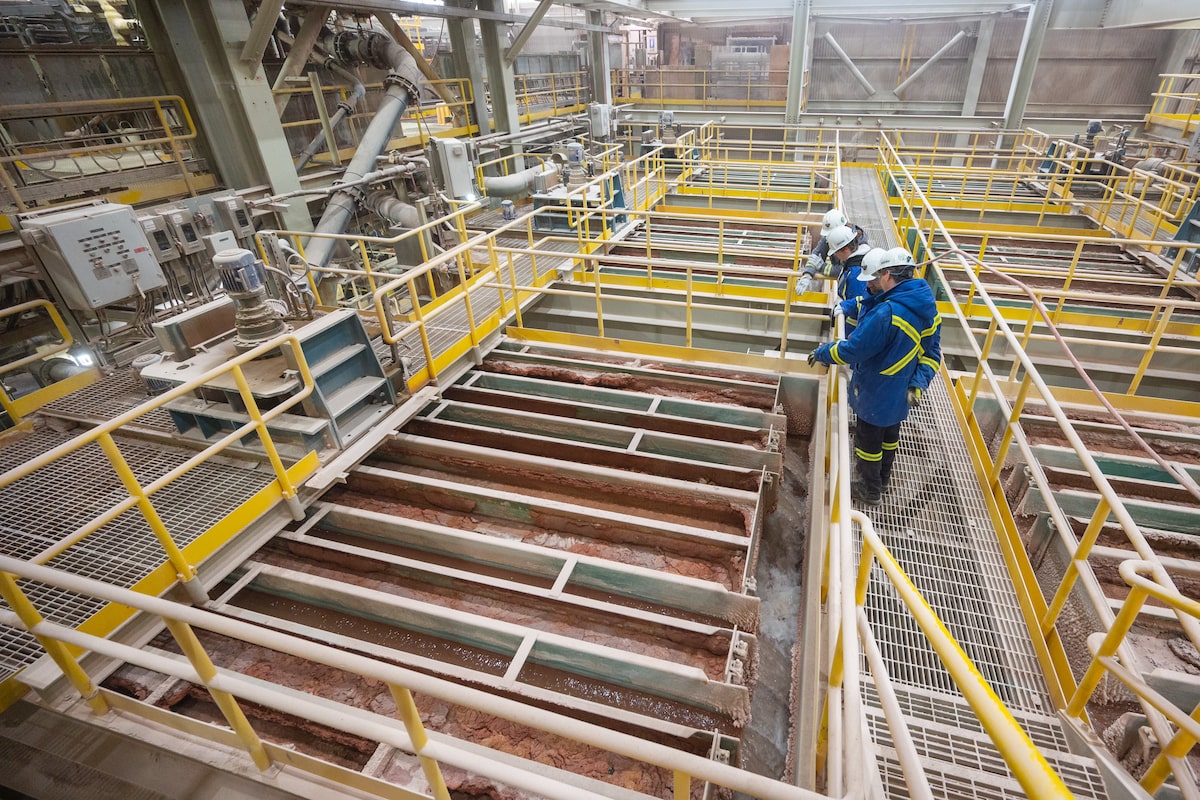
Ore is processed into different forms of potash at Nutrien’s Cory Potash mine near Saskatoon, in February.Matt Smith/The Globe and Mail
The federal government is not offering incentives to win back Nutrien’s NTR-T port investment of up to $1-billion in the U.S., instead hoping Ottawa’s focus on transport infrastructure will change the fertilizer giant’s decision to build south of the border.
Minister of Transport Steven MacKinnon hopes Nutrien will change its mind, he told The Globe and Mail in an interview after a tour of the Port of Vancouver Tuesday, but he said he didn’t think the decision would hinge on “sweeteners or incentives.”
Regardless, the minister said the move is not a total loss, vowing during an event at the Vancouver Board of Trade that it will serve as an “incentive for us all to make sure it never happens again.”
On Nov. 19, Saskatchewan-based Nutrien announced plans to build an export terminal with capacity for five to six million tonnes of potash a year in Longview, Wash.
The company had been scouting sites across the Pacific Northwest for more than a year. Locations up for consideration included Canadian deep-sea ports with rail access. In B.C., the Port of Prince Rupert and the Port of Vancouver fit the criteria.
Ottawa is pressing Nutrien to change course on building a potash export terminal in the U.S.
The news that the company would invest in Washington State came as a blow to the Carney government, which has promised to incentivize capital spending in critical minerals and double non-U.S. exports.
Potash is a mineral critical to all major agricultural production and is Canada’s fifth-largest export. Should Nutrien’s Washington investment be finalized, by 2031 roughly as much Canadian potash mined by Nutrien will be shipped to overseas markets through the U.S. as through Canadian ports.
However, Ottawa is unlikely to win the project back, say analysts. The government’s investment in Canadian transportation infrastructure could make a difference in the future, but the infrastructure doesn’t exist right now.
“Canadians would love to see it stay in country on its way out to the rest of the world” said Josh Linville, vice-president of fertilizer at StoneX, a financial services firm. “But in this case, the fundamentals paint a different picture.”
Mr. MacKinnon and senior officials met with Nutrien staff on Dec. 5. He said the meeting was a “constructive exchange” focused on how Ottawa will improve the country’s transportation infrastructure. Such investments from the federal government include the $5-billion Trade Diversification Corridors Fund, which will back a range of projects to help move Canadian products to overseas markets.
Ottawa, Nutrien to meet to discuss building $1-billion potash export facility in Canada
Projects to expand port capacity are also being prioritized, said Mr. MacKinnon, referencing the Port of Churchill in Manitoba and the Contrecoeur Container Terminal Project at the Port of Montreal, both of which are designated major projects. Roberts Bank Terminal Two, located in Delta, B.C., is also likely to receive special treatment in the new year, he added.
Ottawa is also committed to addressing labour issues at railways and ports, said Mr. MacKinnon. Nutrien has been heavily affected by delays caused by strikes over the past number of years. The minister said Ottawa is looking at stabilizing these relations through better co-operation between employers, unions and government.
Developments in the U.S. could also shift the scales in Canada’s favour, he said.
On the weekend, the Trump administration lifted sanctions on Belarusian potash as relations between the two countries normalized. Belarus is one of only three major global suppliers of potash, alongside Canada and Russia. Nutrien’s shares fell by as much as 5.6 per cent after the announcement, the largest intraday drop for the company in more than eight months.
Canadian fertilizer industry in crosshairs of Trump administration’s price-fixing probe
However, the thawing of U.S. and Belarusian tensions is a “next to non-threat for Nutrien,” said Mr. Linville. In 2021 – before Russia’s invasion of Ukraine drove the Biden administration to restrict Belarusian shipments – the country only accounted for 5 per cent of U.S. imports. Belarus also does not have its own seaports and its potash trade route through Lithuania has been closed since 2022.
The continuing investments in Canadian ports are also largely container-focused, said Barry Prentice, a professor of transportation and supply-chain management at the University of Manitoba. This won’t work for potash, he said. And while Prince Rupert is increasingly a port that handles bulk shipments, it is only serviced by a single class-one railway.
The Port of Churchill is not strategically positioned for Asia – the major growth market for Nutrien. Potash trains would also be too heavy for the rail lines servicing this port, Nutrien’s export agency, Canpotex, told The Globe in September.
The Port of Longview – in comparison – is ready for a major shipper like Nutrien.
It invested US$15-million in redeveloping the berth starting in 2014, Ashley Helenberg, marketing communications manager for the port told The Globe on Dec. 4. The private port is serviced by two major railways, and freight capacity will double because of a US$90-million industrial rail corridor development.
“We’re the community’s economic engine and we take that very seriously,” Ms. Helenberg said. “… All of the ports’ investment has been driven to attract a tenant like Nutrien.”
The Globe reached out to Nutrien for statement. The company declined to comment.