
Agency
18/12/2025
268 views
2 likes
The Swedish-German REXUS/BEXUS programme has selected a new group of student teams for the next flight campaign. These teams will have the opportunity to design and develop their own experiments for launch on a stratospheric balloon or a sounding rocket.
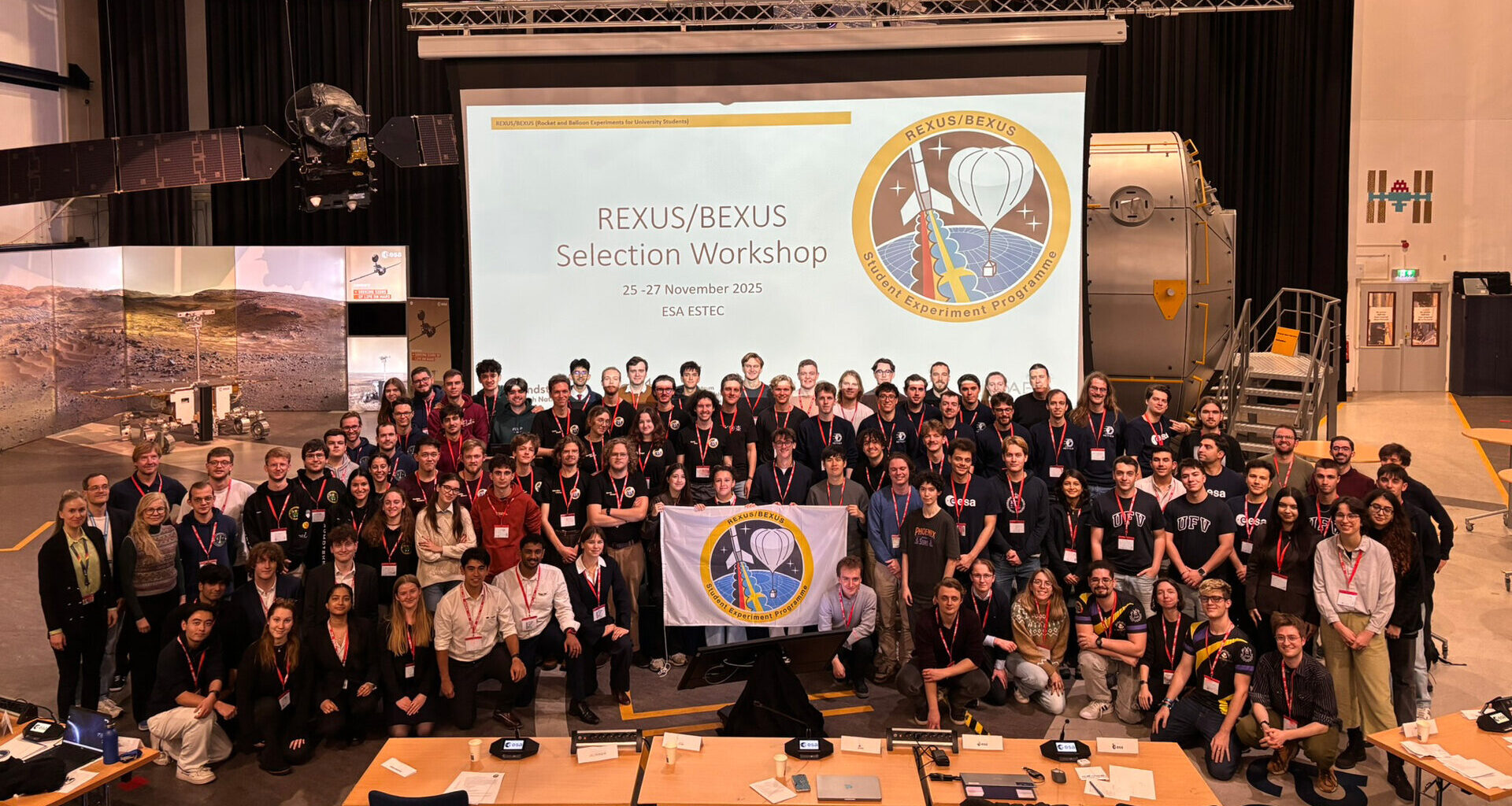
This year’s call for proposals was highly competitive. A record number of experiment proposals were submitted by student teams, and sixteen of these teams were invited to ESA’s technical centre, ESTEC in the Netherlands. From 25 to 27 November 2025, the teams presented their concepts to an expert panel during a dedicated selection workshop.
Almost one hundred students took part in the event, representing sixteen ESA member states and associated member states. Ahead of their presentations, participants received training in project planning, risk management, requirement definition and space project documentation.
The selection panel consisted of engineers and scientists from the European Space Agency (ESA), the Swedish National Space Agency (SNSA), the Swedish Space Corporation (SSC), the Center of Applied Space Technology and Microgravity (ZARM), and the Mobile Rocket Base (MORABA) of the German Space Agency (DLR). Faced with an exceptional set of proposals and a limited number of available flight slots, the panel carried out a thorough evaluation before selecting ten experiments for sponsorship by SNSA and ESA.
The selected teams will now begin developing their experiments for the next phases of the REXUS/BEXUS programme.
The experiments selected for a flight on the BEXUS 38/39 stratospheric balloons are:
BLESS (Bluetooth and LoRa Evaluation in Stratospheric Systems) – Universidad Francisco de Vitoria
CHRONO-CAT (Characterization of High-altitude Radiation on Oscillator Noise and Output Stability / RAdiation Detector – Comparative Atmospheric Test) – University of Southern Denmark
COATHEAL (In-Flight Demonstration of Self-Healing Coatings) – Polytechnic University of Bucharest
MIRAGE (Methane InfraRed Absorption Gas Experiment) – Uppsala Universitet
HELIA (High-altitude Laboratory for Incubation and Analysis) – University of Nottingham
ROCSAR (Rotation Compensated Synthetic Aperture Radar) – University of Porto
The experiments selected for a flight on the sounding rockets REXUS 37/38 are:
Aether:T-ReX (Thermal Re-entry eXperiment) – KU Leuven
CAPILUX (Capillary Fluid Transport and Passive Valve Behaviour in Microgravity) – Riga Technical University
MARA (Mission for Asteroid Resource Acquisition) – Luleå University of Technology
STAR-D (Space Test of Amoeba Response: Dictyostelium) – Leonard de Vinci Engineering School (ESILV)
During a parallel selection workshop held at the German Space Agency at DLR in Bonn, Germany, additional nine teams have been selected to participate under DLR sponsorship.
The next step for the selected teams is to refine their preliminary designs before travelling to Esrange Space Center in Sweden for a full week of training and Preliminary Design Reviews. This marks the beginning of a long journey within the REXUS/BEXUS Programme, which guides students through an entire project life cycle, from concept to launch.
The REXUS/BEXUS programme is realised under a bilateral Agency Agreement between the German Aerospace Center (DLR) and the Swedish National Space Agency (SNSA). The Swedish share of the payload has been made available to students from other European countries through a collaboration with the European Space Agency (ESA). EuroLaunch, a cooperation between the Swedish Space Corporation (SSC) and the Mobile Rocket Base (MORABA) of DLR, is responsible for the campaign management and operations of the launch vehicles. Experts from DLR, SSC, ZARM and ESA provide technical support to the student teams throughout the project. REXUS and BEXUS are launched from SSC, Esrange Space Center in northern Sweden.
Like