
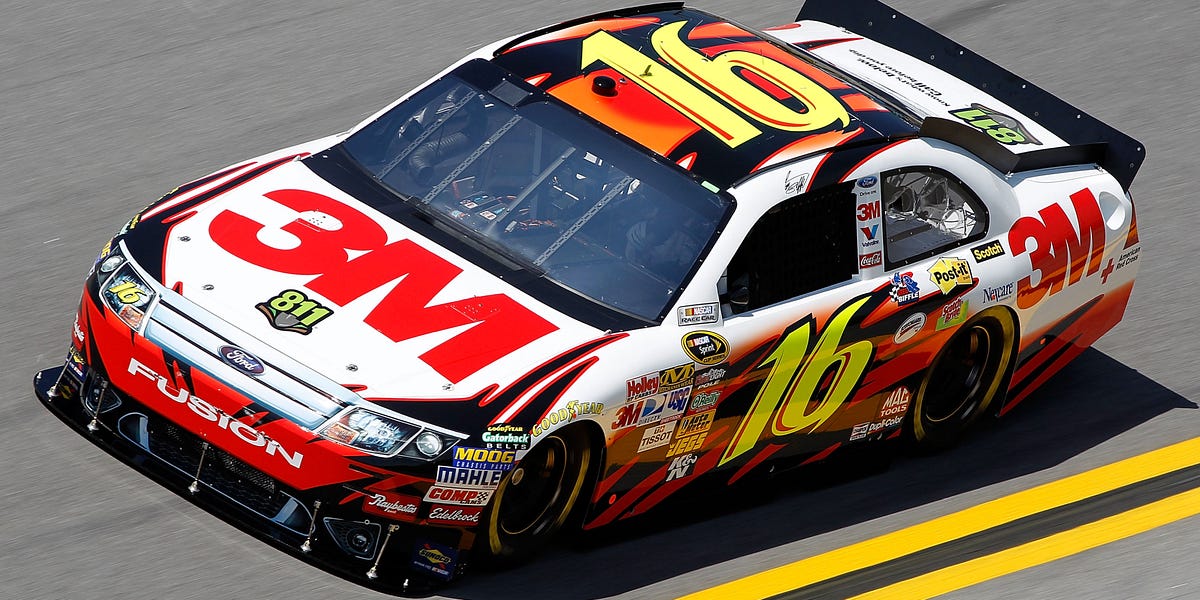
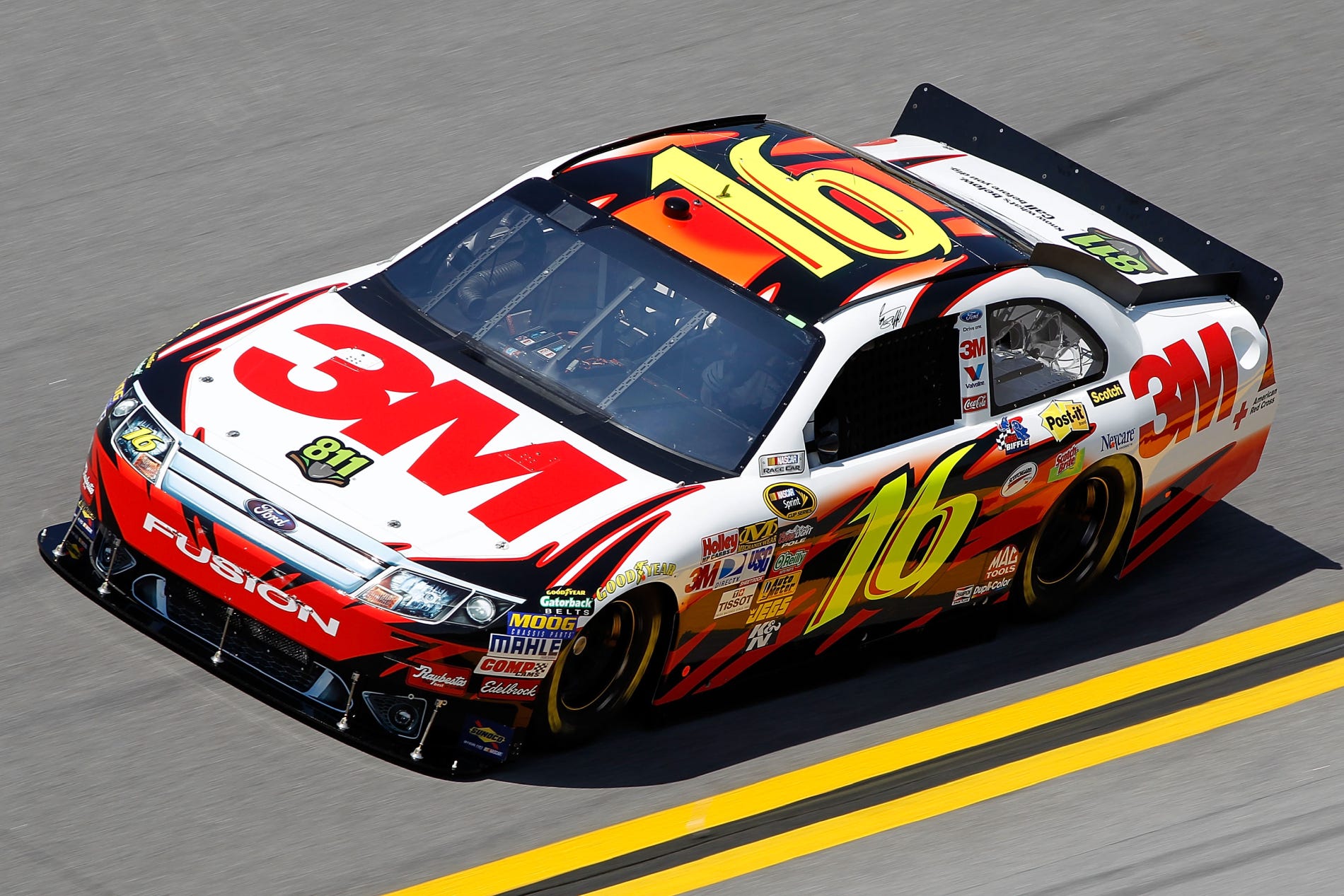
 Greg Biffle drives the #16 3M Ford during practice for the NASCAR Sprint Cup Series Aaron’s 499 at Talladega Superspeedway on April 23, 2010 in Talladega, Alabama. (Todd Warshaw/Getty Images for NASCAR)
(Note: The following tribute to Biffle — both in audio and writing — was adapted from Episode 16 of Podracing, recorded on September 7, 2023, in which Tyler Lauletta and I discussed his career and legacy as the quintessential driver of the No. 16 car.)
Audio playback is not supported on your browser. Please upgrade.
In the wake of his tragic death in a plane crash on Thursday, which also claimed the lives of his wife Cristina, their two children Emma and Ryder, and three others, former NASCAR driver Greg Biffle leaves behind a legacy that deserves a closer look. In addition to what he achieved, his career on the track was defined by an unusual place in NASCAR’s modern history — a limbo that too often made him difficult to classify and easy to overlook.
For one thing, Biffle never quite fit neatly into NASCAR’s familiar generational storylines. He was older than Dale Earnhardt Jr., Tony Stewart, Jimmie Johnson, Kevin Harvick, Carl Edwards and even Jeff Gordon, yet younger than veteran legends like Rusty Wallace, Mark Martin, Bill Elliott and the Labonte Bros. By the time he became a full-time Cup Series driver in 2003 at age 33, many of his similar-aged peers were already established stars. That late start — and the timing of his rise — left him stranded between eras, a fate that sometimes causes great careers to be remembered less fondly than they should be.
And yet, Biffle’s ascent was genuinely remarkable. After finishing second in the Truck Series in 1999, he won the championship in 2000. Within two years of going full-time in what is now the O’Reilly Auto Parts Series, one rung below the Cup Series on the NASCAR ladder, he won that title as well. By 2005 — just three seasons into his full-time Cup career — he finished second in the standings of NASCAR’s highest-level series, trailing only Tony Stewart, while winning six races along the way.
To this day, Biffle remains the driver who came the closest ever to winning championships across all three of NASCAR’s national touring series. As it is, no one else has matched the résumé he did end up producing: Truck champion, O’Reilly champion and Cup runner-up. It is a singular — yet still underappreciated — achievement, one that underscores just how good Biffle was at his peak.
His Cup Series career extended well beyond that near-miss in 2005. He finished third in points in 2008, seventh in 2009, sixth in 2010, and fifth again in 2012. In total, Biffle amassed 19 Cup wins, 92 Top 5 finishes, 175 Top 10s and 13 poles — all while driving primarily for Jack Roush’s No. 16 car, which he piloted for most of 15 seasons across NASCAR’s top levels.
Biffle was known as a hard, uncompromising competitor. He didn’t shy away from rivalries — including memorable clashes with Kevin Harvick — but he was never defined by recklessness on the track. His reputation was that of a tough racer who always earned his results, even if he lacked the flash or star power of some contemporaries.
If anything, the most instantly recognizable part of his career might have been the No. 16 itself, rendered in a distinctive, early-2000s font that became synonymous with Biffle’s name. It was uniquely his — much like his career, which followed a path unlike that of almost anyone else.

Like others on the list of the greatest drivers to not win a Cup Series championship — a group still somehow headed up by Denny Hamlin — Biffle never did etch his name into the sport’s most prestigious record book. But he came closer — and did more along the way — than nearly anyone in NASCAR history, a body of work that ultimately earned him a spot among NASCAR’s 75 Greatest Drivers a few years ago. Even more recently, he was a nominee for the NASCAR Hall of Fame.
Biffle’s career stands as a reminder that success in sports doesn’t always arrive on schedule, nor does it fit neatly into eras. Sometimes it just shows up, meets the competition head-on, and in doing so leaves a mark that deserves remembering.
He, his wife and his children are gone far too soon, and many words will surely be written this week about his off-track endeavors as well, which included serving as a rescue pilot for those in need after Hurricane Helene struck the Southeast in 2024.
But on the track, what Biffle leaves behind is a late-blooming legacy of perseverance, competitiveness and underrated excellence — one that will always be tied to that distinctive No. 16.
Filed under: NASCAR