
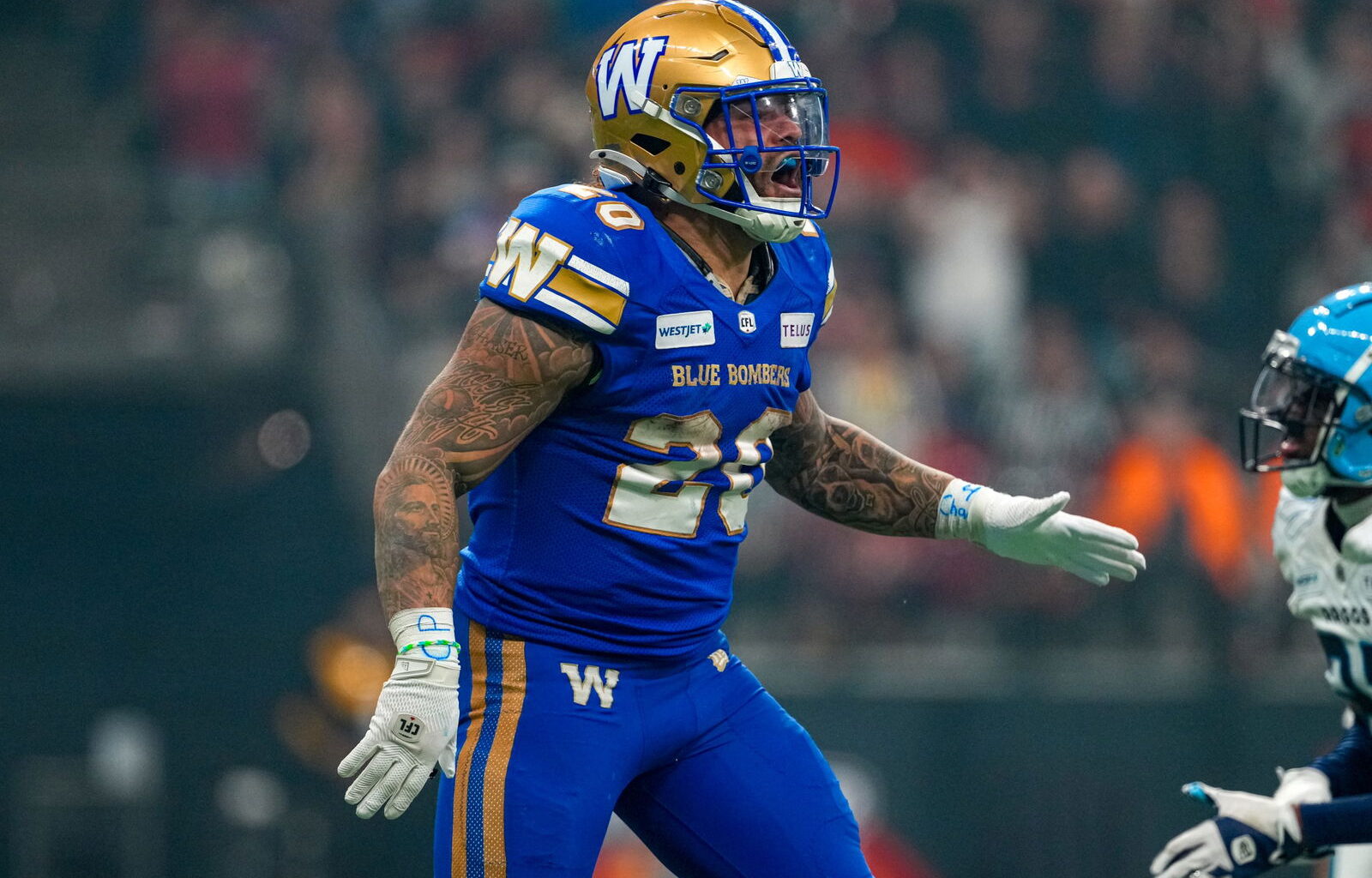
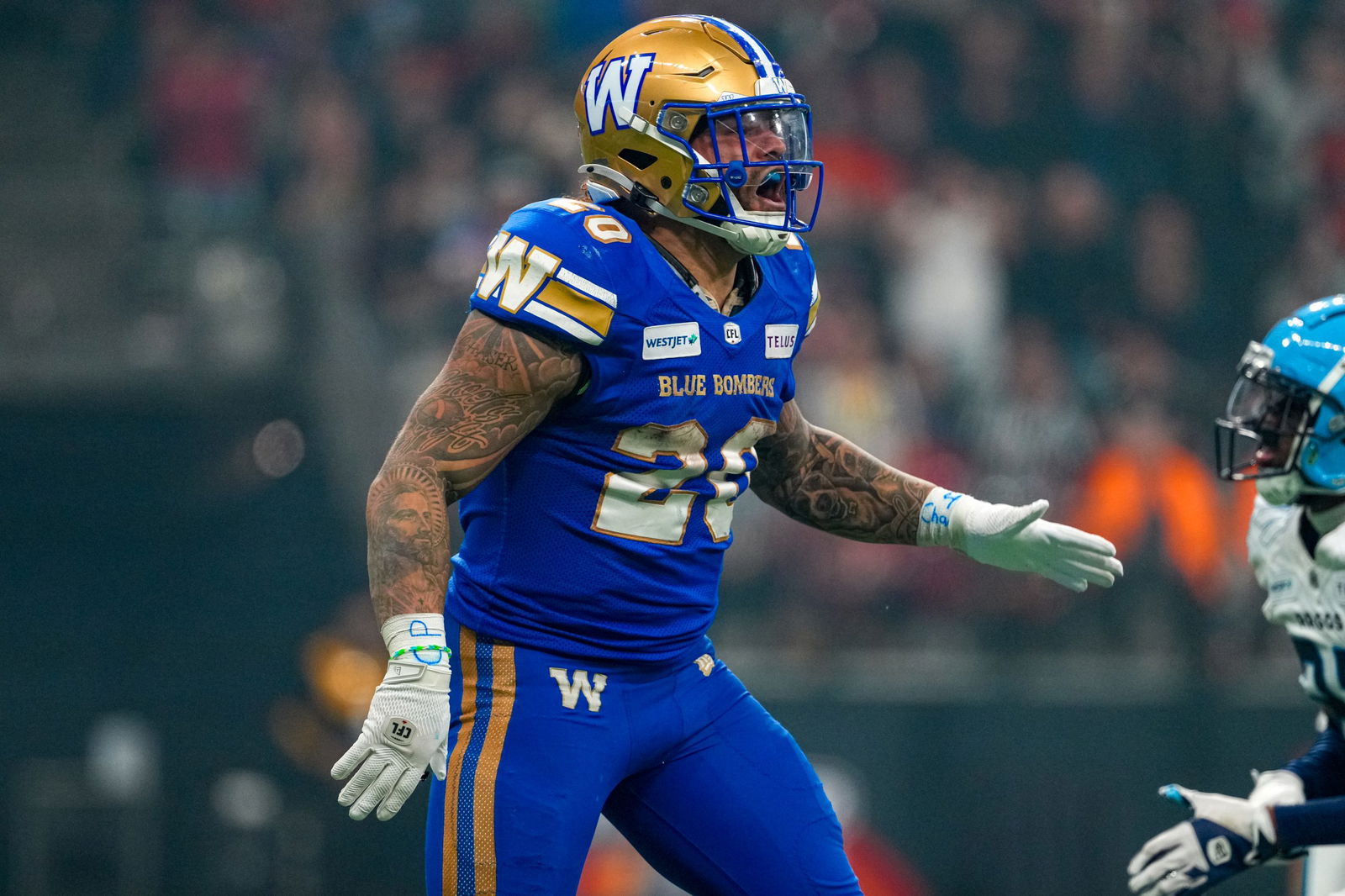
 Photo: Reuben Polansky/3DownNation. All rights reserved.
Brady Oliveira’s three-year contract extension with the Winnipeg Blue Bombers is worth close to an eye-popping $900,000 but he’s confident he could have made even more money had he decided to test free agency in February.
“I think for sure I probably left some money on the table. I think other teams would have offered me more — I don’t know how much more, but I definitely think teams would have offered me more, for sure,” Oliveira told 3DownNation.
“If I wanted to go chase the money, I would have went to free agency and told my agent, ‘Hey, go get me the largest contract that you can get.’ It probably wouldn’t have been with Winnipeg and I would have went somewhere else and played for the money. For me, it wasn’t about the money — it’s about leaving a legacy here in Winnipeg that I’ve been building the last number of years with an amazing team around me.”
“Obviously, you want to be compensated correctly and I think I deserved what I got, absolutely, but it wasn’t all about the money. It was all these other things — for me to play for my hometown and to leave a legacy here as a Bomber and hopefully to play my entire career as a Bomber.”
The five-foot-ten, 229-pound ball-carrier’s new contract, which is reportedly worth $290,000 in 2026 and $300,000 in 2027 and 2028, has given some fans and pundits a serious case of sticker shock. There are few non-quarterbacks who earn that much money in the CFL and there aren’t any other running backs near that figure.
Oliveira left money on the table two years ago when he received offers worth $260,000 and $275,000 annually from the B.C. Lions and Hamilton Tiger-Cats, respectively. These proposals were made when the CFL’s salary cap was significantly lower than it is now.
Powered by RedCircle
The league’s salary cap was $5.525 million when Oliveira signed an extension with the Blue Bombers worth $230,000 in 2024 and $240,000 in 2025. With the salary cap currently set at $6.06 million for 2026, Oliveira’s new cap hit of $290,000 is a relatively small percentage increase from his previous earnings.
It should also be noted that at the recent Grey Cup in Winnipeg, the CFL Players Association indicated that the salary cap could still increase for 2026 based on an audit of the league’s financials, which is expected to be completed sometime next month.
It’s become generally accepted in football circles that running backs don’t deserve to be paid top dollar as the position is easier to fill than most. Oliveira is aware of this sentiment, though it doesn’t appear he accepts it as fact.
“I think you should pay players based off production. For me as a running back, for example, am I getting paid a lot more than the next guy? Yeah, but has anyone else in this league been more productive than me year after year? I’ll let you answer that. I would say no one else has,” said the 28-year-old.
“I think the deal that I got done with Winnipeg, they showed a lot of respect from the jump with the first offer that they gave me, and then the negotiations were very seamless. I think they offered me that deal because of production, not position. I’m productive for this organization week in and week out.”
There’s certainly no arguing with Oliveira’s production. Since he became the team’s starter in 2022, the native of Winnipeg, Man. has recorded 6,807 yards from scrimmage. CFL statistician Jeff Krever told 3DownNation on Thursday that this is the eighth-best total by any player in league history over a four-year span, behind only Mike Pringle, Charles Roberts, Andrew Harris, Joffrey Reynolds, Johnny Bright, and Kelvin Anderson.
In 2024, Oliveira became the fifth Canadian player ever to win Most Outstanding Player. In 2025, he set all-new career-highs in receiving and led the league in yards per carry (min. 50 attempts) despite missing three games due to a shoulder injury.
It also seems fair to question the commonly-held belief that running backs aren’t worth much. The two teams that met in the Grey Cup both started rookie offensive tackles, a position generally considered to be best filled by high-priced veterans. Saskatchewan had the league’s second-highest-paid running back, while the Alouettes had the league’s second-highest-paid linebacker — positions that are both generally lower-paid.
Regardless of whether or not critics consider Oliveira to be overpaid, one thing seems clear — if he’d gone to free agency, he likely could have made even more money.