
19 Dec 2025
Anti-amyloid antibodies may scrape deposited plaque from the brain, but what if we could turn off the toxic tap altogether? Enter γ-secretase modulators. These small-molecule drugs bind to their transmembrane target, γ-secretase, and instruct it to cleave amyloid precursor protein (APP) into shorter Aβ peptides that are less prone to clumping. At this year’s CTAD, held December 1-4 in San Diego, Rosanna Tortelli, Hoffmann-La Roche in Basel, Switzerland, shared the latest data from a Phase 1b study testing nivegacetor, her company’s second-generation GSM, in people harboring the PSEN1 E280A mutation. This mutation weakens APP’s engagement with presenilin, the catalytic core of γ-secretase, resulting in the generation of more pathogenic Aβ42 species.
In PSEN1 E280A carriers, nivegacetor steered APP processing toward shorter, less aggregation-prone Aβ peptides.
Aβ species shifted similarly in plasma and CSF from carriers and noncarriers.
Phase 2 in sporadic AD ongoing; donanemab combination trial in familial AD coming up.
“This is the first data showing in humans that nivegacetor is acting on a mutated γ-secretase in a way that is comparable to the wild-type one,” Tortelli told Alzforum.
In 2021, Roche started a Phase 1 trial of nivegacetor—aka RG6289—in 127 healthy volunteers and, indeed, the drug pushed production toward Aβ37 and Aβ38, all but eliminating pathogenic Aβ40 and Aβ42 (Nov 2023 conference news; Abstract). The drug did not interfere with processing of γ-secretase’s many other substrates, a side effect that had sunk the prospects of several outright γ-secretase inhibitors in the past (Dec 2012 news; Apr 2011 conference news; Aug 2010 news; Jul 2025 news).
These results moved nivegacetor into Phase 2 in 2024, making it the first—and thus far only—drug of its class to get this far. “Others had been tried by BMS, Pfizer, and smaller biotechs, but preclinical toxicity stopped those programs before they could advance,” Robert Alexander, a co-author of Tortelli’s and a clinical trial investigator at Banner Alzheimer’s Institute, told Alzforum. An ongoing study is set to wrap up in late 2026 (AD/PD 2024 presentation; clinicaltrials.gov). It has enrolled 256 people aged 60 to 85 who have brain amyloid as per PET and range from cognitively healthy to mild cognitive impairment.
So far so good, but will γ-secretase modulators work in people with autosomal-dominant AD mutations like PSEN1 E280A, where the catalytic component of the enzyme is mutated? Also called the Paisa cohort in reference to the Colombian region from which they hail, this group tends to develop memory problems in their 40s.
“We wanted to see how the drug affects PSEN1 mutation carriers specifically, because in these individuals the ratio of short to long amyloid fragments is already lower,” Alexander told Alzforum. The longer presenilin is engaged with APP, the more it can trim away at the Aβ fragment, so the weaker interactions in PSEN1 mutation carriers generate more longer peptides, he added.
Tortelli and colleagues recruited 20 members of the Paisa lineage aged 18 to 25. Fifteen of them carry the PSEN1 E280A mutation. They assigned the participants to one of three escalating doses—70, 120, or 230 mg—that they took daily for a week. Plasma samples were collected from day 1 to day 10 to capture pharmacokinetics (PK) during and directly following treatment, while CSF was obtained at baseline and after dosing to assess target engagement and shifts in APP processing, or pharmacodynamics (PD, image below).
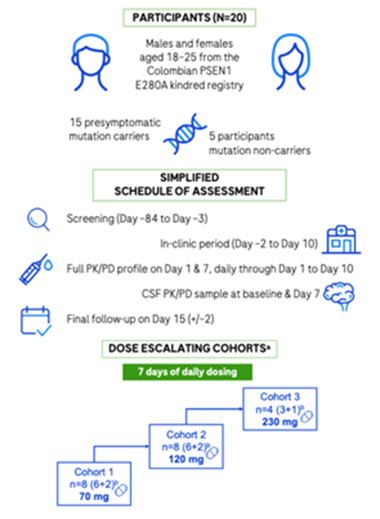
How It Worked. Twenty members of the Paisa kindred were recruited to undergo daily treatment with placebo or one of three nivegacetor doses for a week. Plasma and CSF were sampled to evaluate Aβ metabolism and the PK/PD relationship in carriers and noncarriers. [Courtesy of Poirier et al., 2025, CTAD.]
Nivegacetor produced a dose-dependent shift in Aβ processing in both plasma and CSF, lowering the concentration of longer peptides while increasing that of shorter ones. These changes were consistent across dose-escalating cohorts and similar to those seen in noncarriers, confirming robust target engagement and establishing a strong PK/PD relationship, Tortelli told the audience.
In Paisa carriers who received the highest dose, Aβ42 levels dropped 72 percent in plasma and 53 percent in CSF. On the flip side, Aβ37 and Aβ38 CSF concentrations rose by 401 and 58 percent, respectively.
As might be expected in such a brief trial, downstream biomarkers such as phospho-tau217, GFAP, TREM2, YKL40, neurogranin, and NfL did not change from baseline, the authors noted. “Given the naturally slow disease progression of amyloid build-up in AD, it may require several months until changes on downstream biomarkers become apparent,” Tortelli wrote to Alzforum.
Since nivegacetor slows plaque accumulation, it may work best in people whose plaque load is low when they start treatment, Tortelli told Alzforum. In line with this idea, Alexander is also leading an upcoming trial evaluating the use of nivegacetor in combination with donanemab, Lilly’s anti-amyloid monoclonal antibody.
“In Colombia, we are treating mutation carriers with donanemab for up to 18 months to lower brain amyloid, and then are doing a full factorial study to test nivegacetor, donanemab, the combination, and placebo,” Alexander told Alzforum. “The goal is to see which approach best maintains low amyloid levels.” The trial is to start enrolling in January 2026.—Anna Bright
Anna Bright is a Ph.D. student in New York City.
Therapeutics Citations
Mutations Citations
News Citations
Second-Generation γ-Secretase Modulator Heads to Phase 2 17 Nov 2023
Drug Company Halts Development of γ-Secretase Inhibitor Avagacestat 11 Dec 2012
Barcelona: Allosteric γ Modulation Moves Toward Clinic 1 Apr 2011
Lilly Halts IDENTITY Trials as Patients Worsen on Secretase Inhibitor 18 Aug 2010
AI Decodes Hidden Features of γ-Secretase Substrates, Finds 160 New Ones 24 Jul 2025
External Citations