
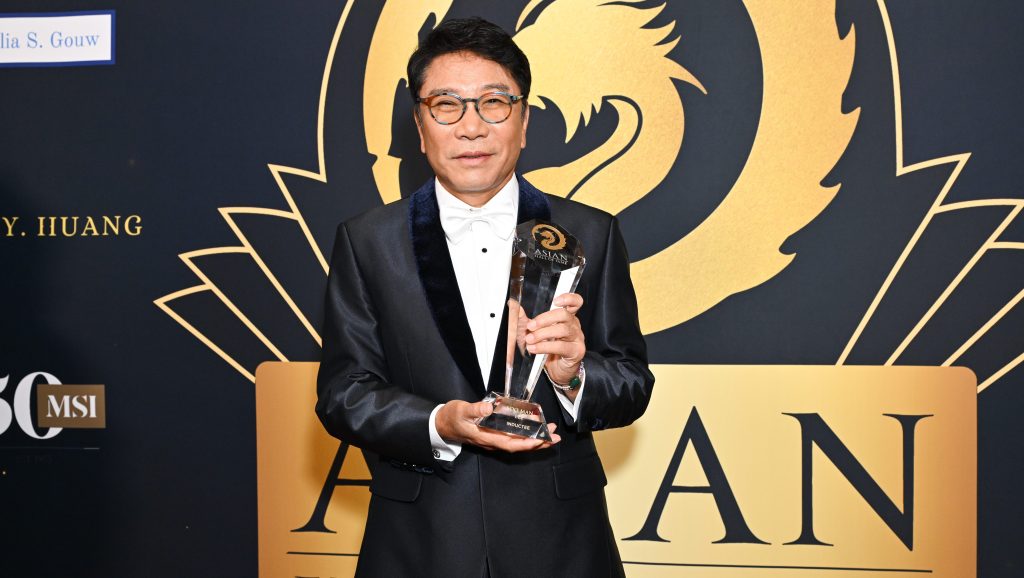
Lee Soo-man‘s career has soared through what seems like three different chapters: First, he was a singer-songwriter in the 1970s, and then he founded Korean music giant SM Entertainment in the 1990s, launching some of the country’s most influential music groups such as H.O.T., Girls’ Generation, Exo, Super Junior and Shinee, and helping to set off Korea‘s cultural wave. Now, Lee is marrying his love for both technology and entertainment, writing a fresh chapter with new label A2O Entertainment.
Last month, the 73-year old Lee was also honored as an inductee to the Asian Hall of Fame in a ceremony held in Los Angeles, alongside basketball legend Yao Ming; Korean astronaut Yi Soyeon; Olympian and US Ambassador to Belize, Michelle Kwan, among others. Indeed, many recognize Lee as one of Korea’s cultural pioneers, but Lee also sees himself as a tech entrepreneur and innovator, in equal measure.
A computer engineer by training, Lee excitedly discusses the convergence of technology and entertainment, in this conversation with Deadline.
He reveals to us how a scene from The Matrix first inspired him to develop a new way to produce music videos, how AI can be integrated into music production and discovery, and how he has developed chatbots for celebrities signed under his new label.
At the same time, Lee also shares his perspective on some pressing questions facing the Korean cultural wave today: Where does K-pop go from here? How does Lee plan to navigate this new era of TikTok and creative influencers? How do you balance AI and human creativity in the entertainment industry?
Launching Korea’s cultural wave
Over the decades, Lee has coined different terms to describe the various culture ecosystems, training pipelines and artistry that he has helped to shape.
One Lee brainchild is the term ‘culture technology’ in Korea, which refers to the highly-structured management ecosystem in Korean entertainment that he has helped to shape. This culture technology produces music artists from early discovery (mostly, in their late teens), to years of extensive training, and on to their debuts and comprehensive marketing campaigns.
A by-product of some of his training as an engineer — with his fondness for formulas and logic — he wrote a manual on this “culture technology” system that employees at SM Entertainment had to become familiar with.
Lee enjoyed a successful singing career in the ’70s as both an individual artist and as a member of various boybands, before he decided to pursue graduate studies in computer engineering in the United States. “When I went to the U.S. to study, that’s when I started thinking, ‘When will Korea become such an affluent and wealthy country with a big economy like the U.S.?,’” he recalls.
“Up until that time, the majority of people thought that it is only when you become a big and wealthy country, with a big economy, that your culture gets to shine globally. Economy comes first and then culture will follow. But I started thinking in the opposite way — that culture should be first and then economy next.”
One of the stars that left a big impression on him was American singer Leif Garrett, who had a concert in Korea in the 1980s.
“I started wondering, ‘Why is it that when foreign singers come to our country, they get so much love, and there’s so much passion from the fans, but that doesn’t happen for our own singers in Korea?” he remembers. “How is it that our singers are not reaching out to the global audience?”

Lee Soo-man
Prime Video
Lee also became increasingly convinced that for singers to go global, they needed to have a well-developed visual and aesthetic dimension, given the rising influence of MTV and videos.
“I saw Michael Jackson, and I saw MTV, and it proved to me that it was video that killed the radio star. Everything was becoming visualized, and I felt that that’s how the music industry should be, and I wanted to change that in Asia,” says Lee.
“When you become a visual artist, it means performing on stage becomes extremely critical, just like Michael Jackson. Being a great singer is also really important, and that means everything needs to be visualized in a way that’s quite aesthetic.”
On embracing technology and AI
When we ask Lee what he would do differently if he were to start his career all over again today, he responds: “If I were to start again today, I would choose a much freer and more technology-centered approach.”
He says that he was particularly inspired by a scene in The Matrix, where Keanu Reeves’ protagonist Neo dodges a hail of bullets, freewheeling backwards as the slugs whizzed past his head. Calling it as “one of the most legendary moments in cinema,” Lee adds that the scene made him wonder how he could apply the cinematic technique to producing a music video to achieve a higher level of visual sophistication.
“That idea led me to develop the ‘Matrix Camera’ system, using 120 still cameras,” he says. “I later applied this technique to music videos for Girls’ Generation and TVXQ.”
South Korean girl group Girls’ Generation. (Photo by Chung Sung-Jun/Getty Images)
Today, Lee collaborates with technology company 4DV Intelligence on ‘Infinite Studio,’ a system that is able to create multi-angle videos from a single shoot, reducing time and cost in video production.
On whether this era of TikTok and YouTube can help singers and creatives launch their own careers and build their audience outside the studio system, Lee says, “Of course, you can do it on your own, but at the same time, when you have the collaboration and cooperation of many other people, that helps your content become better and more refined.”
While Lee recognizes this “new era where anybody can create and a lot of people can do so many different things and express ideas on their own,” he believes that every creative still needs a professional team around them with in-depth knowledge of contracts, marketing and management to help their artistry blossom.
Lee also sees an increasing proportion of the audience becoming “prosumers” in the entertainment industry — a portmanteau which refers to the individual as both a producer and consumer.
“This new era is quite important for prosumers, who are fans and who communicate with celebrities, so that they can share their thoughts and many different things. This is a fandom who are also prosumers, in a symbiotic relationship.”
Korea as a ‘nation of producers’
In many ways, Lee now has the opportunity to return to the drawing board and write a new chapter in Korean entertainment, after his controversial exit from SM Entertainment in 2023. Having at one time been the biggest stakeholder in the music talent giant, his role came under increasing scrutiny from other shareholders and eventually led to the company announcing it would “sever ties” with him.
Lee declines to address how his time with SM Entertainment came to an end, instead choosing to enthusiastically elaborate on his new set up with A2O, seeking to marry entertainment and technology from the get-go.
Lee calls today an “era where capital and technology are globally interconnected” and that he wants Korea to become a “nation of producers.”
He explains: “My goal and purpose in calling this A2O is not just for a label or a name — what it really stands for is alpha to omega — that the next generation creators can find out where their talents lie early on and attain what they want by training, practicing and trying out.”
Lee says that he plans to set up ‘A2O School’, a space where young people can use some of A2O’s content to recreate music and art from existing content that he owns. “A2O School will help them to find out where their abilities and talents lie from early on, so that they can decide on their career path from an early age,” says Lee. “They can use and recreate some of our content… to really play and find out whether they have talent there and create their own content.”
On the AI front, Lee has already launched AI chatbot ‘Blooming Talk,’ which takes on the personality of A2O’s artists, including Chinese girl group A2O May.
Outlining his motivation behind launching the chatbot, Lee says: “It’s quite impossible for one celebrity to communicate with so many fans all the time. Because of that, we made an AI-based platform where this AI can communicate with fans all day long, 24 hours a day. It’s for our new girl group called A2O May, whose songs have launched in both China and the U.S. Through this tool, fans can chat with A2O May for 24 hours.”
There are also some functions where the real A2O May artists can host live chats with fans on the platform, allowing it to run in a hybrid manner.
When asked about the possible negative effects of fans having round-the-clock access to AI versions of their idols, Lee is adamant that technology will always have both positive and negative elements.
“There are always two sides to everything, positive and negative, and I try to look at the positive aspects, because technology can be used in good ways and bad ways, depending on how we intend to use it,” he says.
“We can always create more positive results. Instead of having this AI hallucinate and lie, we create this AI to have the real personality of A2O May through deep learning. It can create a really positive impact on young people, because sometimes teenagers want to talk about their thoughts, but they can’t really go to adults such as their parents or their teachers. This tool can be a great window of communication where they can really talk about what they have on their minds. In that regard, it can be a positive thing where we can resolve some of the issues that we weren’t able to solve using just traditional methods.”
Lee believes that in this age of AI, human creativity becomes an even more precious and protected resource.
“All AI is doing now is collecting data from what has already been done, and packaging it to show you,” says Lee. “It’s not anything new. It’s based on what has already been done. This is where human creativity and ability becomes really important, because humans are still the only ones who can create something new from what AI presents you.”