
Reports about early performance indicators for the 2026 season are already going into overdrive. Information about next year’s development, particularly on the engine front, will dominate F1 news over the coming weeks.
Without a single lap completed by a 2026 car, making predictions for next season is tricky at best and speculative at worst.
However, the first signals on the engine side are certainly worth paying attention to. Arguably the most definitive observation from the winter break so far is that – unlike previous regulation changes – the big teams are truly vulnerable.
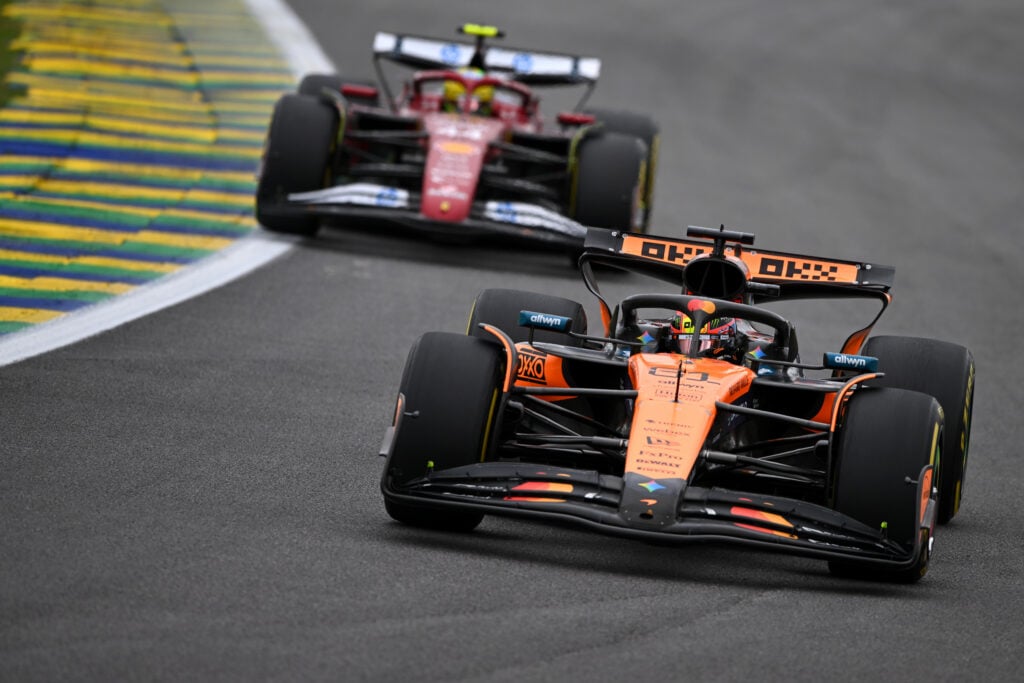 Oscar Piastri leads Lewis Hamilton in Sao Paulo, Brazil. (Photo by Rudy Carezzevoli/Getty Images)
No margin for error over the winter
The infamous Mercedes “zeropods” concept was the biggest talking point in 2022 pre-season testing. Within a few weeks of the season starting, Toto Wolff’s team were forced to recognise their aerodynamic gamble had failed.
Mercedes never truly compensated for this error, spending the next four years playing catch-up to Red Bull and later McLaren.
Still, for all the criticism Mercedes received at the time, they remained firmly at the front. In fact, their supposedly disastrous design was still enough for third in the constructors standings.
At the time, the effects of the budget cap were only starting to take effect. Big teams continued to have a significant advantage in terms of the infrastructure and development tools at their disposal.
This edge is now essentially gone, with midfield teams investing heavily in bridging this gap. Looking ahead to 2026, this puts the traditional big teams in a very awkward position.
In contrast to previous regulation changes, a poor winter of development could put them near the back. A worst-case scenario therefore becomes more worrying than it was five years ago.
Midfield teams like Aston Martin and Williams far better equipped than in previous years. Aston’s Honda partnership in particular has positioned the British team as a potentially unique threat in 2026.
Crucially, teams traditionally in the midfield have become increasingly successful in signing engineers and technical personnel from the big names – partly because their projects are more exciting than in previous campaign.
This mans the top teams no longer dominate in terms of having the best personnel, with Aston Martin, Williams and Audi being especially aggressive in their recruitment.
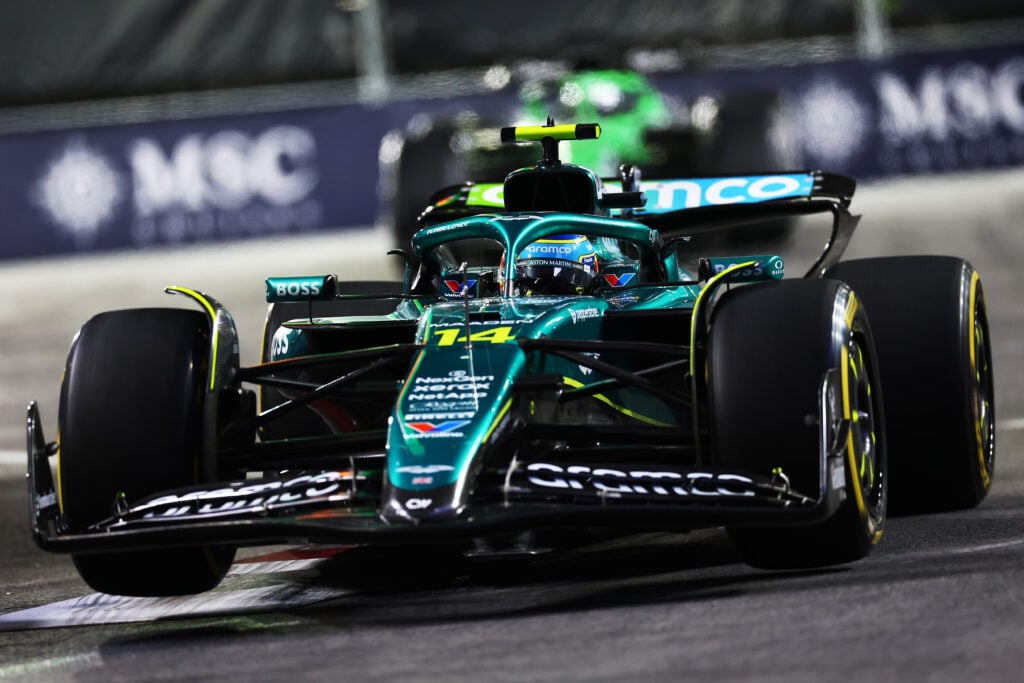 Fernando Alonso in Las Vegas, Nevada. (Photo by Zak Mauger/LAT Images)
Limitations in 2026 development
Arguably the biggest risk for the big teams in 2026 is related to wind tunnel restrictions.
In an effort to level the playing field, F1 has a system whereby the teams further down the constructor standings receive the most hours in the wind tunnel – whilst those at the front are given the fewest hours.
For teams like Williams and Aston Martin (who have had hundreds more hours than the front-runners this year), their position in the standings does not necessarily reflect their potential.
This has given them far more time to conceptualise and refine their 2026 cars. Of course, in the absence of a title fight, the midfield began development on next year’s cars extremely early.
Even Ferrari, who abandoned the 2025 Championship race relatively early, were still bringing upgrades to the SF-25 in July.
Williams, meanwhile, left the FW47 virtually untouched. Aside from putting the top teams at a disadvantage in terms of extracting more performance, their limited development time substantially increases the risk of encountering major problems in the opening rounds.
It is no coincidence that many big teams will bring relatively basic versions of their 2026 cars to testing. Only after being confident in reliability and their data accurately correlating can upgrades be introduced.
In this environment, an opportunistic midfield squad could catch the field by surprise. After all, different teams will have varying levels of risk tolerance.
To be clear, it is too early to declare the entire grid will be turned on its head next year. The likes of McLaren, Red Bull and Mercedes still maintained their supremacy from 2022-2025, a few years after the budget cap was introduced.
Considering these teams were all forced to reduce their workforces to comply with the cap, this is an impressive feat.
However, it must be emphasised that 2026 has more potential than any other season to see one of the big names plummet down the order.
READ MORE: Fred Vasseur gives warning ahead of F1 2026
Main photo: Richard Pardon (Mercedes F1 Media Archive)