
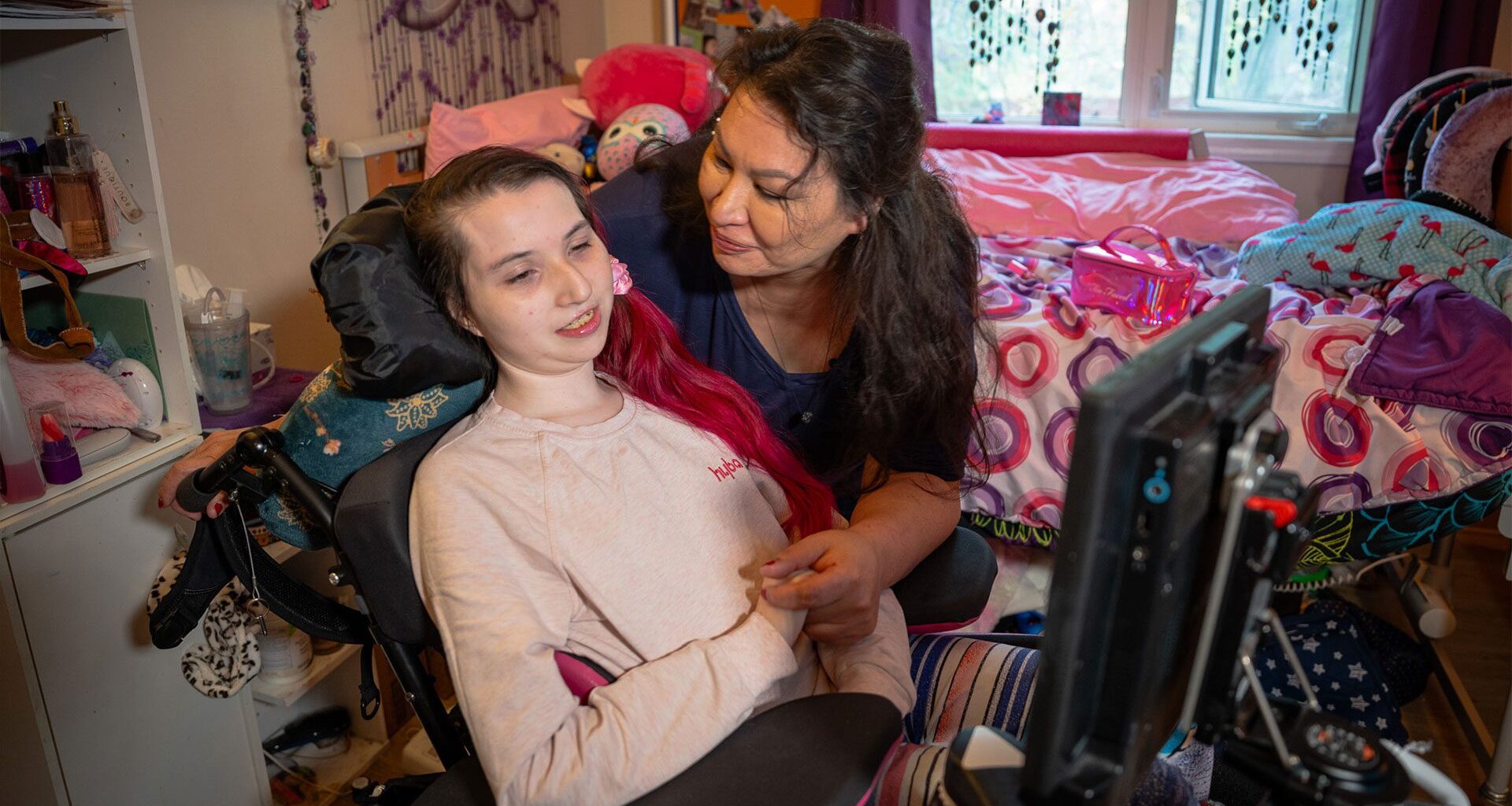
Georgette Aisaican’s daughter is her whole world.
Aisaican, a member of the Cowessess First Nation who’s called Whitehorse home for the past four decades, has a bond with her 24-year-old daughter Selena many mothers and daughters would envy.
The pair have a shared love for classic songs like Singing in the Rain and Good Morning, giggling over TV shows and spending time together checking out a popular Whitehorse farmers market in the summer.
Like most mothers, Aisaican couldn’t be prouder.
“Selena is just this beautiful being – 24-years-old – just a beautiful young lady,” she said. “She’s super intelligent, quite funny, and she’s so inspirational.”
But Selena isn’t your average young person navigating early adulthood.
In fact, she’ll never live on her own, attend university or have a career.
That’s because Selena has Rett Syndrome, a rare genetic disorder caused by a gene mutation on the X chromosome.
Rett Syndrome typically affects girls; boys with the condition almost always die before birth or in early infancy because they lack a second X chromosome to compensate for the gene mutation.
Most of those affected by Rett Syndrome do not live past middle age.
Like others with the syndrome, Selena developed normally in the first few years of her life and then experienced rapid regression.
After learning to walk, Selena struggled to hold herself up and began falling.
Aisaican knew something wasn’t right.
After copious amounts of testing, a genetics team in Vancouver told Aisaican Selena’s symptoms were consistent with Rett syndrome.
Aisaican had never heard of it.
At the time, Selena’s doctors didn’t seem to know much about it, either.
“Even after the diagnosis, I did not believe it. I thought – it just seemed so doomed,” Aisaican told APTN News.
As the syndrome progressed, Aisaican watched her fun-loving daughter lose her independence.
Selena eventually lost the ability to speak, run and play.
By the time she was four, she could no longer swallow solid food.
In just a few short years, the sound of Selena running down the hallway as a toddler was replaced by the grunts of a specialized wheelchair.
Mothers are supposed to protect their children, Aisaican said.
But the disorder’s aggressive grip on her daughter left her feeling powerless.
The future felt grim, especially as there is no known cure for Rett Syndrome.
Aisaican felt like she was watching her little girl develop dementia.
“It’s the strangest thing – you’re grieving over someone that’s still here,” she said.
Now in her mid-twenties, Selena is developmentally no older than an 18-month-old, but with far fewer physical capabilities. She cannot talk, walk, eat or go to the bathroom on her own.
Her list of requirements for daily care is extensive: tube feedings, brief changes, seizure management – not to mention surgeries and the never-ending doctor’s appointments that come with caring for someone with complex medical needs.
Aisaican believes Selena may be the only person in the Yukon living with Rett Syndrome.
Caring for Selena is a full-time job, but one Aisaican is happy to do. She said Selena is a part of her – her own flesh and blood. It’s her duty to protect her.
“I vowed no matter what, I was going to take care and love her with everything I have,” she said.
Family ‘backed into a corner’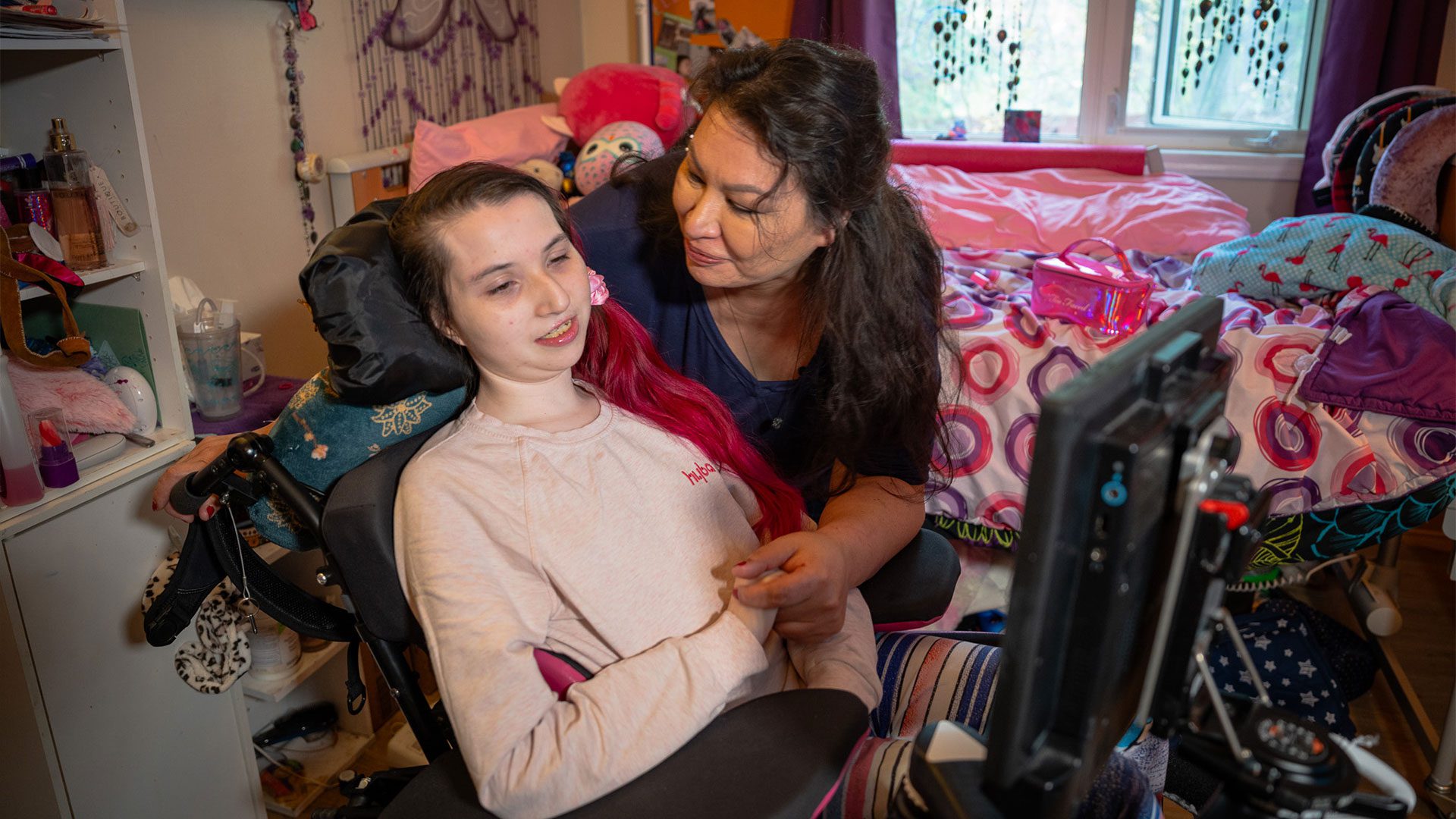 Whitehorse mother Georgette Aisaican with daughter Selena. Selena has Rett Syndrome, a genetic neurological and developmental disorder that affects the way the brain develops. Photo: Jordan Haslbeck/APTN News
But being a full-time caregiver isn’t easy.
Like many family members looking after a loved one with complex needs, much of Aisaican’s time is spent juggling the demands of Selena’s care.
She said while caring for her daughter is highly rewarding, it’s also time-consuming, lonely and exhausting.
At 51-years-old, her daughter’s care has become more difficult with time, and since developing rheumatoid arthritis, the physical demands of that care have made it challenging on her body.
Trauma, too, is a part of Aisaican’s life.
Aisaican said she experienced physical and emotional abuse at the hands of her stepfather, a former official with what is now Indigenous Services Canada (ISC), while also grappling with family dysfunction caused by the legacy of residential school.
Those wounds, she said, continue to impact her to this day.
On top of that, finances have been a constant struggle.
Mother and daughter receive around $1,700 combined per month in social assistance from ISC – around $20,400 per year – an amount Aisaican said barely covers the basics.
It’s led her to wear many hats to help support her family over the years, including working as a chef, floral designer and esthetician.
Aisaican said she even managed to pay off her student loans while on social assistance.
But she said working has been nearly impossible since Selena graduated high school due to the high level of care she requires.
Beyond that, losing child-specific benefits when Selena turned 18 has also made things harder.
Aisaican remembers how the loss of those benefits hit especially hard the Christmas Selena turned 18, as she was counting on them to help cover presents. Instead, Aisaican taped a piece of paper on the wall and drew a Christmas tree.
It was the only thing she could afford to give that year.
On another occasion, Selena desperately needed dental surgery, but as she had aged out of the system, Aisaican said she was told she’d have to pay out-of-pocket. She said Non-Insured Health Benefits (NIHB) also refused to provide coverage.
“I’m tied up in all of this, and the way we’ve been backed into this corner, it’s not fair,” she said. “There’s so much unfairness about it.”
Systems depend on caregivers — but fail to recognize them
Aisaican said while respite care is available, and she has used it in the past, it’s not an option she feels comfortable relying on.
She recalled signing off on a respite worker’s hours, only to learn they were earning as much as $40 an hour while she made $11 working minimum wage.
What stung even more, she said, is that the workers struggled to provide Selena with the appropriate level of care she requires.
“We’re seeing other people in these positions getting paid and supported and celebrated. That’s just not fair,” she said. “I’m doing this 24/7. I don’t get breaks.”
Because of those challenges, Aisaican asked disability services if she could get similar funding to help care for Selena and keep her family’s head above water.
She said the department declined, implying that it wasn’t an option due to concerns the funding would be abused.
Other options, she said, are virtually non-existent due to a number of bad experiences where Selena’s safety was compromised.
Earlier in Selena’s life, Aisaican felt pressured by social workers to place Selena in a long-term care facility a few times a month so she could get respite.
Aisaican reluctantly agreed, noting there were several incidents of staff members neglecting to check on Selena for extended periods of time.
During her last stay, Aisaican discovered Selena fast asleep in her wheelchair, covered in vomit, seemingly unnoticed by nursing staff.
She never took Selena back again.
Aisaican also has limited family support.
As Selena’s father is not involved in her life, she leaned heavily on her mother for support – an option no longer available since her passing.
Today, Aisaican’s only other help is her adult son. While he receives respite care funding and in-home income supports, Aisaican said he’s not able to provide personal care, nor is he expected to, and she wants him to branch out and live a life of his own.
While there’s been occasional suggestions from social workers to institutionalize Selena throughout the years, Aisaican said that’s never been an option.
She believes her daughter deserves to be at home where she is loved and properly cared for.
“There’s no way I’ll ever let anyone take Selena away from me, but I do live with that fear,” she said. “I live with that fear every day.”
As Aisaican puts it, it feels as though the government is willing to pay anyone but her to provide appropriate care for her daughter – and her family is falling through the cracks.
She said the experience has left her feeling invisible.
Like her family doesn’t matter.
Aisaican said while systems depend on caregivers, they fail to recognize their value.
“Why are we still struggling?” she said. “If they’re not doing it, and I’m doing all the work, then they should be ensuring parents are getting paid.”
In Aisaican’s eyes, it’s an oppressive system that disadvantages vulnerable families like hers with little meaningful support.
That’s why she’s speaking out and advocating for paid compensation for family caregivers.
“They say that you can tell a good community by how they care for their most vulnerable. I want to see that come to fruition,” Aisaican said.
“This is worthwhile work that deserves to be compensated.”
Advocates criticize lack of national approach to caregiving
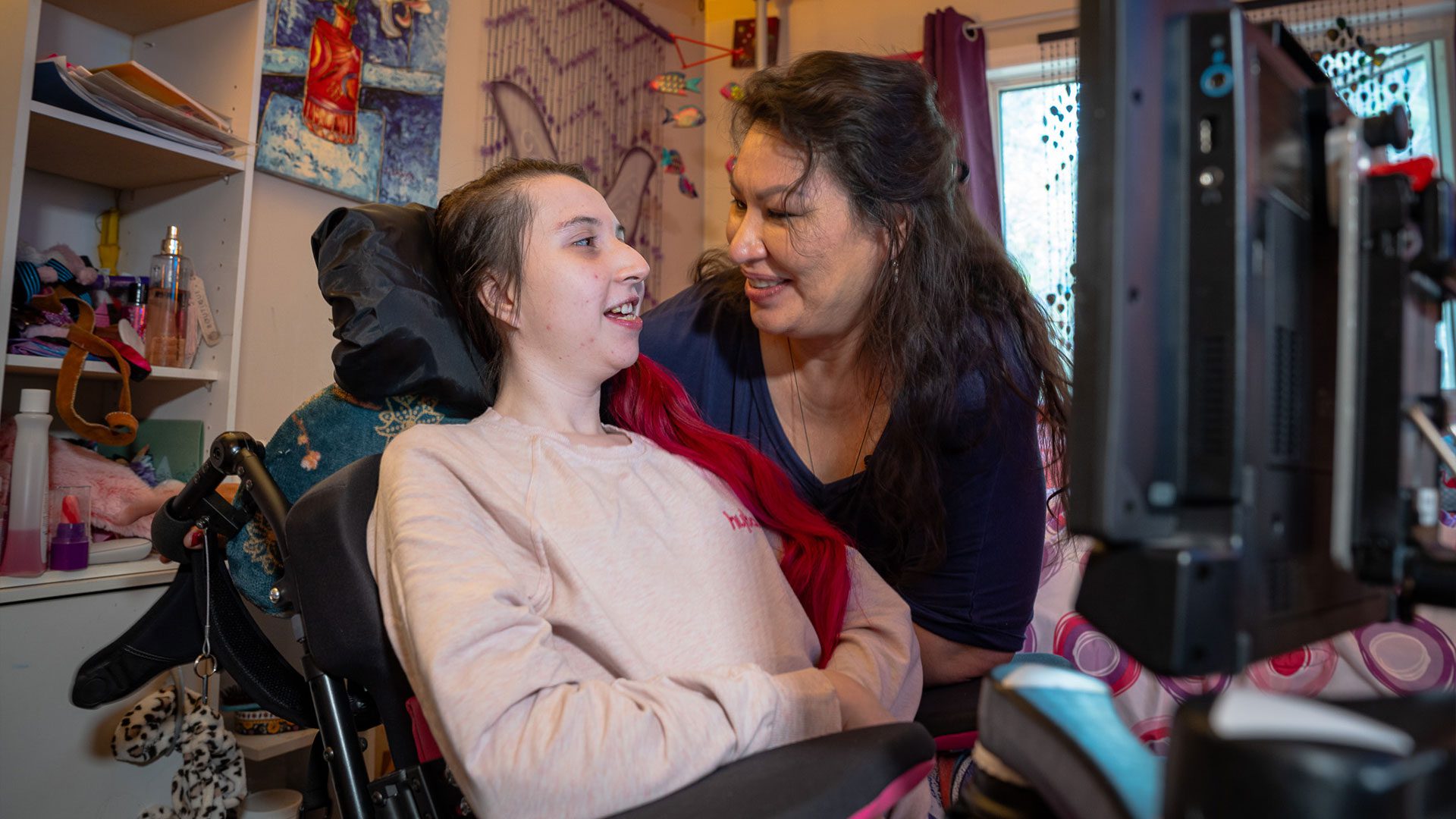 ‘I’ll never let anyone take Selena away from me,” says Aisaican. Photo: Jordan Haslbeck/APTN.
But in the Yukon, there is no mechanism for family members of adults with disabilities to be paid for their care.
Thibaut Rondel, a spokesperson with the Department of Health and Social Services, said in an emailed statement that Individualized Supervisory Care, a program that offers a range of supports to children under 18, and, in some limited cases, compensates parents who lose wages to care for them – is largely unavailable to families caring for adults.
Instead, supports for those over the age of 18 are usually limited to respite funding and participation in day homes.
“While the children’s side of Disability Services has a broader range of supports than the adult side of the program, the Government of Yukon continues to review its policies to ensure they are equitable and responsive to the needs of individuals with disabilities and their families,” Rondel said.
Advocates say the Yukon isn’t alone.
James Janeiro, director of policy and government relations at the Canadian Centre for Caregiving Excellence (CCCE), a program of the Azrieli Foundation that advocates for Canadian caregivers, said those providing care are shouldering enormous pressure.
“The situation out there is not great for caregivers right now,” he said.
While a handful of provinces, including Nova Scotia, Prince Edward Island and Newfoundland, offer paid caregiving programs, compensation differs depending on jurisdiction, and for most Canadians, the financial burden of caregiving typically falls on caregivers themselves.
Janeiro said statistics show 22 per cent of caregivers spend $1,000 per month on out-of-pocket, caregiving-related expenses.
“That’s a lot of money, particularly as we are now in the midst of a cost-of-living crisis and potentially even on the verge of a recession,” he said.
Despite the many challenges an estimated 7.8 million Canadian caregivers like Aisaican face, Canada still has no national approach to caregiving – much less a paid caregiving program.
Earlier this year, CCCE released its national caregiving strategy, which calls on the federal government to take stronger action to address the growing plight that caregivers face.
The strategy outlines several solutions to improve Canada’s caregiving systems, reduce financial and workplace stress and better recognize caregivers and the support they provide.
“We have a road map to make Canada the best place in the world to give and receive care,” Janeiro said, adding that similar supports exist in places like the United Kingdom and Australia.
In the U.K., caregivers can receive around £80–£85 a week – about $145 CAD. In Australia, carers of children and adults can earn $153 AUD bi-weekly (around $135 CAD), and low-income carers can also qualify for an additional carer payment.
“This is an idea that’s got traction both at home and abroad and has been shown to dramatically reduce the stress of caregivers and improve the outcomes, both for caregivers and the recipients of care for whom they provide care,” he said.
According to Janeiro, it’s an issue Canadians can no longer afford to ignore.
CCCE’s data shows one in four Canadians are currently caregivers and half will be caregivers at some point in their lives.
“One quarter of the population is very hard to ignore. Half the population is impossible to ignore when it comes to public policy priorities and getting things done,” he said. “Canadians and our systems are not ready to meet this moment and support caregivers and the important work that they do.”
Heather Aldersey, a professor with Queen’s University School of Rehabilitation Therapy and Canada Research Chair in Disability-Inclusive Development, agrees.
She said evidence overwhelmingly shows caregivers need more support and recognition.
“I’ve heard from caregivers that they need to reduce their working hours or even leave paid employment completely to be able to meet the needs of their loved one with a disability,” she said. “I think that’s definitely something that needs to be valued and honoured and recognized in our society in a way that maybe it isn’t the way it should be right now.”
Aldersey said one of the biggest challenges caregivers of adults face – as seen in Aisaican’s experience – is the “abrupt” transition from school-based services to adult supports.
She said research suggests those requiring care benefit most from a mix of formal supports delivered by paid providers and informal help from families and friends.
She said informal supports, which are done out of love rather than obligation, are especially significant for a care recipient’s well-being.
“We identified that family or friend caregivers often support a person they care for with a sense of love and commitment to a depth that is rare in formal support relationships,” she said.
Indigenous caregivers face increased pressure
Aldersey’s research echoes other findings identified in CCCE’s national strategy, which paint a bleak picture of the current state of caregiving in Canada.
It found that half of caregivers experienced financial hardship and nearly half reported mental health challenges related to their caregiving responsibilities.
Female caregivers in particular are more likely to experience stress, poor mental health and financial strain due to gendered expectations that devalue their labour.
It also found that replacing unpaid caregivers would cost the federal government roughly $97.1 billion annually.
“Without caregivers, Canada’s health and social systems would collapse,” it states, pointing out that while the demand for care is growing as people are living longer with more complex needs, there are fewer caregivers available.
“Canada’s strained healthcare system and the sustainability of the care economy are at a breaking point,” it further warns.
Indigenous caregivers face even greater hardship.
According to the strategy, Indigenous caregivers are more likely to experience poverty than non-Indigenous caregivers.
Janeiro said CCCE’s data is showing “warning signs” that can’t be ignored.
“About 59 per cent of Indigenous caregivers in particular told us that financial support is the number one thing that they would need in order to be able to keep supporting the loved ones around them,” he said.
The strategy notes Indigenous caregivers also face greater challenges as they navigate complex cultural, historical and systemic factors from ongoing impacts of colonization and intergenerational trauma.
Their well-being, too, can be impacted by strong cultural expectations to provide care for family and friends, it notes.
It states Indigenous caregivers often experience discrimination in the healthcare system due to assumed stigma and biases, and that three in four caregivers want supports to be delivered in a culturally sensitive manner.
“This means Indigenous care recipients and caregivers often lack access to culturally safe healthcare: care that does not profile or discriminate against them and respects their culture and traditional healing practices,” it said.
Aisaican has felt those hardships first-hand.
She recalled how strangers in a hospital cafeteria lineup assumed Selena had Fetal Alcohol Syndrome Disorder (FASD) and began loudly accusing her of abusing alcohol while pregnant.
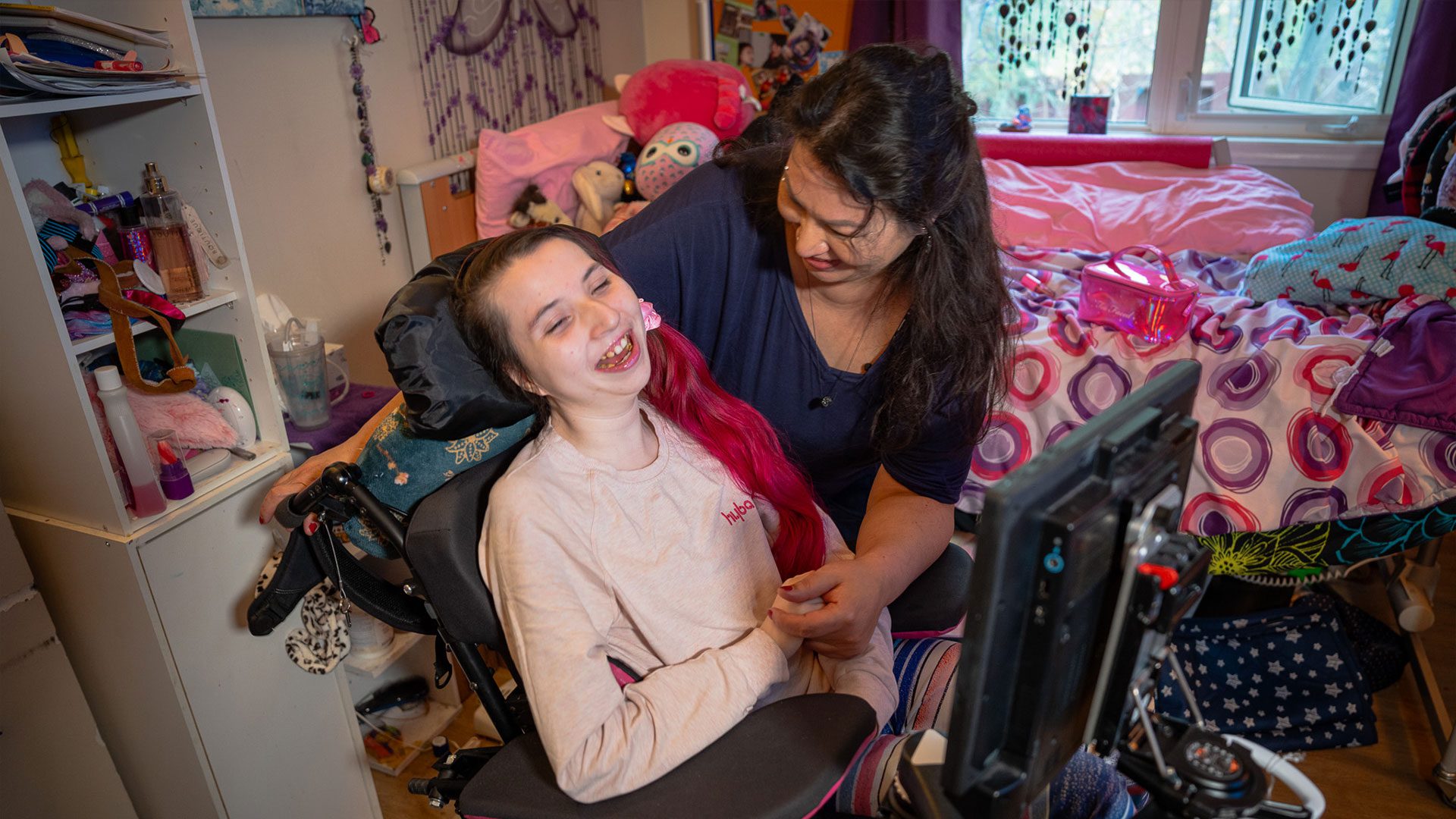 ‘Discrimination is so painful’ says Aisaican. Photo: Jordan Haslbeck/APTN.
It took all of Aisaican’s willpower not to snap back.
“Discrimination is so painful,” she said.
The barriers Indigenous people face can also be institutional.
During a meeting to submit a Jordan’s Principle application for Selena, Aisaican said a non-Indigenous employee repeatedly ignored her while making gestures to someone across the hall and discouraged her from submitting the application, suggesting it likely wouldn’t be accepted.
Shocked by the employee’s dismissive conduct, Aisaican left the meeting in tears.
She later submitted the application on her own and got it approved.
“It makes you feel like you don’t belong,” she said.
New collective aims to uplift Indigenous caregivers
Experiences like Aisaican’s are what drive Dr. Grant Bruno’s work to transform the landscape for Indigenous caregivers in Canada.
A member of the Samson Cree Nation and an assistant professor in the Department of Pediatrics at the University of Alberta in Edmonton, Bruno is the father of five children, two of whom are autistic.
He’s now spearheading the Indigenous Caregiving Collective (ICC), a three-year initiative with the CCCE that aims to support and connect Indigenous caregivers of neurodivergent children, starting with the four Nations of Maskwacîs.
While the program is tailored for caregivers of children, its broader vision includes supporting caregivers and care recipients of all ages.
“I recognize all the challenges that many of our families face, whether it’s jurisdiction, it could be isolation, it can be feeling overwhelmed, it could be not being able to get the right supports and services for your families,” Bruno said.
Launched earlier this year, the project is still in its infancy. The plan is to eventually establish a national network of Indigenous caregivers, Elders, health practitioners and more to share knowledge and advocate for better caregiving policies.
Bruno believes it’s the first project of its kind in Canada.
“I’m really hoping that it grows and that we find more support,” he said.
That support, he said, is needed now more than ever as Indigenous caregivers are in crisis mode.
Bruno said Indigenous families he’s encountered are often unable to access supports due to bureaucratic challenges linked to living on-reserve.
He said in some extreme cases, families have voluntarily given their children up as they don’t have adequate support or financial assistance to properly care for them. Those children, he said, can potentially be sent to non-Indigenous families who receive compensation for their care.
“They’re not putting the same amount of resources into our communities where the families should be,” he said.
He also noted Indigenous caregivers are struggling to navigate colonial systems that don’t recognize how their role is deeply rooted in culture, ceremony and kinship networks.
It’s an issue the ICC is hoping to change.
“I think it’s really important to recognize the strength that many, many caregivers carry,” he said. “Those strengths need to be celebrated as well because it’s not easy.”
Federal supports ‘just a token’
 ‘I think what this points to is that we really do not have adequate financial resources for caregivers,’ says Liberal MP Brendan Hanley. Photo: Jordan Haslbeck/APTN.
The federal government says it’s aware of the strain caregivers are facing.
Saskia Rodenburg, a spokesperson with Employment and Social Development Canada, said in a written statement that provinces and territories have ultimate jurisdiction over healthcare, and that the federal government is continuing to work with them “while respecting their jurisdiction.”
When asked if the federal government would ever consider implementing a paid caregiving program, she said the department couldn’t speculate on future policy decisions.
Another spokesperson with the department, Maja Stefanovska, said caregiving is a “pressing issue.”
She pointed to various federal supports that are designed to support family caregivers of adults with disabilities, including the Canada caregiver credit (CCC), EI caregiving benefits and the Disability Tax credit (DTC).
She noted the DTC can open doors to other programs like the Canada Disability Benefit and the Registered Disability Savings Plan (RDSP).
However, she acknowledged that none of the existing federal supports are intended to provide compensation to family caregivers.
Aisaican said while federal supports may look good on paper, they don’t offer any tangible benefits to ease the immediate pressure of caregiving at the level and quality she believes she provides.
She said she’s never been able to take advantage of non-refundable credits such as the CCC or DTC as she’s never owed income tax.
She also called the RDSP into question, noting that the funds can’t be accessed until the beneficiary turns 60, and that care recipients like Selena with life-threatening conditions may never live long enough to tap into the program.
“For me, it’s just a token,” she said.
Janeiro isn’t surprised.
He said federal supports aren’t effectively meeting the needs of caregivers who require them most, and despite two federal commitments to make the CCC refundable, that has yet to happen.
“It doesn’t work very well,” he said, noting only nine per cent of caregivers can actually access the credit. “This is something that caregivers desperately need.”
CCCE’s national strategy calls on the government to change the credit to refundable, something it argues would help 94,000 low-income caregivers.
“In 2021, 552,000 Canadians were entitled to receive the CCC. Currently, that entitlement only benefits people with taxes owing —approximately 17% of Canadians who file. The CCC should reach all caregivers,” it states.
The national strategy likewise advocates for a caregiver allowance for “high-intensity” caregivers who provide more than 35 hours a week of care.
“While some financial supports exist for caregivers, they do not provide nearly enough support for caregivers with high-intensity caregiving responsibilities—and the low incomes that often come with those responsibilities,” the strategy states. “Many caregivers providing over 35 hours a week of care are likely doing it at the expense of staying in paid employment with full-time jobs.”
Janeiro said CCCE is also recommending a $600 monthly allowance to begin with, a figure he noted is comparable to programs in the U.K. and Australia.
“We recognize that this is the beginning of a conversation, right?” he said. “So, $600 is a number that we felt was more doable, more practical to achieve in the shorter, medium term, and once it’s there, we can grow it.”
Yukon MP Brendan Hanley, who has met with Aisaican, said he supports CCCE’s push for a national paid caregiver program and agrees more federal action is needed.
“I think she makes a very compelling case for that,” he said. “I think what this points to is that we really do not have adequate financial resources for caregivers.”
Hanley said he’s heard from caregivers and other groups that the disability tax credit form is not user-friendly and can be difficult to fill out, and that additional supports outside tax credits could further benefit families – whatever that may look like.
“Whether or not it’s paid caregivers, we certainly need to address the inadequacy of financial support for caregivers in general,” he said.
Hanley noted that implementing CCCE’s strategy was a budget commitment made last year, which included forming a sectoral table on national caregiving.
“There’s a lot of language, both in the budget and in some of the federal actions about the caregiver economy, recognizing that this is a hugely under-recognized and underpaid economy,” he said. “Whatever recommendations come out of the sectoral table, (we need to ensure that’s) put into action.”
Caregivers wait for more action
Despite the many challenges in Aisaican’s path, she still has hope.
Last year she saved enough money to travel to Victoria, British Columbia, where she attended the Indigenous Disability Wellness Gathering.
Aisaican said the event was a reminder she’s not alone.
“That trip was just so meaningful,” she said. “It was a gold mine of connections and support and resources and things I never even knew existed.”
She said recent meetings with Hanley and the territorial government have been encouraging, and she also sees disability services’ commitment to review the Individualised Supervisory Care program as positive step.
The ICC likewise gives her encouragement.
“(That’s something) I’ve been looking for because we’re so isolated,” she said. “I’m always looking for connections.”
As it stands now, only time will tell how the federal government chooses to respond to the incredible challenges caregivers like Aisaican face, and if that response will, in fact, result in the change needed to reshape Canada’s caregiving landscape for the better.
Aisaican is hopeful that there will one day be a future where caregivers are better recognised, appreciated, and respected.
Until then, she plans to keep fighting, not only for herself, but also for her daughter.
“I’m her everything, and I would do it forever,” she said.
“I would choose that every single day.”
Report an Error
Tell us your Story
Continue Reading