
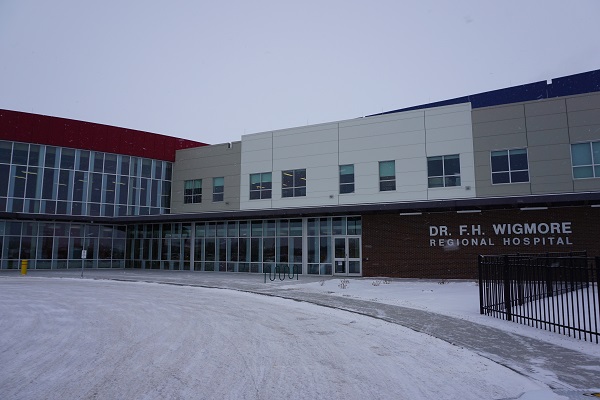
A leaked provincial safety risk report released by the Opposition NDP shows the Dr. F.H. Wigmore Regional Hospital’s emergency department is under severe strain, with capacity over 100 per cent and wait times ballooning.
Saskatchewan NDP Health Shadow Minister Meara Conway said the leaked “overcapacity safety risk level” data tracks hospital occupancy, available beds, emergency room volume and longest wait times.
According to her, the report shows Moose Jaw’s emergency department moved from high risk to very high risk over the past few days.
The hospital’s capacity exceeded 100 per cent during that time, and the longest wait times climbed from 33 hours on Sunday to 73 hours on Tuesday.
Conway said those figures were “distressing” and “unheard of” for a community hospital.
Safety risk report shows worsening strain
Conway said the report highlights mounting pressure on frontline health care services.
“That speaks to a system that is being strained to the absolute brink,” she said. “We’re concerned about the experience of patients waiting in these situations. We’re concerned about the distress of frontline healthcare workers having to work in these conditions.”
NDP calls on provincial government to act
Conway blamed multiple systemic issues for the crisis, including:
Lack of patient flow due to insufficient long-term care beds and home care options
Short staffing and failures in recruitment and retention
Social issues such as homelessness and addiction worsening pressures on emergency services
“We need action on all fronts, and we’re just not seeing it,” she said.
Conway called on Premier Scott Moe and provincial Minister of Health Jeremy Cockrill to lay out a plan to address the emergency department overload before the holidays, traditionally a time of increased strain on hospitals.
Staffing, beds and system failures
Asked what the plan should include, Conway described what she’s hearing from health care workers: a “picture of multiple system failures.”
“There’s the issue of the lack of patient, so lack of long-term care beds, home care options, affordable care for seniors, which is contributing to this,” she said.
“There are the issues of short staffing and the failure to effectively recruit and retain enough healthcare workers. There are all the social issues that we see the Sask. Party failing to address.”
Conway also said the government should expand rapid response services to help patients who don’t need to remain in hospital and overhaul its recruitment and retention strategy.
She argued stakeholders in health care have not endorsed the current plan.
Conway added that ongoing winter weather has made inter-hospital transfers more difficult, limiting “load level” or the practice of shifting patients between centres to ease strain.
“With the storm happening right now, there’s concern about that,” she said on Wednesday afternoon.
Conway reiterated that the situation in Moose Jaw is dire and urged immediate action from the provincial government.
Response from Saskatchewan Health Authority
The following written statement was given by Saskatchewan Health Authority Chief Operating Officer Derek Miller:
The Saskatchewan Health Authority (SHA) is committed to providing high quality, safe and accessible patient care to the people of Saskatchewan and would like to take this opportunity to thank our staff and physicians for the work that they do every day to help deliver care.
Interpreting internal documents which are used regularly by health system experts to inform decision making outside of their intended context should be done with caution. Wait times included in the report referenced measure the time from patient registration to discharge from the emergency department. These wait times do NOT represent the time patients wait to be assessed by a physician.
Hospitals across the province respond to patient ebbs and flows. The SHA monitors emergency department and acute care capacity across all hospital sites in the province on a continuous, real-time basis to support system-wide decision making, including transport decisions for patients who require a higher level of care or transfer to home hospital. This monitoring includes overall hospital occupancy, patients identified for admission and those being monitored in emergency departments. A scoring system is used to assess levels of risk and to guide appropriate actions at different thresholds.
The SHA is committed to meeting the needs of patients as close to home as possible, including during periods of increased demand, while ensuring patients can be safely transferred to appropriate facilities to meet their care need, and that our care teams are properly supported in these high demand situations.