
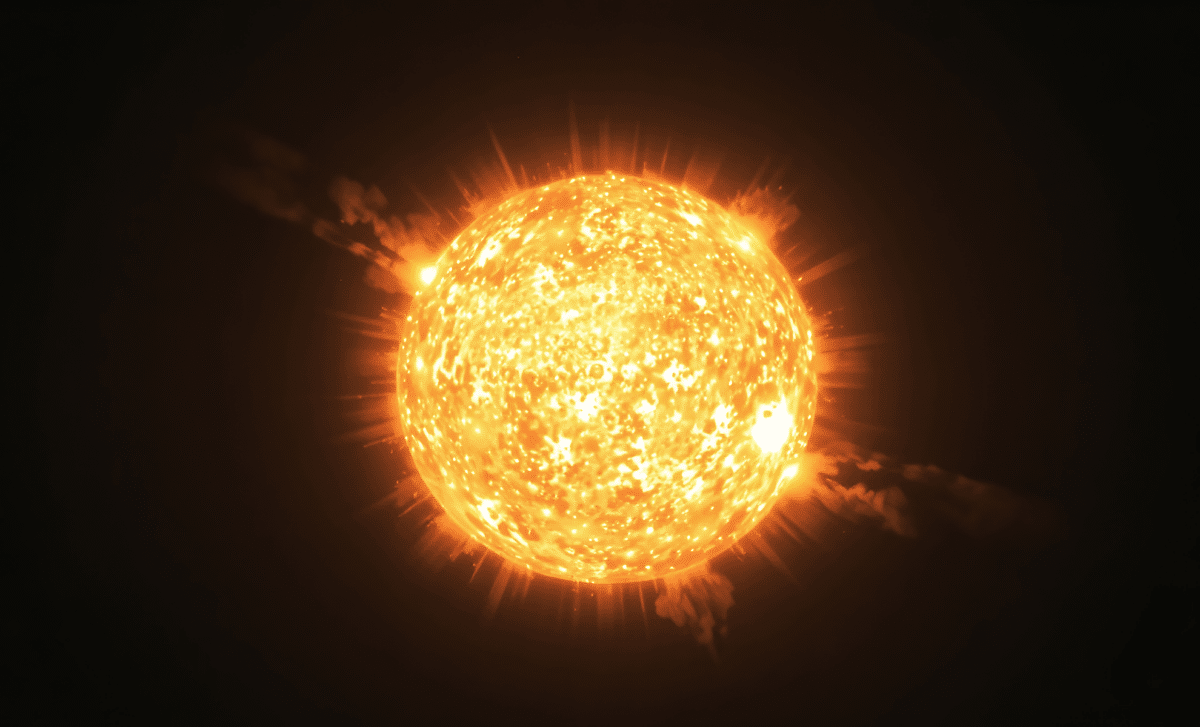
The Southwest Research Institute (SwRI) has unveiled groundbreaking results from NASA’s PUNCH mission, revealing a breathtaking, continuous view of the solar corona and solar wind in unprecedented detail. The study marks a milestone in heliophysics, offering scientists a clearer understanding of the Sun’s dynamic influence across the solar system.
A New Vision Of The Sun’s Majesty
For the first time, scientists have visualized the Sun’s corona and solar wind as one interconnected system, a long-sought goal of heliophysics research. Using a coordinated network of four spacecraft, the PUNCH (Polarimeter to Unify the Corona and Heliosphere) mission captures the ethereal dance of solar material as it expands outward, forming the invisible magnetic environment that envelops every planet.
“PUNCH imaging gives us a unique view on the pageantry of the planets and reveals the grandeur of our sun in the cosmos,” said Dr. Craig DeForest, principal investigator of the PUNCH mission at Southwest Research Institute.
These observations extend beyond the Sun itself, depicting planets, comets, and even the Moon as they interact with the solar wind.
The mission’s imaging data—spanning from the inner corona to interplanetary space—represents the most comprehensive visual coverage ever achieved. PUNCH’s panoramic view helps researchers track coronal mass ejections (CMEs) as they traverse space, a key advancement in predicting space weather events that can affect Earth’s technology and astronauts.
The “Golden Fishbowl” Of Our Cosmic Neighborhood
Through the mission’s sensitive imaging system, PUNCH has captured scenes reminiscent of classic space imagery yet filled with entirely new insight into the Sun’s continuous activity. “Seeing solar activity sweeping across the moon, planets and even passing comets gives us a sense of place in our solar system. It reminds me of the impact of the blue marble image of the Apollo era, though PUNCH data is more of a golden fishbowl view of our neighborhood in the cosmos. We live here,” DeForest explained.
The “golden fishbowl” metaphor encapsulates the mission’s immersive perspective. Unlike previous telescopes that viewed isolated portions of the Sun, PUNCH provides an unbroken cinematic sweep—tracing energetic clouds of plasma, tracking how solar storms interact with magnetic fields, and unveiling the intricate choreography of solar dynamics.
Unlocking The Science Of Space Weather
Beyond its visual marvels, PUNCH’s findings have major implications for space weather forecasting. As energetic solar events—such as coronal mass ejections—propagate through the heliosphere, they can disrupt communications, power systems, and spacecraft operations.
“PUNCH can actually show us directly the violence of space weather as clouds of electrons cross the solar system,” DeForest noted. “Viewing the corona and solar wind as a single system provides a big-picture perspective essential to helping scientists better understand and predict space weather. This forecasting is critical to protecting astronauts, space satellites and electric grid technology from these events.”
This integrated view helps scientists trace the full journey of solar eruptions from their origin to their far-reaching effects. The continuous data stream from the four PUNCH satellites allows near-real-time tracking of solar storms—something that ground-based observatories could never achieve.
Tracking Comets And Unexpected Discoveries
While PUNCH’s primary focus is on solar physics, the mission’s broad observational capabilities have led to surprising discoveries.
“The NASA Small Explorer’s mission had a bird’s-eye view of the CME in early November that lit up skies across the nation with colorful aurora,” DeForest said. “And we’ve discovered some incredible bonus science that PUNCH performs, tracking comets and other objects. We were able to track the third identified interstellar comet 3I/ATLAS as it traveled through the inner solar system while bright sunlight rendered it invisible to other telescopes and space assets.”
This capability demonstrates the versatility of PUNCH’s instruments, capable of detecting faint moving objects lost in the Sun’s glare. The detection of interstellar comet 3I/ATLAS—an object originating beyond our solar system—provides unique data on materials that formed around other stars.
The Southwest Research Institute, leading the mission’s design and operations, emphasizes that these findings expand the mission’s scientific reach far beyond its original scope. PUNCH’s long-term potential may include mapping the interplanetary dust environment, studying cometary tails, and contributing to future solar defense systems designed to mitigate space weather risks.