
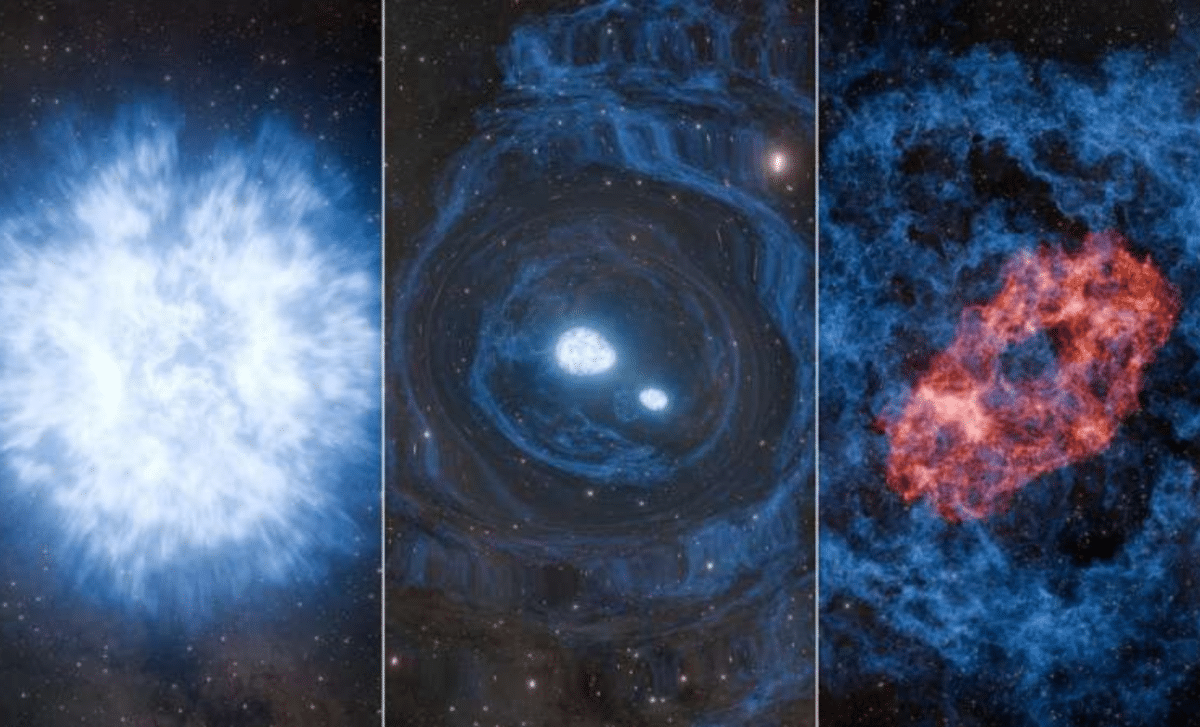
In an unprecedented discovery, astronomers might have observed the first known “superkilonova” – an explosive cosmic event that combines elements of both a supernova and a kilonova. This event, observed in August 2025, was initially thought to be a standard kilonova, but later observations revealed surprising traits. The groundbreaking study, published in The Astrophysical Journal, details how gravitational wave data and follow-up observations have led scientists to propose the existence of this new class of stellar explosion.
A Complex and Mysterious Event
The discovery, published in The Astrophysical Journal, began with the detection of a gravitational wave signal on August 18, 2025, recorded by the LIGO and Virgo observatories. The signal, named AT2025ulz, suggested the merger of two neutron stars. Neutron stars, the remnants of massive stars that have exploded in supernovae, are famous for their extreme density and gravitational pull. The initial excitement surrounding AT2025ulz came from its similarity to the groundbreaking 2017 kilonova event, GW170817, which had been observed across both gravitational waves and electromagnetic radiation. However, as astronomers turned their telescopes toward the source, they began to notice something unexpected.
“At first, for about three days, the eruption looked just like the first kilonova in 2017,” says Mansi Kasliwal, a professor of astronomy at Caltech and director of the Palomar Observatory. “Everybody was intensely trying to observe and analyze it, but then it started to look more like a supernova, and some astronomers lost interest. Not us.”
This shift from a typical kilonova to something more akin to a supernova prompted the researchers to keep their focus on the event, suspecting that they might be witnessing something entirely new.
Signs of a Supernova-Like Explosion
While kilonovas are the result of neutron star mergers, they typically generate a faint, brief burst of light with a red glow. This is because the merger produces heavy elements, such as gold and platinum, which block shorter wavelengths of light but allow longer wavelengths to pass through. The AT2025ulz event initially followed this pattern, showing the expected red glow. However, after a few days, the light from the event began to change unexpectedly.
The burst started to brighten and take on a blue hue, characteristic of hydrogen emissions. Hydrogen, typically associated with supernovae, had not been observed in kilonovae before, signaling that the explosion might have been more complex than a simple neutron star merger. Supernovae are much more energetic and can involve the explosive death of massive stars, but they typically do not produce gravitational waves of the intensity detected by LIGO. Thus, AT2025ulz’s gravitational wave signal raised questions about its true nature.
“While not as highly confident as some of our alerts, this quickly got our attention as a potentially very intriguing event candidate,” says David Reitze, the executive director of LIGO and a research professor at Caltech. “We are continuing to analyze the data, and it’s clear that at least one of the colliding objects is less massive than a typical neutron star.”
This finding suggested that something unusual had occurred during the merger—perhaps the presence of a less massive neutron star, which could have influenced the event’s observed characteristics.
The Hypothesis of a “Superkilonova”
The team, led by Kasliwal and others, began to consider a new possibility: that AT2025ulz could be a “superkilonova.” This theoretical event had been long speculated by astronomers but had never been observed. A superkilonova would occur when a neutron star merger is preceded by a supernova, the explosion of a massive star. The merger of the two neutron stars would generate a kilonova, but the earlier supernova explosion could obscure the view, complicating the event’s appearance.
The researchers speculated that the event’s change in color and the presence of hydrogen might indicate a supernova explosion obscuring the kilonova.
“The only way theorists have come up with how to birth sub-solar neutron stars is during the collapse of a very rapidly spinning star,” says Brian Metzger, a team member from Columbia University. “If these ‘forbidden’ stars pair up and merge by emitting gravitational waves, it is possible that such an event would be accompanied by a supernova rather than be seen as a bare kilonova.”
The idea of sub-solar mass neutron stars being formed in this way is one of the keys to understanding this potential superkilonova.