
How about some good news from the federal health department? New data from 2024 show that over 91% of clients in the federal Ryan White HIV/AIDS Program reach viral suppression. In other words, their viral load is undetectable. Nationally, about 67% of people diagnosed with HIV were undetectable in 2023.
People with HIV who adhere to their treatment regimen and achieve and maintain viral suppression experience slower disease progression, enjoy better overall health and are less likely to acquire opportunistic infections. What’s more, people with an undetectable viral load don’t transmit HIV to others through sex. This is known as treatment as prevention, or Undetectable Equals Untransmittable (U=U).
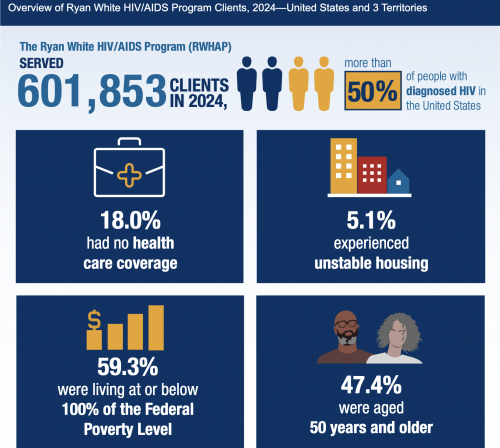
A graphic of data from the 2024 Ryan White HIV/AIDS Program Annual Data ReportCourtesy of ryanwhite.hrsa.gov
According to the new 2024 Ryan White HIV/AIDS Program Annual Data Report, the “continued, steady improvements in viral suppression could be due to innovations in care delivery, such as rapid antiretroviral therapy (rapid ART) or new medication options (e.g., two-drug combinations, long-acting injectable medications).”
The report shows that 47% of Ryan White clients are 50 or older, 75% are members of racial or ethnic minorities and nearly 50% are covered by Medicaid and/or Medicare. Of note, the report did not include data on LGBTQ people—including transgender people—who are living with HIV and receiving Ryan White support, although this population is disproportionately affected by the epidemic. (Scroll down for a deeper dive into the report’s findings.)
In 2024, a total of 601,853 clients received services from providers funded by Ryan White—the most ever served in the agency’s 35-year history, according to a federal press release about the report. This accounts for over half of people diagnosed with HIV in the United States. (About 1.2 million people are living with HIV in the United States, and it’s estimated that about 13% of them don’t know they are positive. What’s more, nearly 40% of new HIV cases are transmitted by people who don’t know they are HIV positive.)
The federal Ryan White HIV/AIDS Program provides HIV services for low-income people by funding cities, counties, states and local community-based organizations that provide HIV care, treatment, prevention and essential services.
The Ryan White HIV/AIDS Program is administered by the HIV/AIDS Bureau within the Health Resources and Services Administration (HRSA), which is part of the Department of Health and Human Services (HHS). Health Secretary Robert F. Kennedy Jr. leads the HHS and its many agencies, including the Centers for Disease Control and Prevention and the Food and Drug Administration.
Despite the successes highlighted throughout this latest report, the Trump White House and Republican leaders in Congress aim to gut federal HIV funds. For more, see “If Congress Ends Ryan White HIV Services, How Many Americans Will Contract HIV?” (The answer: Researchers predict a 49% spike in cases—or 75,000 excess HIV diagnoses—by 2030.)
Data in the latest Ryan White report include calendar years 2020 through 2024, before the current Trump administration took the proverbial chainsaw to federal and global health funds while also attacking programs that support diversity, equity and inclusion (DEI).
Below are the report’s highlights about the Ryan White HIV/AIDS Program (referred to as RWHAP):
• The RWHAP serves over 600,000 people. In 2024, a total of 601,853 clients received services from RWHAP-funded providers, an increase of more than 40,000 clients since 2020. In 2024, people aged 50 years and older accounted for 47.4% of all RWHAP clients. People aged 65 years and older accounted for 13.4% of all RWHAP clients, an increase from 9.5% of clients in 2020.
• Retention in care remained relatively stable at nearly 80% year-to-year from 2020 through 2024. In 2024, 78.7% of 374,823 patients receiving medical care were retained in HIV care.
• More than 91% of RWHAP patients who received outpatient ambulatory health services (OAHS; meaning that clients didn’t check into a hospital) reached viral suppression in 2024. In 2024, 91.4% of 392,148 RWHAP patients who received OAHS and had viral load information had a suppressed viral load at their most recent test.
Men had slightly lower viral suppression (91.2%) than women (91.8%). Young people aged 15−29 years made great progress in improving viral suppression from 2020 through 2024. In 2024, viral suppression was 85.9% among patients aged 15–19 years and 86.4% among those aged 20–24 years. Although these percentages are the lowest by age group, they reflect increases of more than 5 percentage points for each of these groups from 2020 through 2024. Among older adults aged 50 years and older, viral suppression (94.1%) was higher than the national RWHAP average (91.4%). Among older adults, viral suppression was lowest among patients experiencing unstable housing (83.0%), especially among Black/African American older adults (81.7%), Hispanic/Latino older adults (84.5%) and White older adults (84.2%), or aged 50–54 years and American Indian/Alaska Native (89.8%) or Black/African American (90.5%).
• Three quarters of RWHAP clients are from racial and ethnic minority groups. In 2024, 75.1% of clients self-identified as Black/African American, Hispanic/Latino, American Indian/Alaska Native, Asian, Native Hawaiian/Pacific Islander, or people of multiple races. Nearly one quarter (24.9%) self-identified as white.
• More than half of RWHAP clients are living at or below 100% federal poverty level (FPL). In 2024, 59.3% of clients were living at or below 100% FPL. In 2024 in the contiguous United States, individuals earning $15,060 were considered at 100% FPL, and households/families of four earning $31,200 were considered at 100% FPL.
White clients had the lowest percentage of clients living at or below 100% FPL (50.3%), and American Indian/Alaska Native clients had the highest percentage of clients living at or below 100% FPL (68.9%) Nearly two thirds of female clients were living at or below 100% FPL (67.1%), and 56.7% of male clients were living at or below 100% FPL
• Nearly 50% of RWHAP clients are covered by Medicare and/or Medicaid, and 18% lack health care coverage. Approximately 30% were covered by Medicaid (29.8%), 10.7% were covered by Medicare, and 6.9% were covered by both Medicaid and Medicare (dual eligibility). In addition, 12.0% had private individual coverage, and 10.2% had multiple forms of coverage (i.e., any combination of health care coverage types, except those who had both Medicaid and Medicare).
Nearly one fifth (18.0%) of RWHAP clients had no health care coverage in 2024, which is slightly lower than in 2020 (19.4%). Clients ages 20–29 years had the highest percentage of clients with no health care coverage (20–24 years: 30.3%, 25–29 years: 31.0%). Clients aged 65 and older had the lowest percentage of clients with no health care coverage (5.3%), likely due to enrollment in Medicare.
• More than 1 in 10 RWHAP clients are experiencing temporary or unstable housing. In 2024, 7.9% of clients experienced temporary housing and 5.1% of clients experienced unstable housing.
The Ryan White HIV/AIDS Program launched in 1990 after Congress passed the Ryan White Comprehensive AIDS Resources Emergency (CARE) Act. It’s named after the Indiana teenager with hemophilia who at age 13 contracted HIV through a blood transfusion in 1984, during the early days of the epidemic. He died in 1990, a month before his high school graduation. Ryan White and his mom, Jeanne White-Ginder, made global headlines as outspoken AIDS advocates after he was kicked out of school and the family was discriminated against because of his HIV status. (His mother gave an inspiring speech at the U.S. Conference on HIV/AIDS in September.)
“For 35 years, HRSA’s Ryan White HIV/AIDS Program has transformed HIV from a death sentence into a manageable chronic condition by ensuring access to comprehensive care, medications, and essential support services nationwide,” said HRSA administrator Thomas Engels in the HHS press release on the new report. “Today’s data underscore the critical role of the Ryan White HIV/AIDS Program in improving health outcomes in communities across the country.”