
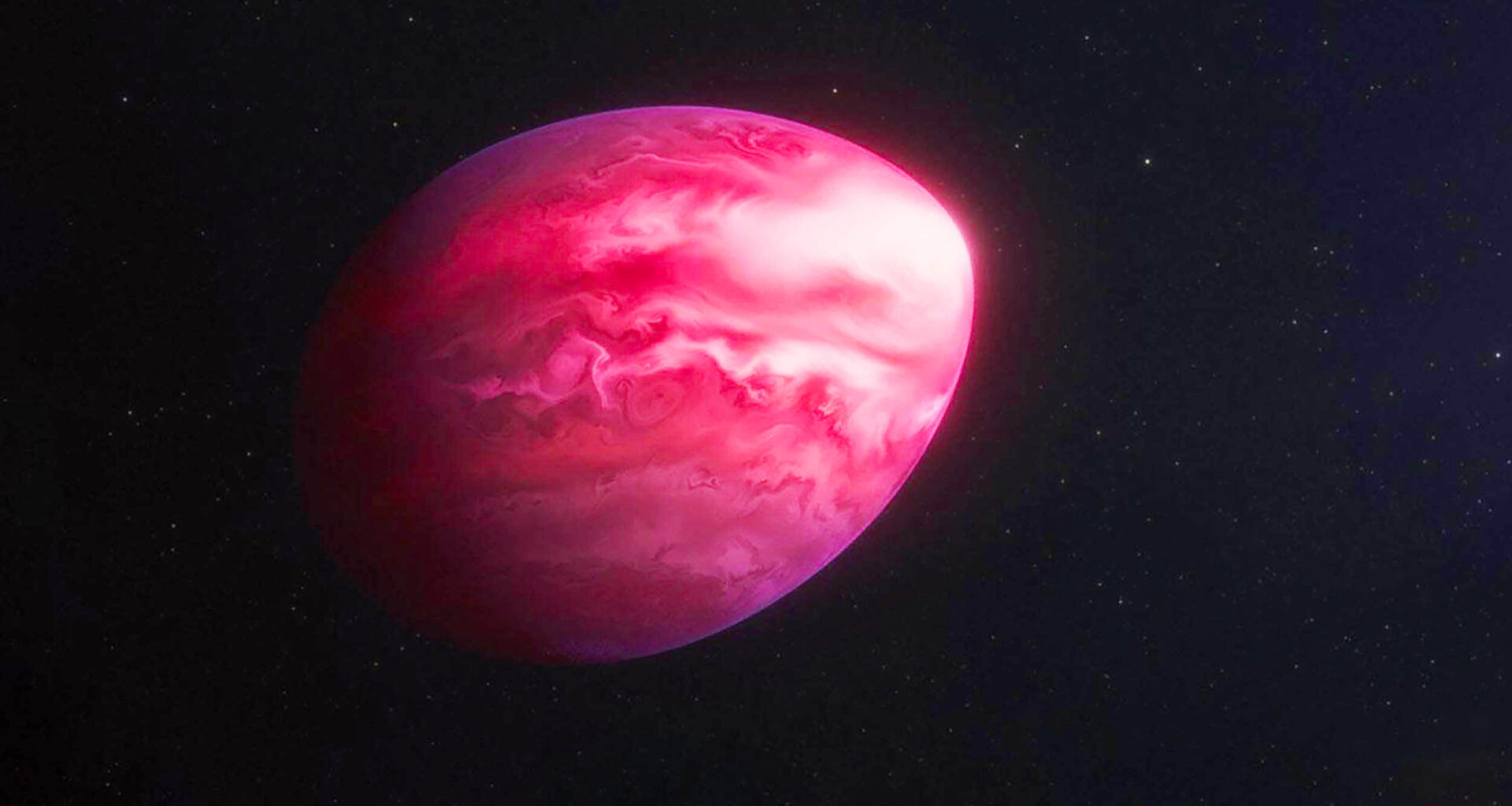
Astronomers spotted an object that looks like a planet, weighs about as much as Jupiter, and yet behaves like nothing anyone has seen before.
This strange world sits dangerously close to a dead star. Its air is filled with carbon instead of water vapor. Sooty clouds drift through its skies.

Even its shape is warped, stretched by gravity into something closer to a lemon than a sphere. It is the kind of find that makes scientists stop, stare, and admit they don’t have a neat explanation.
Meet PSR J2322-2650b
All known planets have some basic properties. Gas giants have thick atmospheres composed mostly of hydrogen. Rocky planets contain oxygen, water, or carbon dioxide. This object defies all of that.
Officially named PSR J2322-2650b, the atmosphere consists largely of helium and carbon.
Sooty clouds of carbon abound in the atmosphere, while extreme pressure can occasionally convert carbon into diamonds. The mix is so unusual that it sets the planet apart from anything seen before.
“Instead of finding the normal molecules we expect to see on an exoplanet – like water, methane, and carbon dioxide – we saw molecular carbon, specifically C3 and C2,” said Michael Zhang, the principal investigator of the study from the University of Chicago.
This planet also circles a neutron star, one of the densest objects in the universe. Neutron stars are what remain after massive stars explode.
“The planet orbits a star that’s completely bizarre – the mass of the Sun but the size of a city,” said Zhang. “This is a new type of planet atmosphere that nobody has ever seen before.”
Planet seen without its star
Neutron stars known as pulsars spin rapidly and send out narrow beams of radiation. These beams sweep through space at steady intervals, sometimes just milliseconds apart.
Most of that radiation comes in high-energy forms like gamma rays, which the James Webb Space Telescope cannot detect.
That limitation works in the scientists’ favor. Because Webb cannot see the pulsar itself, the planet’s light stands out instead.
The planet remains fully illuminated by its star, but the star does not overwhelm the signal. This allows researchers to capture an unusually clean and detailed spectrum of the planet across its entire orbit.
With the host star effectively invisible, the planet’s atmosphere becomes easier to study than most known exoplanets. What emerged from those observations was unexpected and unlike anything seen before.
Close enough to be torn apart
PSR J2322-2650b hugs its star at a distance of just one million miles. For comparison, Earth sits about 100 million miles from the Sun. This tight orbit gives the planet a year that lasts only 7.8 hours.
That closeness comes at a cost. The neutron star’s gravitational pull weakens the planet considerably. Brightness changes across its orbit suggest the planet is being tugged into a lemon-like form rather than staying round.
The pairing also places this system in rare company. Together, the star and planet resemble what astronomers call a black widow system.
In these setups, a fast-spinning pulsar slowly erodes its companion with intense radiation and particle winds. Over time, the smaller object can be stripped down or even destroyed.
Like the spider, the pulsar consumes its partner. In most known cases, that partner is a small star. Here, the International Astronomical Union classifies the companion as an exoplanet. That classification only deepens the mystery.
“Did this thing form like a normal planet? No, because the composition is entirely different,” said Zhang.
“Did it form by stripping the outside of a star, like ‘normal’ black widow systems are formed? Probably not, because nuclear physics does not make pure carbon.”
PSR J2322-2650b’s atmosphere
One idea suggests the planet may have started out very differently, then changed under extreme heat, pressure, and radiation. As the object cooled, materials inside could have separated in unusual ways.
“As the companion cools down, the mixture of carbon and oxygen in the interior starts to crystallize,” said Roger Romani from the Kavli Institute for Particle Astrophysics and Cosmology.
“Pure carbon crystals float to the top and get mixed into the helium, and that’s what we see. But then something has to happen to keep the oxygen and nitrogen away. And that’s where there’s controversy.”
There’s no consensus yet. Each explanation solves one problem while raising another. For scientists who study extreme systems, that’s part of the appeal.
“But it’s nice to not know everything,” said Romani. “I’m looking forward to learning more about the weirdness of this atmosphere. It’s great to have a puzzle to go after.”
Next steps for PSR J2322-2650b
This discovery depended on the James Webb Space Telescope doing what ground-based telescopes can’t.
Webb orbits about a million miles from Earth and stays extremely cold behind its massive sunshield. That cold environment is critical for infrared observations.
“On Earth, lots of things are hot, and that heat really interferes with the observations because it’s another source of photons that you have to deal with,” explained Zhang. “It’s absolutely not feasible from the ground.”
PSR J2322-2650b may not fit into current planet categories. It may force new ones to exist.
For now, it stands as a reminder that the universe is under no obligation to follow our expectations, and sometimes the strangest worlds teach us the most.
The full study was published in the journal The Astrophysical Journal Letters.
—–
Like what you read? Subscribe to our newsletter for engaging articles, exclusive content, and the latest updates.
Check us out on EarthSnap, a free app brought to you by Eric Ralls and Earth.com.
—–