


Photo-Illustration: Vulture; Photo: Netflix
Early on in Jay Kelly, the title character, a movie star played by George Clooney, runs into his old roommate from his acting-school days at a funeral. Timothy Galligan (Billy Crudup) never made it in the business and is now a child therapist. But back when they were both starting out, he was the one whom everyone admired. Over drinks at a bar they used to frequent, Jay reminisces about how Timothy could make anything compelling, even a menu, then coaxes his former friend to do exactly that. As Jay watches, rapt, Timothy summons the memory of something meaningful to him, and tears spring to his eyes as he starts gutturally reciting “Truffle Parmesan fries … Brussels sprouts with balsamic-honey glaze” as though it were a monologue from Death of a Salesman.
It’s a party trick, but it’s also a line that the film draws between the types of performers the two men represent. Timothy may have real talent, but Jay was the one who became famous because of looks and luck and a touch of ruthlessness but also because he has been anointed with that ineffable quality that makes people want to bask in his presence, even if it’s just through a screen. Timothy is an actor, he’s method, but Jay is a movie star. He has something that can’t be taught, and he’s started to wonder if that means that he doesn’t actually deserve it.
Clooney isn’t playing himself in Jay Kelly. Clooney isn’t single after a string of failed marriages the way Jay is, Clooney doesn’t have two adult daughters who are varying degrees of estranged from him, and Clooney isn’t so untethered that his only real friend is his manager, Ron (Adam Sandler). But Jay is close enough to Clooney to make you wonder at how much of the high-end existential crisis that unfolds on the screen could be the man’s own. Their names even exist in parallel, pairing the same sets of starting sounds designed to only be spoken in full. “Zhay Kelly!” the crowds in Paris murmur in excitement when they see him at a train station, a scene that recalls the story Clooney likes to tell about the time he got in a terrifying motorcycle accident in Italy in 2018, and onlookers gathered around with their phones out: “They were like: A-George Clooney!”
Jay is, like Clooney, not merely famous but beloved, the kind of celebrity people can’t aspire to be like; they can only fathom being around. He is also, like Clooney, someone who gets accused of playing variations of himself on screen — a familiar saw used to describe a certain type of performer we nevertheless appreciate. It’s true that Clooney has never been the type to disappear into a role. But the best evidence that Clooney isn’t always playing himself, and especially not here, is that the angst Jay feels over whether he’s just been fortunate his entire life is much less interesting than Clooney’s own long history of feeling conflicted about his own status.
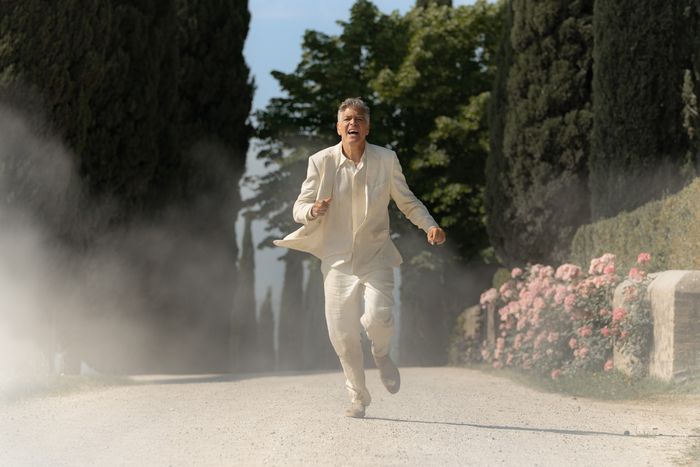
George Clooney in Jay Kelly.
Photo: Peter Mountain/Netflix
Another thing people reflexively say about George Clooney is that he’s one of the last old-school movie stars, a man who harkens back to an earlier time in Hollywood, with his chiseled jaw and beautiful suits and air of gracious sophistication. He’s an emissary of an era in which stars were not just like us but instead made an agreeable pretense of being better — more beautiful and more glamorous but also possessing an ease that comes with keeping some distance between themselves and the public. While Tom Hanks leaned into being our answer to Jimmy Stewart, an everyman who was also larger than life, Clooney emerged as a contemporary Clark Gable (whose Tudor-style mansion Clooney lived in for years): masculine, impish, celestial.
But part of the delicate dance that is being George Clooney means never being so hubristic as to make those comparisons himself. “We don’t want to be compared to those two guys. They’re icons,” he protested to GQ in a joint interview with Brad Pitt when asked which of the Wolfs stars is Robert Redford and which is Paul Newman. When Clooney brings up Spencer Tracy and Cary Grant, it’s not to put himself alongside them but to talk about them as legends. “They’re not as long as you think they are,” he said of their careers in a profile in GQ. “As time goes on, it’s boring to just be an actor.” Clooney’s notably good at speaking frankly about movie stardom — it’s one of his greatest tricks in interviews, a way of putting his examiner and himself on equal footing as joint observers of his incredibly favored life.
It’s tempting to think of Clooney as someone who was born jetting around Lake Como in perfectly tailored Armani without a tie. But unlike Jay Kelly, for whom doors opened after landing a breakout role as a young hotshot in an acclaimed movie, Clooney rattled around in low-budget movies and in guest spots on TV shows for years. He played his own evil twin on the motorcycle-cop drama Street Hawk. He starred in the schlock sequel Return of the Killer Tomatoes. He didn’t vault into fame but arrived at it eventually, aged into it like someone who was only ever meant to read as a grown-up on screen. The relaxed confidence he exudes in roles and on press tours is more of a self-fulfilling prophecy than an indicator of actual effort. He’s worked hard to make things look so easy.
At the age of 33, Clooney was the oldest of the original cast members on ER. The medical drama was a network hit that made him a household name, but it aired at a time when television was regarded as a JV form of renown. When Clooney makes his entrance as devoted pediatrician and compulsive ladies’ man Doug Ross, showing up drunk to the hospital so his co-workers can give him an IV of fluids, he appears with a full head of brown hair. Watching the 1994 pilot today, it’s startling. Clooney’s subtle grays have been such a core part of his movie-star image that when he got an awkward dye job earlier this year to play Edward R. Murrow in the Broadway production of Good Night, and Good Luck, adapted from his own 2005 film, he couldn’t stop joking about it, like he was Samson shorn of his silvery temples.
When Clooney attempted to transition to varsity league, the movie roles he ended up in didn’t always match his capabilities, leading some to label him a lousy actor. He’s told a story about getting advice from Steven Spielberg on the set of ER. The advice was to not move his head around so much when acting. Clooney was an infamously lousy fit for Bruce Wayne in Joel Schumacher’s campy Batman & Robin (1997), and he’s since turned apologizing for his superhero turn into a talk-show bit. He made for a middling romantic-comedy lead in One Fine Day (1996), matching Michelle Pfeiffer in terms of beauty but also coming across as interchangeable. He ended up being forgettable in The Peacemaker (1997), too, playing a competent intelligence officer who could have been airlifted in from countless other military thrillers. Clooney was no David Caruso, who famously flopped at his attempt to become a big-screen leading man after NYPD Blue. But when you look at the stretch of movies Clooney made in the wake of leaving ER, it’s not hard to imagine a world in which he fizzled in the ’90s. Being effortlessly charming isn’t enough to guarantee the movie you’re in is actually worth watching.
It was his work with Steven Soderbergh, who understands star wattage like no other filmmaker working today, that cemented his spot in the Hollywood stratosphere. As bank robber Jack Foley in 1998’s Out of Sight, Clooney manages to be just as captivating convincing a bank teller to hand over an envelope full of cash as he is romancing Jennifer Lopez’s character at a hotel bar on a frigid night in a snow globe of a sequence in which the pair’s verbal jousting is as sexy as the intercut images of them tumbling into bed. Then as Danny Ocean, the mastermind behind the heists in the Ocean’s trilogy (2001, 2004, 2007), he’s irresistible, delivering an earnest speech about how the house always wins to his platonic soulmate Rusty Ryan (Pitt), then breaking and chummily undermining the drama of the moment when he’s called out about having practiced it (“Did I rush it? It felt like I rushed it”).
Soderbergh isn’t shy about drawing parallels between heists and filmmaking throughout those three pictures — there’s a whole gag in the second one in which Julia Roberts, as Tess, pretends to be Julia Roberts, the movie star. Soderbergh understands the particular playfulness around acting; how a great actor can help turn the juice on and let his audience in on the joke.
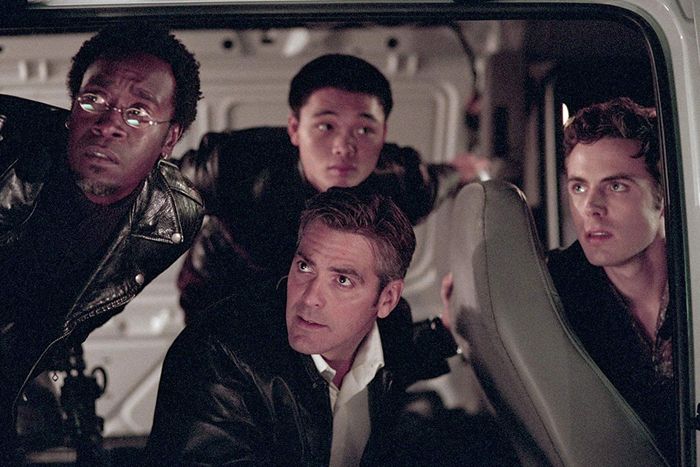
George Clooney in Ocean’s Eleven.
Photo: Warner Bros.
Clooney gives good lovable rogue, a descriptor that could be applied to the majority of his roles, though some of his most endearing work has played off his handsomeness and ability to get by on charm as much as they’ve leaned into it. His most acclaimed role, in Michael Clayton, is as shaped by his charisma as some of his more obviously starry turns, underscoring the ways in which his shady law-firm fixer is someone who seems like he should have amounted to more, that he should be occupying a corner office instead of working in the shadows. The Coen brothers like to cast Clooney as venal types whose egos could stand some puncturing after getting too accustomed to gliding through life — as escaped convict Ulysses Everett McGill in the Odyssey-inspired period musical O Brother, Where Art Thou?, fast-talking divorce attorney Miles Massey in screwball comedy Intolerable Cruelty, and blustering U.S. marshal Harry Pfarrer in the D.C. satire Burn After Reading.
As dim-bulb actor Baird Whitlock in Hail, Caesar!, he has a scene that echoes that speech in Ocean’s Eleven. Baird, starring as a Roman soldier in a biblical epic, is filming a scene in which he stands in front of a crucified Jesus to give a monologue about how an earlier encounter with the man sparked a religious awakening. As he delivers his lines, face bronzed to a burnt sienna, eyes alight courtesy of the spotlights reflected in his pupils, we watch the jaded crew members who take notice, and nod along, and show signs of being visibly moved.
But just as Baird ramps up toward his big finish, voice quavering with emotion as he talks about “a truth beyond the truth we can see,” he forgets the end of his climactic line, and the spell is hilariously broken. The scene is the reverse-image version of Timothy Galligan crying while reading the bar menu, a demonstration of how you can have the audience in the palm of your hand even as you’re parroting words you have so little connection to that the obvious conclusion (“Faith!” Baird hollers in frustration when he’s reminded, “Faith!!”) slips your mind.
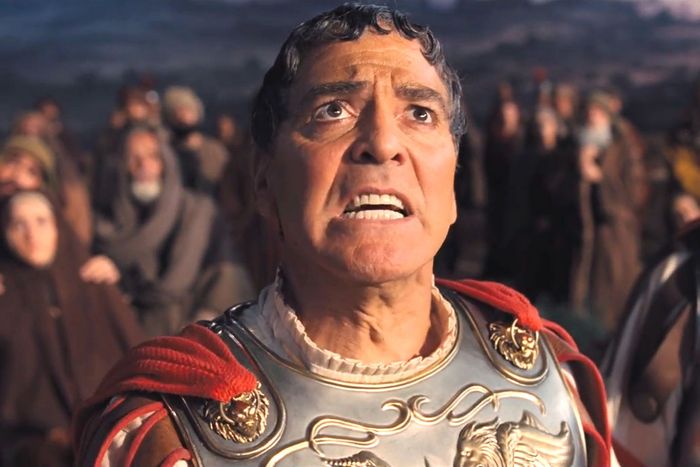
George Clooney in Hail, Caesar!
Photo: Courtesy of Universal Studios
That fear of being an empty suit, a lightweight who’s coasted by on surface appeal and who has nothing much going on underneath, is the most piquant aspect of Jay Kelly, and it’s a fear that seems to have animated more of Clooney’s choices as he’s gained greater say over the roles. He’s tried to distance himself from the charm that comes so easily to him, or prove that, if not someone capable of chameleonic range, he’s someone who could put that quality on a dimmer switch, turning it all the way down to play CIA officer Bob Barnes in Syriana, the role that won him his first Oscar, and one for which, in a classic demonstration of actorly seriousness, he gained weight.
But the way in which Clooney has exerted the most control over his output onscreen — his forays into directing — also make up the least interesting slice of his filmography. Clooney made his debut behind the camera in 2002 with Confessions of a Dangerous Mind and has directed eight other features since. As a filmmaker, he’s studiously unexceptional, skewing toward true stories rendered in handsome historical detail like the aforementioned Good Night, and Good Luck, the inspirational rowing pic The Boys in the Boat, and the WWII movie The Monuments Men. There’s no aspect of his career that feels more shaped by a desire to prove himself, whether he’s highlighting a fight against McCarthyism or attempting to tackle racism in his major misfire, than the 2017 thriller Suburbicon.
The fact that something comes easily doesn’t mean it’s without value, but it does feel like Clooney takes his own magnetism for granted. It’s why he does things like cast himself in The Midnight Sky, which he also directed, in a part that consists of him trudging morosely around the Arctic by himself, as though having traveled to the ends of the earth to escape his own allure.

George Clooney in The Midnight Sky.
Photo: Netflix/
When he and Pitt reunited last year for the just-good-enough Wolfs, in which they once again played bickering underworld professionals, the press conference the pair did at the Venice premiere ended up being a better showcase of his ability to win over a crowd than the film itself. Jay Kelly stack the decks against its character by portraying him as really having nothing meaningful going on in his personal life — unlike the man playing him, who’s testified before Congress about the border between Sudan and South Sudan, written op-eds in the New York Times, and married and started a family with famed human-rights attorney Amal Alamuddin. (Charli XCX, in the Substack she launched last month, has the grace to admit that “One of the main realities of being a pop star is that at a certain level, it’s really fucking fun.”)
Jay’s is a more trite depiction of movie-star angst than what the actual movie star at its center wrestles with, one that concludes with Jay getting weepy over a montage of his work, which is actually Clooney’s work — a strange selection, possibly because of licensing costs, heavy on single-second snippets and shots of Clooney walking down hallways and away from explosions.
The more revealing scene is the one in which Jay insists on buying tickets on the same train that he suspects his teenage daughter will be taking as part of a summer backpacking trip with her friends. To the consternation of his beleaguered team, there’s no first-class space in which their client can be cordoned off from everyone else, and Jay piles right in with the locals and the vacationers. There he is, like a god who’s stepped down from Olympus to mingle with the mortals, making small talk with a couple about their vacation and joking about using the same toilet as everyone else. He even pauses in the aisle to hold court, asking the crowd “So, what do you all do? Where are you all going?” and answering every called-out response with something he has in common.
Rather than be made uncomfortable by the attention, Jay soaks it up, seeming to become even more at ease and far more himself than he is when he’s alone. Clooney, silver-gray hair gleaming, eyes crinkling at the corners, sells you on something more resonant than the secret loneliness of the astoundingly privileged celebrity, which is the contradiction of his charm. You believe that people feel that Jay is somehow a higher class of human being, and one who is even more special for his willingness to pretend otherwise while rubbing shoulders with the public.