

Mercedes have been discussed as 2026 favourites for some time, long before this season’s Championship concluded.
Their impressive track record, combined with statements of confidence from drivers helped shaped this narrative. Over the last few days, however, more concrete information about the team’s 2026 development has emerged.
Along with Red Bull powertrains, Mercedes are understood to have found a grey area in the regulations to capitalise on.
For more reasons than one, the FIA’s decision on this solution could define the next era of Formula 1. Not for the first time, Mercedes are front and centre.
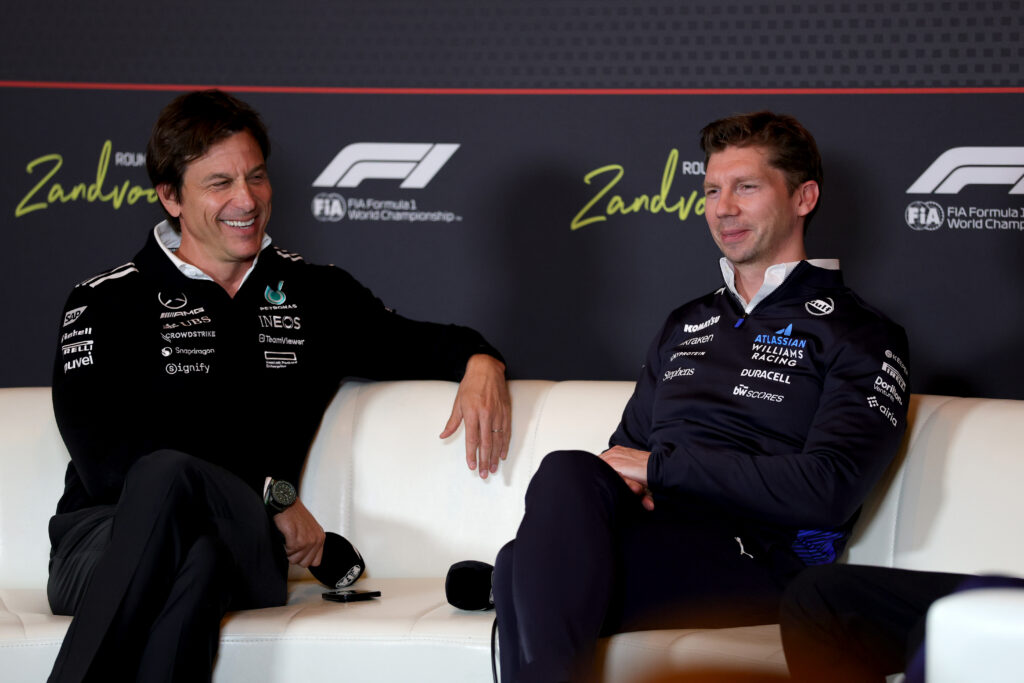 Toto Wolff and James Vowles, Dutch Grand Prix, Friday.
First real substance to 2026 Mercedes hype
Mercedes knew their chances of fighting for a Championship this year were slim. Because of this, among the front-runners, the Brackley squad were swift to prioritise 2026 development.
In terms of aerodynamic development and concept work, the Silver Arrows abandoned this year’s W16 relatively quickly.
Regarding their power unit, Mercedes – like other manufacturers – have worked towards these regulations for several years. Crucially, though, their infrastructure and quality of personnel puts them in a very strong position.
It is no accident that Red Bull proactively recruited so many engineers from Mercedes to join their new powertrains division.
All things considered, there has been a lingering sense that the German manufacturer could have a notable benefit at the beginning of 2026. Of course, team principal Toto Wolff has routinely described this scenario as highly improbable.
Somewhat unsurprisingly, with reports circulating about Mercedes and Red Bull finding a work-around to use thermal expansion to increase their compression ratio from 16:0 to 18:0, the Silver Arrows have been reinforced as favourites.
Whilst Red Bull are also pursuing this unique approach, Mercedes are understood to be further along in their development and refinement of this idea. Therefore, if the FIA decide this innovation is legal, Mercedes engines would be the main beneficiaries.
This is also very relevant for the Brackley-based operation’s customer teams.
In the case of McLaren and Williams, two teams with aspirations of fighting at the front, a strong Mercedes engine would further boost their chances. With Alpine also running the German team’s power units next year, the FIA’s decision on compression ratio will have immense consequences.
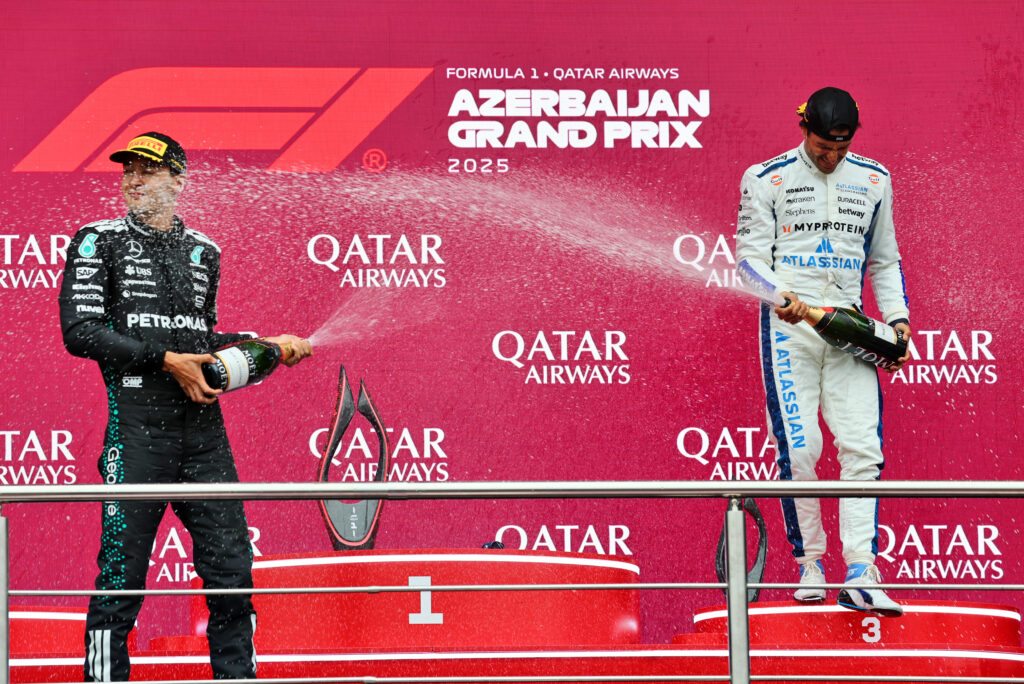 George Russell with Carlos Sainz (ESP) Atlassian Williams Racing.
A critical stage for every manufacturer
There are numerous estimates being floated about the lap-time Mercedes and Red Bull’s engines can achieve from their approach. Given that 2026 is largely unknown territory, nothing is certain until the cars circulate on track.
Still, it should be noted that pure horsepower is not the only factor at play.
Next year’s F1 machines will also use carbon-neutral fuels. Teams have different fuel suppliers, and work closely with these partners to optimise interaction between the fuel and the engine.
It is expected that greater synergy between fuel and power units could not only impact performance, but also reliability. Partly because of this, Aston Martin’s partnership with Aramco (who supplied sustainable fuels in F2 last season) is seen as noteworthy.
Returning to Mercedes, they are the leaders in this controversial power unit idea. Depending on the official FIA verdict, their chances in 2026 – alongside their customers – could be greatly altered.
For other manufacturers, the Silver Arrows’ willingness to push the limits is a signal of their intent.
A fresh set of regulations provides immense opportunity for innovation and creative interpretations. Simultaneously, it creates an environment where teams move swiftly when they believe rivals have gone out of bounds.
As a result, the next developments on the Mercedes and Red Bull engine controversy are already critical for 2026 and beyond.
READ MORE: Ferrari, Honda, Audi want answers on Mercedes and Red Bull engine trick
Main photo: LAT Images (Mercedes F1 Media Archive)