
Breadcrumb Trail Links
But individual donors still contribute more in revenue, and some question ethicality of using gambling for health care
Published Dec 22, 2025 • 10 minute read
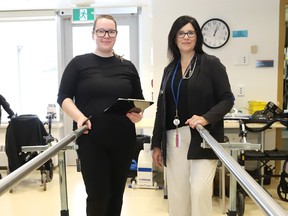
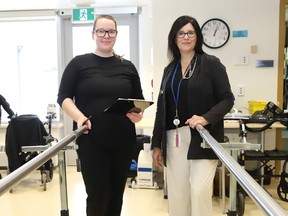 Dr. Jo-Anne Clarke, right, geriatrician and medical lead at the Acute and Reactivation Care Centre at Health Sciences North, meets with reactivation worker Sarah McColeman. Photo by John Lappa/Sudbury StarArticle content
The halls of Health Sciences North’s acute and reactivation care centre hum with life. Here, elderly patients practise walking, stretching and moving with therapists, all in an effort to regain independence. The 52-bed unit opened in 2023 and was made possible in part by $2.3 million from the HSN 50/50 lottery — funding that helped bring this specialized approach to life.
Advertisement 2
This advertisement has not loaded yet, but your article continues below.
Article content
“We created a model of care that specifically targets the conditions and complexities of older adults,” says Dr Jo-Anne Clarke, a geriatrician, the unit’s medical director and also the lead at the North East Specialized Geriatric Centre. Older adults are at high risk of functional decline once admitted to hospital – one third of them lose function and half of them never recover, she explained. The aim is to use targeted interventions to reverse that loss within the first 48 to 72 hours of hospital admittance. Timely assessment followed by interventions and therapy is key to helping these patients, who are 65 and older, return home.
Article content
Recommended Videos
Article content
“Therapy is not just a physiotherapist coming in, which is very important, it is anything that gets you cognitively thinking and moving,” said Clarke.
Advertisement 3
This advertisement has not loaded yet, but your article continues below.
Article content
Despite the program’s success, it addresses only one part of the bigger picture and doesn’t fully meet the broader health care needs of the community.
“Our hospital isn’t big enough to meet the needs of our current demographic, and all of us worry that with the demographic shift that is coming, we need more beds, specialized care and models of care to address the aging population,” said Clarke.
A massive expansion project is planned for Health Sciences North and the community will have a role to play in raising funds to make it a reality, the same way it contributed to the Heart and Soul Campaign, where $23 million was raised to support construction of the one-site hospital and St Joseph’s Villa, along with the expansion of what is now known as the Shirley and Jim Fielding Northeast Cancer Centre. Today, the Sudbury community remains actively involved in supporting and strengthening the existing health-care system.
Sudbury Star Morning Briefing
Thanks for signing up!
Article content
Advertisement 4
This advertisement has not loaded yet, but your article continues below.
Article content
In Sudbury, the HSN lottery has become more than a fundraising bonus; it is increasingly helping to shape the very spaces where patient care and recovery happen. It seems that just about every hospital in the North and across the province has active lotteries to generate revenue. Some foundations — including the one that supports Georgian Bay General Hospital — have paused or suspended their lottery programs after overhead costs became too high. When ticket sales fall short, expenses such as specialized software can outweigh revenues, making the program financially unsustainable.
Currently, that hospital foundation is focused on other fundraising initiatives – it recently surpassed a fundraising goal and raised well over $100,000 in its Giving Tuesday campaign to purchase nine stretchers for the Midland hospital.
Advertisement 5
This advertisement has not loaded yet, but your article continues below.
Article content
Meanwhile, the 50/50 draw in support of the Thunder Bay Regional Sciences Centre touts itself as having the largest 50/50 jackpot in Canada. Recent social media posts had organizers in Sudbury, in front of the Big Nickel, encouraging local participation in a lottery program that benefits health care further north.
As hospitals across Ontario vie for ticket buyers and millions of dollars in revenue, questions arise about how sustainable this model really is. With so much money on the line, are people buying tickets to support local health care — or simply chasing the chance at a big win?
Since launching in 2020, the Health Sciences North 50/50 lottery has become a major source of supplemental funding for the hospital, generating more than $68 million in ticket sales. Half of that revenue is paid out to jackpot winners, while roughly 35 per cent – about $23.8 million to date – has been reinvested directly into patient care, equipment, research and facility upgrades.
Advertisement 6
This advertisement has not loaded yet, but your article continues below.
Article content
Some residents assume lottery money can instantly solve hospital bed shortages, but in reality, the funds are allocated gradually to specific programs. Lottery proceeds at Health Sciences North have helped fund advanced diagnostics and surgical technology, improvements to cancer care and neonatal services, emergency equipment and capital planning, with millions being set aside for future renovations. The lottery program illustrates how lottery revenue has shifted from a fundraising bonus to a significant part of hospital financing.
“Philanthropy and fundraising are critically important to the success of a health care institution in any community,” said Anthony Keating, president and CEO of Health Sciences North Foundation. “Of course, we are here to provide a high level of care to people in Northeastern Ontario and one of our biggest mandates at Health Sciences North Foundation is to ensure that people living in Northeastern Ontario have fair and equitable access to health care in the community. That is what drives our work and fundraising activities.”
Advertisement 7
This advertisement has not loaded yet, but your article continues below.
Article content
Keating has nearly two decades of fundraising experience. Before joining the HSN Foundation, he was at Princess Margaret Cancer Foundation in Toronto, where he spearheaded major gift fundraising for research, hematology and pediatric oncology.
Hospital foundations exist to help hospitals raise money for aspects of health care not covered by government funding, explained Keating. For example, when it comes to capital projects, a minimum of 10 per cent of construction costs has to be covered by community fundraising efforts. The community must also pay for equipment, like life-saving diagnostic tools, specialized programs and furniture.
“Recently we purchased two new MRIs for HSN,” said Keating. “The operational costs are covered by government, but equipment costs are not. That’s where the foundation steps in to raise money in the community to support those particular initiatives.”
Advertisement 8
This advertisement has not loaded yet, but your article continues below.
Article content
Keating said that project costs have increased over the years, as technology evolves and demographics change, specialized tools and equipment become more expensive. So fundraising needs increase as well.
HSN is a research and teaching institute, but the funding required for research isn’t covered by the government. “A large portion of the money we raise through the foundation, be it 50/50 or other fundraising initiatives, we also support that research and academic mandate of Health Sciences North,” said Keating.
While lotteries contribute, they are not HSN’s primary source of community-driven funding.
“We raise money in a variety of different ways, and that varies from hospital to hospital,” said Keating. “But for Health Sciences North, our lottery funds aren’t the biggest revenue generator. In fact, individual donors making financial contributions are our biggest source of revenue.”
Advertisement 9
This advertisement has not loaded yet, but your article continues below.
Article content
Most often, those donors are people whose loved ones have received exceptional care at HSN and want to give back as a form of gratitude, he said. One example is OCP Construction Supplies and the Cousineau family, who, earlier this fall, donated $5 million to support the expansion of pediatric care in Northeastern Ontario.
Specifically, last year the HSN Foundation raised $12.2 million with $5.5 million through donations and fundraising, $3.4 million through the lottery and $3.1 million through net investments and other income. Further, the HSN lottery generated $11.7 in revenues, with $6.2 million going to prizes, $3.4 million in revenue for patient care, and $2 million in direct costs.
Despite other sources of community support, the 50/50 draw remains important. “Lotteries are an important part of the revenue we raise because that money is going to support those high-priority equipment needs, capital projects and investing in research that we wouldn’t be able to do without the support of the community through the lottery, but it isn’t our biggest revenue generator,” said Keating.
Advertisement 10
This advertisement has not loaded yet, but your article continues below.
Article content
When asked if the foundation has a plan in place in case of an economic downturn, ticket fatigue or competition from other lotteries, Keating said that HSN Foundation has a five-year strategic plan focused on all fundraising programs.
“Any one of those fundraising initiatives may have an ebb and a flow, and that’s why it’s really important for us as an organization to ensure we have diversified revenue streams,” he said. “If there is an ebb or flow in lottery revenue, hopefully, we see that our corporate giving will increase or our marketing strategies will increase, but we manage and monitor our fundraising activity on a day-to-day basis, which is embedded in our five-year strategic plan.”
Keating said $6 million in lottery revenue has already been reserved for HSN’s large capital expansion project that will see more beds and enhancements to pediatrics and mental health.
Advertisement 11
This advertisement has not loaded yet, but your article continues below.
Article content
“We are currently working with the Ministry of Health with finalizing our capital project for Health Sciences North,” he said.
Health Sciences North was originally built for 429 inpatients and now has 526 beds, including 52 at the Acute and Reactivation Care Centre (ARCC), yet it cares for an average of 631 admitted patients daily, often using hallways, overflow wards and other non-clinical spaces. The hospital is undersized for the region’s needs and plans a major redevelopment.
Phase 1 will expand pediatric services, integrate mental health and addictions care, modernize the emergency department and add acute care beds, aligning with provincial health priorities to meet current and future healthcare demands in northeastern Ontario.
Advertisement 12
This advertisement has not loaded yet, but your article continues below.
Article content
Phase 1 of this expansion will bring HSN’s total beds to 852 beds by 2043.
At the same time, the growing reliance on alternative funding methods, such as hospital lotteries, has raised concerns among health-care advocates. Natalie Mehra, executive director of the Ontario Health Coalition, said the reliance on hospital lotteries is unprecedented.
“The use of gambling to raise money for hospital equipment has now reached a whole new level,” said Mehra. “I do think it’s disturbing, and I am quite worried about it.” That’s because at one point, lotteries were used once or a few times a year, not monthly, she said.
She said that raising local funds for hospital capital or equipment faces the same challenges across the board — such as the inequities between communities and the fact that poorer areas have less capacity to generate that money.
Advertisement 13
This advertisement has not loaded yet, but your article continues below.
Article content
“But this is different — this is gambling,” Mehra said. “Having a health care facility that is pushing gambling to raise money raises a whole other set of ethical questions that need to be answered.”
For decades, the association has advocated for more hospital funding. “We want hospitals to do well, but this tips the scale into a kind of fundraising where questions about the ethics of encouraging people to gamble have to be raised,” she said.
When it comes to the local share, the association was never in favour of shifting increasing costs onto local communities in the first place.
“There are big wealth differences between communities and those communities that are poorer or have smaller populations, obviously, lose if the weight of raising money for the services is local,” said Mehra.
Advertisement 14
This advertisement has not loaded yet, but your article continues below.
Article content
While advocates raise ethical concerns about relying on gambling for hospital funding, The Sudbury Star sought the Ontario Hospital Association’s perspective on how lotteries have become a key revenue source for some hospitals. The Star received the following response from Anthony Dale, president and CEO of the OHA.
“In Ontario, approximately 88 per cent of all hospital operating revenues come from the provincial government (primarily from the Ministry of Health and Ontario Health),” said Dale. “The remainder comes from commercial services (such as retail stores or parking fees), specific patient fees (such as preferred accommodation), fundraising and donations from the community. Many hospital foundations operate fundraising lotteries as a way to generate revenues. Hospitals take great care in considering all their funding and fundraising strategies.”
Advertisement 15
This advertisement has not loaded yet, but your article continues below.
Article content
Dale reiterated where fundraising revenue goes: directly back into supporting patient care.
“It’s often used to support clinical research, capital equipment and projects, infrastructure, and day-to-day operations, such as facility maintenance,” he said. “While hospitals must continually replace and modernize equipment to stay current, they do not receive direct government funding for capital equipment or information technology. Local fundraising plays a key role in meeting these needs.”
For hospital capital projects, the Ministry of Health typically covers 90 per cent of eligible construction costs, leaving hospitals responsible for the remaining 10 per cent — known as the “local share” — which they fund through donations, municipal contributions, and other services, he continued. Because these projects are large, the local share can be substantial.
Advertisement 16
This advertisement has not loaded yet, but your article continues below.
Article content
“In general, Ontario hospitals are managing a range of complex financial and operational pressures, including inflation, population growth, a rapidly aging population, and other systemic costs,” he said. “These challenges are structural, years in the making, and are expected to continue into the years ahead.”
Dale said that Ontario is facing economic uncertainty, partly due to a U.S.-initiated trade war, leading the government to limit funding for hospitals in 2025-26. Health sector spending growth is projected to slow sharply to 0.7 per cent annually, down from 6.6 per cent in previous years.
With government support constrained, hospitals increasingly rely on alternative revenue sources — and hospital lotteries, which show no signs of disappearing — are part of that strategy. Because of this, Mehra says there needs to be better guidelines. She pointed out that such lotteries often target lower- and working-class people, drawing them into gambling.
Advertisement 17
This advertisement has not loaded yet, but your article continues below.
Article content
“I think that crosses into uncharted ethical territory,” said Mehra, emphasizing that hospitals must confront the consequences of promoting gambling – particularly when they target ticket buyers beyond their own communities. “There should be some limits on this.”
Quick facts
A closer look at where some HSN Foundation lottery revenues have gone:
· $6 million has been earmarked for the local share of the capital plan.
· $2.3 million invested in the Acute Care Reactivation Care Centre.
· $2.67 million has been invested into research to improve care for cancer care, cardiac, healthy aging, mental health and addictions, Indigenous health and more.
· $500,000 invested in renovations for radiation bunkers at Shirley and Jim Fielding Northeast Cancer Centre, serving cancer patients across Northeastern Ontario.
· $445,000 for the mobile CT unit designed to provide diagnostic imaging during surgical procedures.
· More details can be found here: hsn5050.ca/pages/impact.
Bluesky: @sudburystar.bsky.social
X: @SudburyStar
Article content
Share this article in your social network