

Listen to this article
Estimated 4 minutes
The audio version of this article is generated by AI-based technology. Mispronunciations can occur. We are working with our partners to continually review and improve the results.
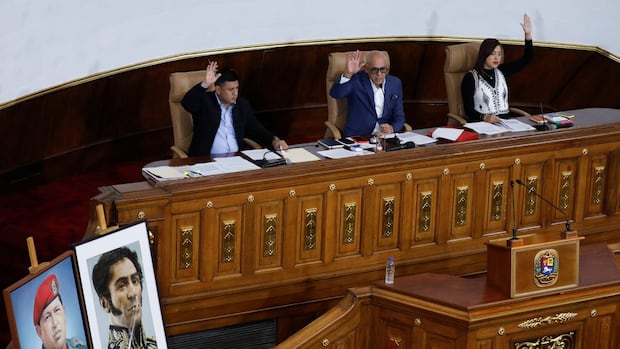
Venezuela’s parliament on Tuesday approved a measure that criminalizes a broad range of activities that can hinder navigation and commerce in the South American country, such as the seizure of oil tankers.
The bill — introduced, debated and approved within two days in the country’s National Assembly — follows this month’s seizures by U.S. forces of two tankers carrying Venezuelan oil in international waters.
The seizures are the latest strategy in U.S. President Donald Trump’s four-month pressure campaign on Venezuela’s leader Nicolás Maduro.
The tankers are part of what the Trump administration has said is a fleet Venezuela uses to evade U.S. economic sanctions.
The legislative assembly, which is controlled by Venezuela’s ruling party, did not publish drafts on Tuesday, nor the final version of the measure.
But as read on the floor, the bill calls for fines and prison sentences of up to 20 years for anyone who promotes, requests, supports, finances or participates in “acts of piracy, blockades or other international illegal acts” against commercial entities operating with the South American country.
Venezuela’s political opposition, including Nobel Peace laureate María Corina Machado, has expressed support for Trump’s policy, including the seizure of tankers. Machado and Trump have both repeatedly said Maduro’s days in power are numbered.
Bill goes to Maduro for signature
The bill, which now awaits Maduro’s signature, also instructs the executive branch to come up with “incentives and mechanisms for economic, commercial and other protections” for national or foreign entities doing business with Venezuela in the event of piracy activities, a maritime blockade or other unlawful acts.
The U.S. Coast Guard on Saturday seized a Panama-flagged vessel called Centuries that officials said was part of the fleet moving sanctioned cargo. With assistance from the U.S. Navy, it seized a rogue tanker called Skipper on Dec. 10. That ship was registered in Panama.
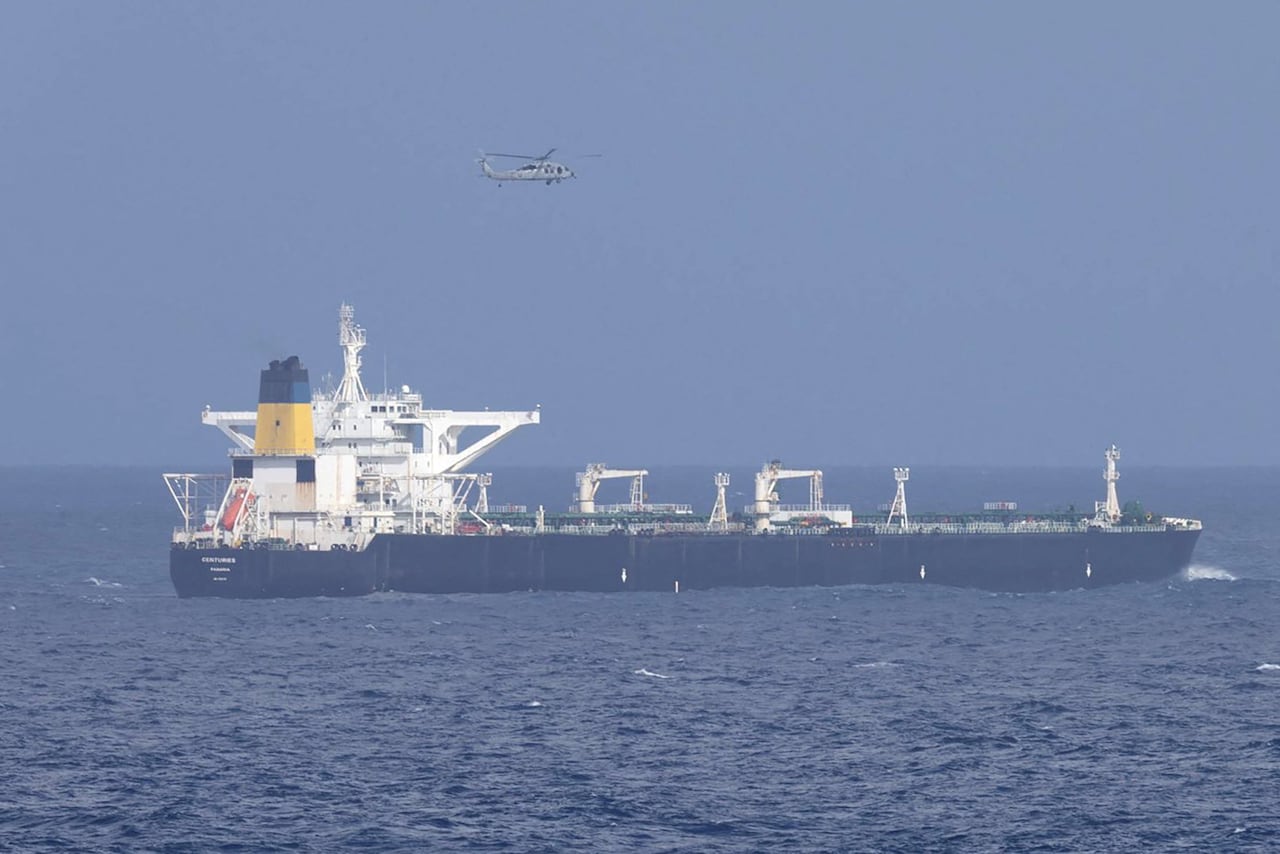 A U.S. military helicopter flies over the Panama-flagged Centuries, which was intercepted by the U.S. Coast Guard Dec. 20 east of Barbados in the Caribbean Sea. (DHS/Handout.Reuters)
Trump, after that first seizure, said the U.S. would carry out a “blockade” of Venezuela. He later demanded that Venezuela return assets that it seized from U.S. oil companies years ago, justifying anew his announcement of the blockade against sanctioned oil tankers travelling to or from the South American country.
At an emergency meeting of the United Nations Security Council called by Venezuela on Tuesday, U.S. Ambassador Mike Waltz stressed that sanctioned oil tankers “operate as the primary economic lifeline for Maduro and his illegitimate regime.”
“Maduro’s ability to sell Venezuela’s oil enables his fraudulent claim to power and his narco-terrorist activities,” Waltz said. “The United States will impose and enforce sanctions to the maximum extent to deprive Maduro of the resources he uses to fund Cártel de los Soles.”
WATCH | Emergency meeting at the UN: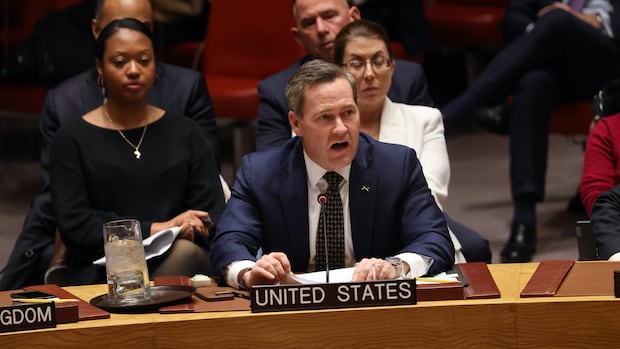
UN holds emergency meeting on U.S.-Venezuela tensions
The United Nations Security Council convened an emergency meeting requested by Venezuela over U.S. conduct in the Caribbean Sea. Several countries have called on the U.S. to curb further escalation as it continues to move more military assets into the region.
Maduro was indicted in 2020 on narcoterrorism charges in the U.S. and accused of leading the Cártel de los Soles, which the Trump administration designated as a foreign terrorist organization last month. The entity is not a cartel per se.
Venezuelans began using the term Cártel de los Soles in the 1990s to refer to high-ranking military officers who had grown rich from drug-running. As corruption expanded nationwide, its use loosely expanded to police and government officials as well as activities like illegal mining and fuel trafficking.
At Tuesday’s meeting, Venezuela’s UN Ambassador Samuel Moncada accused the U.S. of acting “outside international law” and its own domestic laws, by demanding that Venezuelans vacate the country and hand it over to the Trump administration, including all its oil fields.
“What right does the United States government have to appropriate, to date, almost four million barrels of Venezuelan oil?” Moncada asked, referring to the cargo of the two seized tankers.
“This alleged naval blockade is essentially a military act aimed at laying siege to the Venezuelan nation, degrading its economic and military apparatus, weakening its social and political cohesion, and causing internal chaos to facilitate aggression by external forces.”
Many countries expressed concern about violations of international maritime law and adhering to the UN Charter, which requires all 193 member nations to respect the sovereignty and territorial integrity of every other country. The U.S. actions were supported by a few countries, including Panama and Argentina.