
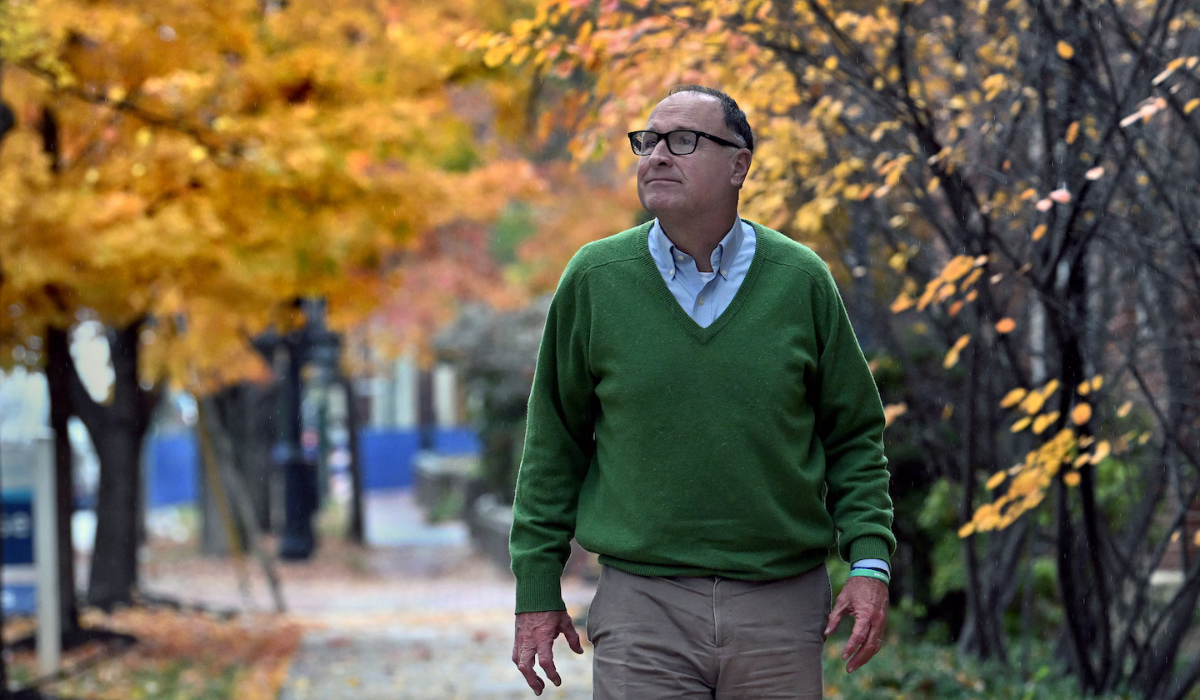
Senator Creigh Deeds, whose son attacked him before dying by suicide, on what must change now.

Senator Creigh Deeds admits mental illness wasn’t always a top priority as a legislator. Then one day in 2013, something unthinkable happened that changed everything. Deeds, a state senator from Virginia, was outside his home when his son, Gus, attacked him with a knife. The senator was left severely wounded. Gus, who was in a mental health crisis, took his own life shortly after.
After his personal tragedy, Deeds shifted focus to mental health. In the grief-filled years since, he has made it his mission to improve the mental health care system in his home state. Reflecting on broader attitudes, he notes that society has wrapped mental illness with stigma. “We have not prioritized treatment for the mentally ill,” says Deeds. “We raise money for breast cancer and other illnesses, but historically, we haven’t put as much priority on mental illness.”
Deeds and his team have vigorously pushed for reforms. They have advocated for laws that prevent the denial of psychiatric care due to unavailable beds—an issue Gus experienced. Deeds has championed research into Virginia’s mental health care gaps. He has supported mental health education for young people. His mission is colossal, and his drive is endless.
This week, The Sunday Paper sat with Deeds to discuss real-life options for those suffering from mental illness and their families. Deeds spoke passionately, acknowledging the “compassion for all the people involved” in the horrific deaths of Rob and Michele Reiner, whose son struggles with mental illness and is charged with their murders. Deeds said that while the mental health system is flawed, he will never give up on improving it and urges others to do the same.
A CONVERSATION WITH SENATOR CREIGH DEEDS
You’ve talked openly about the tragedy you went through with your son, Gus, and how you believe the mental health care system failed him. How did the system fail your son, and how does it continue to do so for those who are struggling and their families?
As a society, we built this wall of stigma around mental illness. We’ve made it difficult and embarrassing for some people to seek treatment or to admit their problems. We’ve made it difficult for parents to acknowledge that problems might exist with their children. And we’ve made services basically inaccessible.
We have not prioritized mental health. It’s difficult for anybody to know how to deal with mental illness. My son was so smart and so talented. He was a musician and soccer player, a Valedictorian, and an honor roll student. He was this curious, smart kid, and suddenly, he hit this wall, and he was covered in delusions and paranoia. I’ve come to realize that for a lot of people seeking treatment, they feel like their creative juices are taken away. And so again, we have not prioritized treatment for the mentally ill. We raise money for breast cancer and other illnesses, but historically, we haven’t put as much priority on mental illness.
But one of the things I’m most proud of is that we’ve begun to tear down the walls of stigma. We’ve begun building up resources to make services more accessible and more likely for people to get the care they need.
Where have you been seeing positive change?
You must focus on what’s in front of you. As a Virginia state legislator, I’ve worked to make the Virginia system more accessible to people with needs. We’ve invested more in services. We’ve invested more in psychiatric facilities. Here in Virginia, the public system is called Community Service Boards, which run around the state, and we’ve invested more in those services. And we’ve tried to build more benchmarks to understand whether we are achieving what we want.
A number of years ago, we recognized that 70 percent of mental illness people have their first episode between the ages of 12 and 24. So we then recognized the need to raise awareness and education around mental illness among young people. We’ve integrated mental health topics into the curriculum for eighth-, ninth-, and tenth-graders. They need to know about the warning signs and what to look for in their peers and in themselves. Now, I’ve been to different parts of the country, and I don’t want you to think that we’re doing it all right, because we’re still learning every single day. There are some good programs around the country, and we’ve learned from some of those.
What do you say to the family member of a loved one who is struggling, including those with adult children?
The first thing I’d say is, Don’t give up hope. Never ever, ever give up hope. The hard part when you have an adult child with a problem is that there are really two big problems: One is a lack of resources, and two is the law that says after a person turns 14 years of age, their parent has limited input in their ability to seek services. [Editor’s note: In the state of Virginia, someone aged 14 and older does not need parental approval to consent to outpatient mental health treatment.] So, you never give up. Keep looking for a way. Keep pushing the system to work for your family members and to work for your child. Sometimes that’s hard, and it comes at a cost, because it takes the resources out of your pocket and a lot of time. But never, ever give up.
What resources do families have? Where can they turn?
There are private hospitals to turn to. There are always public mental health providers to turn to. In Virginia, as I said, we’ve got the Community Service Boards, and it’s easy to reach out to them. Mental Health Virginia, an affiliate of Mental Health America, has a warm line you can call to talk about a problem. There’s the national 988 number for suicide prevention and other suicide lines. Anything you can do to try to delay a person’s plan might save a life. So again, keep looking for resources and never ever give up.
For the person out there who wants to advocate to better the mental health system, what can they do?
I harken back to To Kill a Mockingbird, where [the character] Boo Radley was developmentally disabled and was kept “under the porch.” That’s historically the way we’ve treated mental illness and developmental disability: We’ve just wanted to hide it from the public. We’re done hiding. We’re done hiding. We have to always be ready. I tell people this all the time: In life and in politics: The squeaky wheel gets the grease. We all have a responsibility. You have a responsibility to make this known by the people who represent you at the local level, at the state level, at the federal level. You must make them know that this is important to you. We must always work to make sure that services are accessible.
I’m convinced we focus too much on the crisis. We have to focus on keeping people out of crisis, and so in Virginia, we now invest more money in community services and local public services. You must focus on ways you can make a difference, and let the people representing you—whether you like them or whether you vote for them, it doesn’t matter—once they’re in office, get to know them and make sure this is a priority to them at the local level, at the state level, at the federal level. That is the only way real change happens: the people elected have to understand that this is a priority for the people they represent.
When it comes to the stories of those struggling with mental illness and those close to them, is there an aspect that is still not getting enough light?
Honestly, that’s part of it: Often, we focus on hospital care, but that’s the most expensive and sometimes the least effective, and it affects the smallest portion of the population of people who are mentally ill. The real heroes are the licensed clinical social workers, psychologists, and practicing psychiatrists who will see people. Those are the people on the front lines every single day in communities, talking to people and helping them.
You know, I say, How do you eat an elephant? One bite at a time. Tragedies occur, and it’s heartbreaking. But we still have work to do—one bite at a time.
Senator, you have been through the unconscionable, and you keep going, pushing to better the mental health system and the world. How do you do it?
While you live, you have a responsibility to live. You have a responsibility to make a difference in somebody’s life, more than just your own. You’ve got a responsibility to make life better for people around you and for the people you represent and for the people you leave behind. Nobody lasts forever, but I’m still here, and I’m still around, and I still have things to say and things to do, and I’m going to keep doing them.
Senator R. Creigh Deeds is a lawyer and politician serving as a member of the Senate of Virginia representing the 11th district. Learn more at senatordeeds.com.
If you or someone you know is struggling, the following resources are there to provide support:
988 Suicide & Crisis Lifelinen: Call or text the national hotline at 988 for 24-hour support.
The Trevor Project: Call or text the suicide prevention nonprofit organization for LGBTQ+ young people for 24-hour support.
NAMI: The National Alliance on Mental Illness, a grassroots organization in support of people affected by mental illness, offers state-by-state support chapters.