
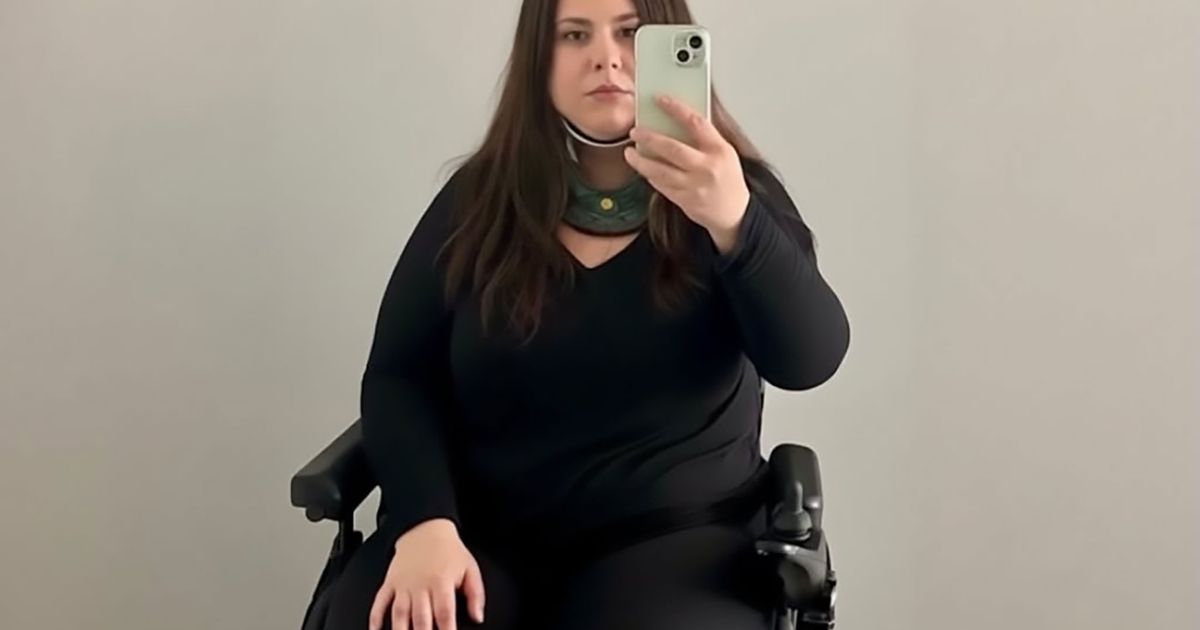
A Toronto woman has spent the bulk of her adult life suffering from a debilitating disorder, and Ontario’s health care system has left her in constant pain and no closer to corrective surgery.
Tiffany Felkai has suffered from Ehlers-Danlos Syndrome (EDS) since her mid-20s, and has been battling with the Ontario Ministry of Health (OMH) for over a decade in a thus far fruitless journey of self-advocacy.
Felkai spoke to blogTO about her continued challenges with EDS and roadblocks from the OMH that have deprived her of required treatment, leaving no option besides costly private clinics in the U.S.
Felkai tells blogTO that she first developed symptoms of EDS in her childhood and early 20s, and was first diagnosed in her mid-20s.
Throughout her journey, Felkai faced repeated misdiagnoses that thwarted treatment, including a negative experience with Toronto’s Good Hope Ehlers-Danlos Clinic, where genetic testing, which she argues was “conclusive” proof of EDS, was disregarded.
Her health deteriorated rapidly in 2017, when a minor injury and subsequent viral illness left her with limited strength and unable to walk.
“I remember trying to call my mom and letting her know, and I couldn’t even hold the phone,” she tells blogTO.
The illness had immediate ramifications for her professional life. “I was doing some academic upgrading in university because I was already on disability at that time, but I was functioning and trying to rebuild some sort of life for myself where I wasn’t on my feet 40 hours a week, and so I had to drop out of school,” she explains.
Felkai was, at various points throughout her illness, misdiagnosed with Guillain-Barré syndrome and myopathy before what she describes as doctors’ “gaslighting her” into believing that her symptoms were simply the product of ‘functional disorders.’
“When they say that a condition is non-medical, essentially a functional neurological disorder is a rebranded conversion disorder,” Felkai explains, noting that mental distress manifesting as physical symptoms is a top reason cited for neurologist visits.
Felkai says she was stuck on the carousel of medical visits and subsequent “gaslighting” for two years, being told throughout that her symptoms did not align with the condition she is certain she suffers from.
“I would go home and try to trick myself into being better, moving better. Or I would try to force myself, because the doctor said [I could], and nothing they said was adding up or explaining what was going on with me.”
Eventually, without seeing any improvement and still using a wheelchair, Felkai hired a medical case management agency and was sent to a U.S.-based neurologist specializing in EDS.
“He reviewed my genetic testing and not only concluded that I have Ehlers-Danlos, but he was able to tell me what type I had based off of the genetic mutation,” says Felkai.
“So that was the first step. The second step is that they started to come across some materials that explained spinal manifestations of Ehlers-Danlos Syndrome, including something called Cervical Cranial Instability.”
Cervical Cranial Instability, or CCI, is a condition associated with EDS and other disorders where patients’ ligaments connecting the upper vertebrae and skull are loose, resulting in Felkai requiring a neck brace, and causing a long list of symptoms, including extreme headaches and brain fog.
But even with this diagnosis, the OMH fell back on the previous diagnosis from local doctors, leaving Felkai unable to pursue the recommended treatment options.
“We exhausted our options within the Canadian healthcare system, even neurosurgeons who, typically on paper, would be the correct ones to manage this condition, were just essentially shutting it all down, not even just not offering surgery, but not wanting to offer any treatment, or not even wanting to acknowledge the diagnosis.”
Eventually, she was able to secure a referral to a neurosurgeon and was accepted by a specialist at St. Michael’s Hospital in 2021 after numerous rejections.
“This is quite common for folks who are in this patient profile,” says Felkai, noting that “Some don’t even ever get to see a neurosurgeon.”
Felkai suffered through some personal issues in the years that followed, but by October 2024, she was bed-bound up to 20 hours a day, suffering from symptoms that range from weeks-long periods of speech loss, migraine-induced paralysis, and pain down her spine she describes as “unbearable.”
The treatment for Felkai’s CCI is a procedure known as occipital cervical fusion, where surgeons permanently fuse the skull to the spine to prevent dislocations that create pressure on the brainstem and lead to body-wide neurological deficits.
Despite stating that she has 15 diagnosed and comorbid conditions, the OMH did not approve the operation, leading Felkai to look elsewhere for treatment.
Noting that there are fewer than a dozen doctors worldwide who can and are willing to perform the procedure, Felkai tells blogTO that she reached out to a U.S. neurosurgeon and submitted an out-of-country application to go forward with the operation, but was again denied by the OMH, again citing her layered diagnosis history.
“The first thing that they came back with was saying that [one certain] surgeon did not work in a hospital,” says Felkai, explaining that she next had to contact an advocate who worked as a liaison between Canadian patients and the Mount Sinai public hospital where this surgeon works.
After getting a letter confirming his employment there, the MOH returned to Felkai, asking for even more criteria.
“So I got a letter confirming that he is a surgeon there, and I submitted it to the MOH. Then they came back asking for additional criteria, including a confirmation of the procedure’s necessity from a specialist within the neurosurgery field,” for which Felkai turned to her neurosurgeon for a letter of support.
This letter of support — which has been reviewed by blogTO — was then submitted to the MOH, only for the province to again deny Felkai treatment a month later, despite the procedure being recommended by multiple medical professionals.
In its rejection letter, the MOH argued that another neurosurgeon consulted by the ministry for such reviews suggested that this treatment was not a first line of defence and claimed that it was indeed available in Canada — something Felkai has experienced as untrue.
Running out of options, Felkai applied for an independent review of her case with the same neurosurgeon the MOH consulted for its assessment. It cost her $1,500 out of pocket and six months of waiting through continued pain, but she remained steadfast in her journey of self-advocacy in the meantime.
While that was all processing, Felkai was referred to a neurovascular surgeon who uncovered a serious development with her condition; in layman’s terms, the largest vein in her brain is not properly draining, creating pressure that affects her vision.
Things started to develop rapidly in mid-2025. On June 17, her neurovascular surgeon told her that she required a stent in her brain within one to three months, and three days later, her U.S. neurosurgeon informed her that she is a candidate for a process of invasive testing — a test only surgical candidates are qualified for.
She presented this information to her local neurosurgeon, who informed her in mid-July that, despite her worsening symptoms, she is no longer a candidate for the very stent she was told she required, claiming it was “unsafe” to perform until her spine is stabilized in the U.S.
So, while one would assume that, with all of this information confirmed by experts and a surgeon available, the MOH would finally relent and offer to pay for the surgery, but the previous rejection still stands. Felkai feels no closer to a resolution.
She tells blogTO that “this has put me in an even more difficult situation where my vision can permanently be lost or damaged because he can’t perform this surgery, because the first surgery is not able to be performed in Canada, and the Ministry of Health is not funding it.”
“It’s like they set a bar and I actually meet the impossible threshold, then they throw me another loop. And so now it’s come to the point where any subsequent or any incidental surgery that I might need, like, let’s say I fall and, heaven forbid, need some sort of surgery, there’s always going to be an intubation risk because my spine is not stable.”
Meanwhile, day to day, Felkai hasn’t even been offered any pain management by the health care system, telling blogTO “that’s the most unbearable part.
“In lieu of surgery, I’ve been provided nothing.”
She tells blogTO that she has “been rejected by so many pain clinics that I have lost count,” and has entirely run out of options short of the surgery.
With the MOH unwilling to help, Felkai has turned to public advocacy to try and raise awareness about her condition and the lack of support from our supposedly “universal” health care system.
She has contacted her local MP, Leslie Church, and MPP, Stephanie Smyth, and despite them recognizing her challenges, politicians have not taken on her cause.
“They’ve recognized my position, acknowledged my position, but they refuse to do any advocacy. They just keep bouncing the ball back and forth to each other, and in the meantime, nothing has been done.”
Without political support or approval from the MOH, Felkai’s only remaining option is to pay out of pocket for the surgery in the U.S.
Even the pre-surgery invasive testing comes with an estimated price tag of $40,000 to $50,000, along with an estimated $10,000 in associated costs for travel and personal support care.
In total, Felkai would be looking at a mid-six-figure cost for the full procedure — an entirely unrealistic burden for someone already on a disability income in a society where we accept the trade-off of high taxes in exchange for the understanding that there will be coverage in situations exactly like these.
blogTO has contacted the MOH for comment on Felkai’s condition, and the Ministry has not yet made a statement regarding the continued rejection.