
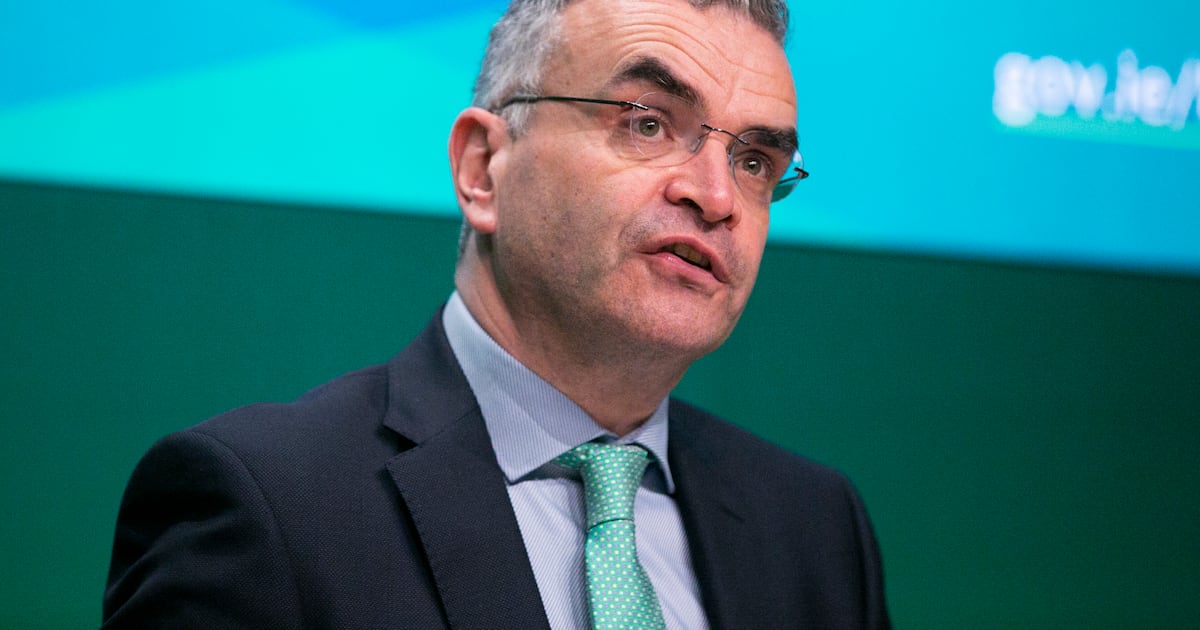
Minister for Social Protection Dara Calleary has introduced last minute rules mandating minimum contributions to occupational pensions schemes from January.
Any employer offering a defined contribution occupational pension scheme will need to ensure that contributions to the scheme at least equal 3.5 per cent of a worker’s gross pay or €1,200 a month, whichever is the lower. Of that, the employer must pay at least 1.5 per cent of gross pay.
If not, the business will be required to enrol the worker in the Government’s new mandatory workplace pension scheme, My Future Fund. Contributions to in house occupational schemes will be assessed over three months to see whether they comply with the new rules.
The 3.5 per cent figure equals the initial contributions under My Future Fund, of which 1.5 per cent will come from the employee, the same amount from the employer and 0.5 per cent from the State.
“We don’t want to cut across any well established, well designed and well operating schemes,” Mr Calleary said. “However, it is also important that such occupational schemes, if they are to be exempted, serve their purpose in allowing participants to accumulate sufficient retirement savings to fund a decent pension in retirement.”
The new rules were announced late on Tuesday, the last full working day before Christmas, and just over a week before the new auto-enrolment pension scheme comes into force. Employers who have staff who will be eligible for the scheme under this last minute rule change now have only days to complete a mandatory registration of those workers.
The Minister also announced that more than 77,000 employers with approximately 645,000 employees, had registered for My Future Fund since the start of the month. Government estimates suggest around 750,000 workers will be covered by the scheme.
Anyone who is aged between 23 and 60, earns over €20,000 in a year from all employments and who is not otherwise signed up to a qualifying occupational pension scheme will be automatically enrolled in My Future Fund.
Deductions from their wages towards the funds will start from their first pay packet of the new year.
The Minister had promised to introduce such regulations after it emerged last month that some employers were enrolling staff in in-house occupational schemes offering less value that the My Future Fund. The department said the move was designed to counter perceived abuse of the scheme by some employers.
Originally, anyone who voluntarily signed up to an occupational pension scheme with their employer was excluded from My Future Fund. However, the Department of Social Protection discovered that certain employers were reportedly signing staff up to pension schemes where just 1 per cent of their salary would be going towards their pension.
In a letter to the Irish Congress of Trade Unions, the department said it had become aware that some employers were illegally looking to force employees to join in-house schemes with contributions of as little as 1 per cent, which would be of “marginal, if any, use to them” in terms of improving financial security in retirement.
The Minister said on Tuesday in a late night statement that he did not expect the National Auto-Entrolment Retirement Savings Authority (Naersa) to have to exert its new powers to forcibly enrol workers who were signed up to occupational schemes “to any great extent”.
“We have, however, learned that a very small number of employers have sought to enrol some employees, who were not previously participating in those occupational schemes with just a notional contribution. Even though this is a very small number, it is not a practice that can be ignored as it, in effect, denies the employees concerned access to an effective retirement savings plan.”
Department secretary general John McKeon also warned employers in November that compelling staff to join an in-house scheme without their explicit consent could leave companies exposed to action for breaches of data protection legislation.
Small business group, Isme, reacted angrily to the original accusation that some businesses were actively working to undermine auto-enrolment and called on the Department of Social Protection to provide evidence.
Ibec, the employers group which generally represents larger employers, had expressed alarm at Government plans, with chief executive Danny McCoy warning of the “scope for adverse unintended consequences on existing pension schemes if the proposed regulation is enacted with undue haste and without proper consultation during the run-up to Christmas”.
Under auto-enrolment, contributions will increase over the next 10 years, with employers and workers putting in 3 per cent of gross salary each from 2029, 4.5 per cent from 2032 and 6 per cent from 2035, at which point the State contribution will be 2 per cent of gross salary.