
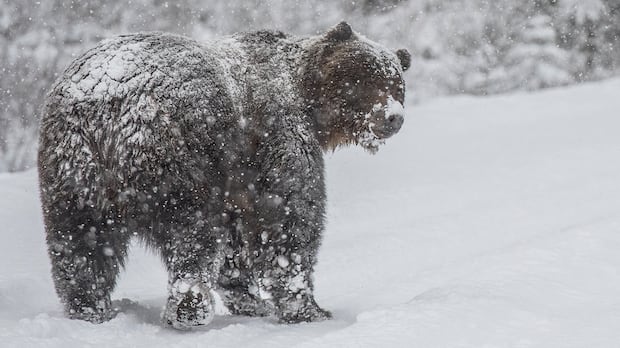
If you’re talking to a scientist, try not to use the words “bear” and “hibernate” in the same sentence.
It’s common knowledge that bears enter a deep sleep during winter, but what’s the proper terminology for that? Calgary naturalist Brian Keating says it’s more complicated than many might think.
“It’s been argued as to whether or not it’s a hibernation with bears,” he said. “They definitely go into what I would call a hibernation. Professionals, I guess, call it a torpor.”
‘Hibernation’ versus ‘torpor’
Hibernation and torpor are similar concepts, in which mammals enter a state of reduced heart rate and body temperature.
“What forces these animals to go into hibernation is they can’t make a living in our ridiculously difficult winters, so they go to sleep,” Keating said. “Not a bad idea.”
But what scientists call “true hibernation” is experienced by only a few animals in Alberta, primarily ground squirrels and marmots.
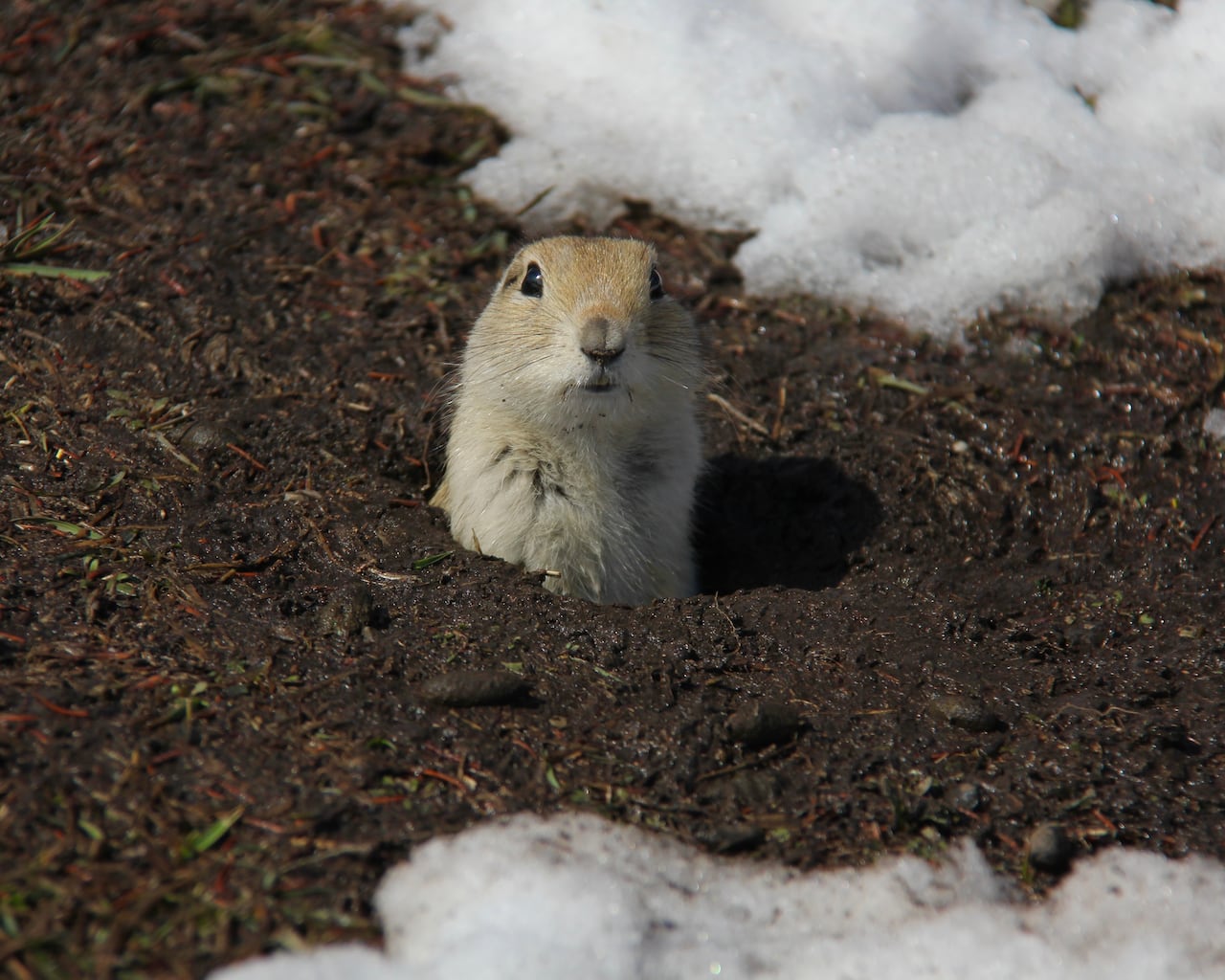 A Richardson’s ground squirrel, known colloquially as a gopher, pictured in Calgary in March, around the time the rodents emerge from hibernation. They enter what scientists refer to as a true hibernation, as opposed to bears’ similar state of deep sleep known as torpor. (Amir Said/CBC)
“Ground squirrels will burrow down into the ground and sustain themselves in their burrow in an ambient air temperature about a degree above freezing,” Keating said. “They let their body go down to that kind of temperature, so they are basically in a state of suspended animation.”
Hoary marmots and Columbian ground squirrels, both commonly found in Alberta’s mountains during the warmer months, spend about three-quarters of the year in hibernation underground.
“It takes a long time — perhaps half an hour or so of shivering and shaking — to get their muscles warmed up before they can actually be active enough to move around to any great degree,” Keating said.
Keating recalled visiting a friend’s lab in Manitoba, where ground squirrels had been put into hibernation. The friend pulled out a hibernating ground squirrel, and it began to shiver and shake as it knew it was being handled, Keating said.
It takes a great deal of effort and energy for an animal in true hibernation to wake up.
That’s not the case with bears.
“If you were to climb into the den of a bear, that bear can come out of its state of torpor rapidly, and would probably end up ripping off your face,” Keating said.
Torpor, which is also experienced by skunks, raccoons and some bats, is not nearly as deep of a sleep as true hibernation.
“Their body temperature drops just a little bit. Their heart rate and respiration drop quite a bit, but not to the extent where they take a long time to come out of hibernation,” Keating said.
Before torpor, bears enter a state of extreme hunger called hyperphagia, in which they spend up to 20 hours a day eating everything they can get their paws on. That can even include digging up hibernating ground squirrels for an easy snack, with some bears consuming up to 20,000 calories a day during this state.
WATCH | Bear torpor is ‘more relaxed hibernation’: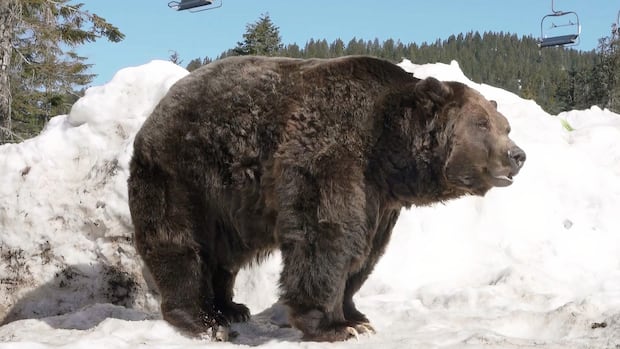
Bears are waking up: torpor is over
As our winter weather warms up, you’ll be seeing more bears in the mountains.
Other Alberta animals experience different forms of deep sleep.
Wood frogs, commonly found across Canada, freeze during the winter, becoming encased in ice before thawing out in the spring.
Garter snakes huddle together in an underground cluster called a hibernaculum in a state of dormancy referred to by biologists as brumation.
The bottom line when it comes to bears: “hibernation” is acceptable to use in everyday conversation, but to impress a scientist, say “torpor.”
“But I think even the hardcore biologists will loosely call it hibernation,” Keating said. “I don’t think there’s that much of a delineation.”
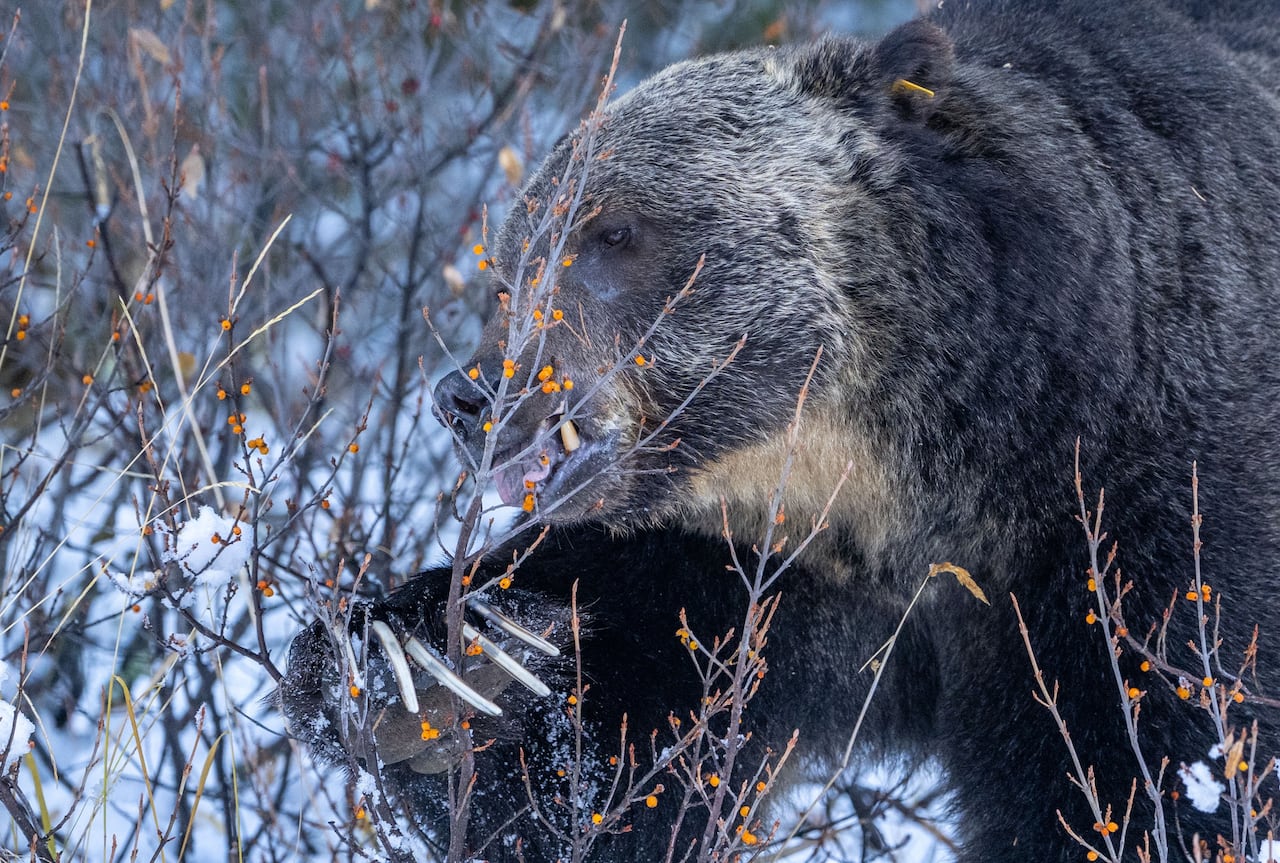 A male grizzly bear known to Parks Canada as bear No. 136 — nicknamed Split Lip — pictured feeding on berries in Banff National Park in October 2025. (Jason Leo Bantle)Bear activity during winter
It’s unlikely hikers or skiers would encounter a bear at this time of year, but it’s certainly not impossible, says Nick de Ruyter, program director of the BioSphere Institute’s WildSmart program. He said some bears are out through December and even into January.
“Typically the grizzly bears, especially the male ones, are the last ones to go into the den, and the first ones to get out of their dens, so I think that’s also why we most often hear stories about grizzly bears,” de Ruyter said.
A grizzly bear encounter in Yoho National Park, about 20 kilometres west of the Alberta-British Columbia border, left a hiker with minor injuries near the end of November.
Through WildSmart, de Ruyter sends out weekly bear reports on wildlife activity in the Bow Valley.
WATCH | Legendary grizzly ‘The Boss’ among first grizzlies to awaken: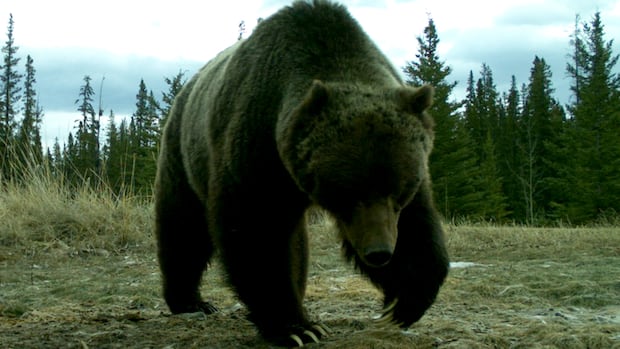
#TheMoment legendary grizzly ‘The Boss’ came out of hibernation
Wildlife photographer Jason Leo Bantle recounts the moment legendary grizzly bear ‘The Boss’ was spotted awake and roaming around Banff National Park after emerging from hibernation.
The Kent Ridge North and James Walker Drainage sites in Kananaskis Country’s Peter Lougheed Provincial Park have been closed to the public by Alberta Parks this winter due to a grizzly bear denning in the area.
A closure in Banff National Park has been issued by Parks Canada for an area on the west side of Eagle Mountain, by Banff Sunshine Village, due to a black bear denning in the vicinity.
“It’s not very likely that bears will be walking around year-round on the landscape, but some might be late going in or early getting up, and some could get woken up by people recreating as well,” de Ruyter said.
He said it’s important for hikers to carry bear spray year-round — not only on the off-chance they come across a bear, but also in case they encounter other predators like wolves or cougars.