
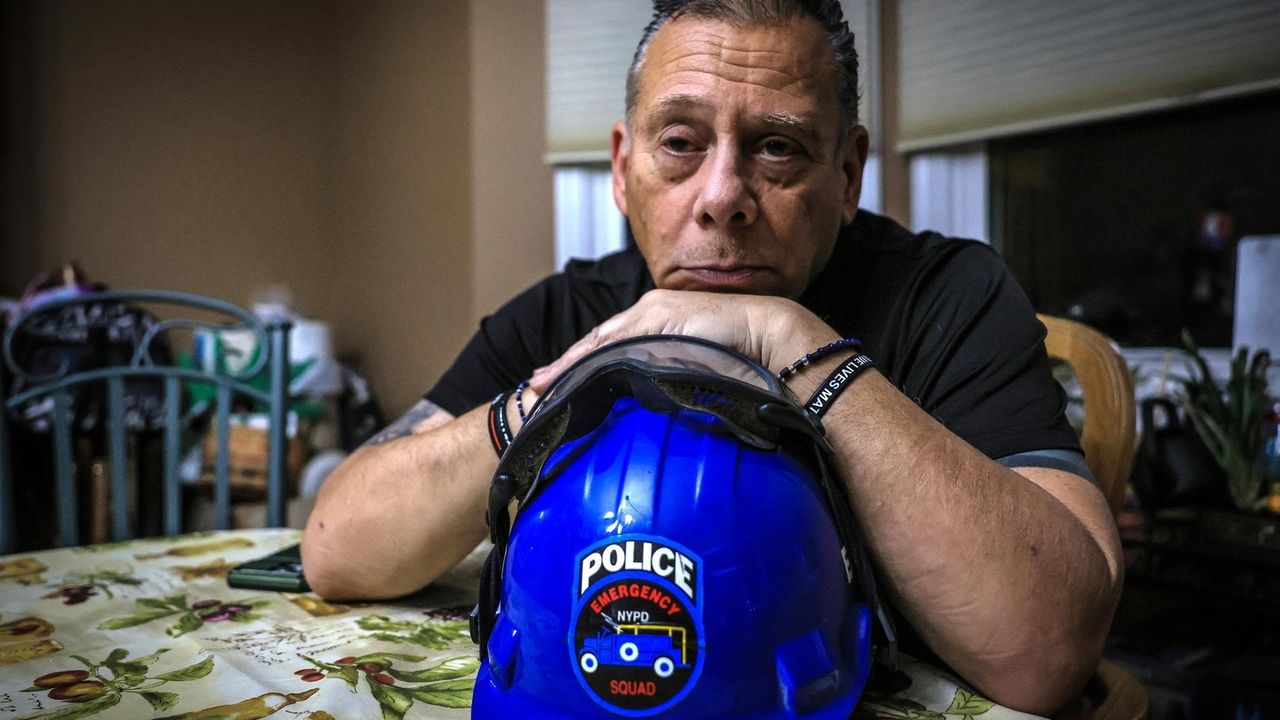
Glen Klein said he endured years of nightmares, heavy drinking and bouts of rage before he sought help for post-traumatic stress disorder.
The old, yet lingering stigmas surrounding mental health treatment among first responders delayed Klein — a retired detective specialist with the NYPD’s Emergency Services Unit — and others from receiving the help they needed while reeling from the sights, sounds and smells of Ground Zero after the 9/11 terror attacks.
“Even if you sign up to be a police officer or a firefighter, never in our wildest dreams did we ever think that we would be digging bodies out from two 110-story buildings for almost a year,” said Klein, 67, of Centereach, who has been diagnosed with chronic PTSD. “It was common to see dead bodies because we deal with homicides and bad car accidents. But to have almost 3,000 people buried in the rubble … it has to affect you pretty severely.”
New research spearheaded by Stony Brook Medicine’s World Trade Center Health and Wellness Program found that the trauma first responders like Klein experience exacted not just a psychological toll, but a physical one. An analysis of MRIs spearheaded by the Commack-based Stony Brook program revealed an abnormality in the brain composition of first responders who have re-experienced 9/11 through flashbacks or nightmares.
WHAT NEWSDAY FOUNDNew research spearheaded by Stony Brook Medicine’s World Trade Center Health and Wellness Program found an abnormality in the brain composition of first responders experiencing certain forms of post-traumatic stress disorder.This study is the first of several slated for publication by Stony Brook researchers about the biological markers of PTSD.The approximately 23% of World Trade Center first responders diagnosed with PTSD currently cannot receive compensation for the condition through the September 11th Victim Compensation Fund.
This study is the first of several slated for publication next year in which Stony Brook researchers will reveal the physical impacts of PTSD, tangible evidence patients and doctors can use to advocate for earlier and more appropriate treatment.
Altering perceptions of PTSD
Dr. Benjamin Luft, director of Stony Brook’s 9/11 program, told Newsday he hopes that studies of the biological effects of PTSD will persuade lawmakers to update the James Zadroga 9/11 Health and Compensation Act. The legislation currently excludes the approximately 23% of World Trade Center responders diagnosed with PTSD from receiving compensation for the condition through the September 11th Victim Compensation Fund, which sends “a very strong symbolic message,” he said.
“It separates out this group of people, saying, ‘You don’t have a real injury, so we aren’t going to give you any money for it,’ ” Luft added.
Since the World Trade Center program began shortly after 9/11, Stony Brook doctors and researchers have sought to change how “PTSD was being dealt with societally, medically, in that it was highly stigmatized,” Luft said. When treating generations of first responders as well as veterans, he added that addressing “PTSD was something that was not given the same importance as that for physical ailments.”
The MRIs and other biological evidence of PTSD affecting the brain and body also may lead those still concerned about stigmas to seek help.
About 80% of the more than 6,000 first responders across the state who participated in a mental health needs assessment survey published earlier this year reported that stigma remains “somewhat of a barrier” for responders seeking services.
“There are a lot of people who still either don’t know they have [PTSD] — they just think they have anger problems or they just like to drink — and they may never come out and say anything,” Klein said. “But I positively think that once they know it’s a physical injury … they’re going to come out and say, ‘Oh … I don’t have to deny it anymore.’ ”
Brain composition changes
When neuro-images of nearly 100 World Trade Center responders — around half of whom were diagnosed with PTSD — were captured between 2016 and 2019, MRIs of responders with PTSD appeared “blurry,” Sean Clouston, the study’s lead author and a professor at Stony Brook University’s Renaissance School of Medicine, told Newsday. An MRI of a healthy brain should provide a clear contrast between a brain’s gray matter, akin to a processing unit and hard drive, and white matter, which sends signals throughout the brain and body.
The parts of the brain associated with memory are “mostly in the gray matter,” Clouston said. The loss of gray-white contrast in the brains of the first responders with PTSD “could help to explain why [traumatic memories] are more severe, harder to control” and “running amok” in the form of flashbacks and nightmares, he added.
The most significant changes in brain composition appeared in first responders who re-experienced symptoms of PTSD, such as the nightmares that plagued Klein, compared with those for whom the PTSD materialized as depression, for example, and those with no PTSD diagnosis.
The finding could reveal that there are “different clusters of PTSD,” Clouston said.
“We treat people with PTSD pretty similarly,” he said. He added that if researchers find biological evidence of PTSD materializing differently in different people, “that might lead us to actually provide different treatment to different people, which might benefit them a lot more. … I’d like to see more optimized treatments for people.”
In addition to first responders, Stony Brook’s research also could benefit other populations prone to PTSD, including veterans, as well as survivors of car accidents, natural disasters and sexual assaults, according to Luft, the World Trade Center program director.
Over the next few months, Stony Brook’s World Trade Center program researchers will publish additional studies regarding biological markers of PTSD, including a look at how PTSD impacts proteins found in the blood. Finding physical evidence of PTSD “is so essential to getting people treated early,” especially those reluctant to seek mental health assistance, Luft said.
Like any other disease, early detection and treatment, Luft added, is “the best chance that we have of really taking care of these problems.”
Nicholas Grasso covers breaking news for Newsday. A Long Island native, he previously worked at several community newspapers and lifestyle magazines based on the East End.