
In Trondheim, Norway, there’s a clever piece of cycling infrastructure that solves one of the biggest challenges in everyday riding: steep hills. The Trampe CycloCable is a pedal-powered lift embedded in the pavement that pushes cyclists uphill at around four miles per hour. You just place one foot on a retractable footplate and let the mechanism carry you to the top. No pedaling required.
Installed on a steep street called Brubakken near the city center, the original lift was built in 1993 by a local engineer as a prototype. It was intended to get more residents biking in a city known for its cold climate and challenging terrain. After proving popular with locals, it was upgraded in 2013 and rebranded as the CycloCable. Today, it stretches 130 meters (about 430 feet) up the hill and is used thousands of times each month during the warmer seasons.
The system works via an underground cable powered by an electric motor. Riders straddle their bikes, place one foot on the footplate, and are gently pushed uphill while they balance on the bike. There’s a bit of technique involved—keeping your supporting leg straight and staying relaxed helps—but once you get the hang of it, it’s remarkably easy. The lift is also open to people on scooters and even kids on smaller bikes.
It’s not a major piece of infrastructure. It doesn’t cost millions, and it doesn’t require traffic to be rerouted. But it removes a significant physical barrier in a city that wants to prioritize cycling, and it does so in a way that’s practical, not flashy.
Which makes you wonder: why hasn’t anyone else done it?
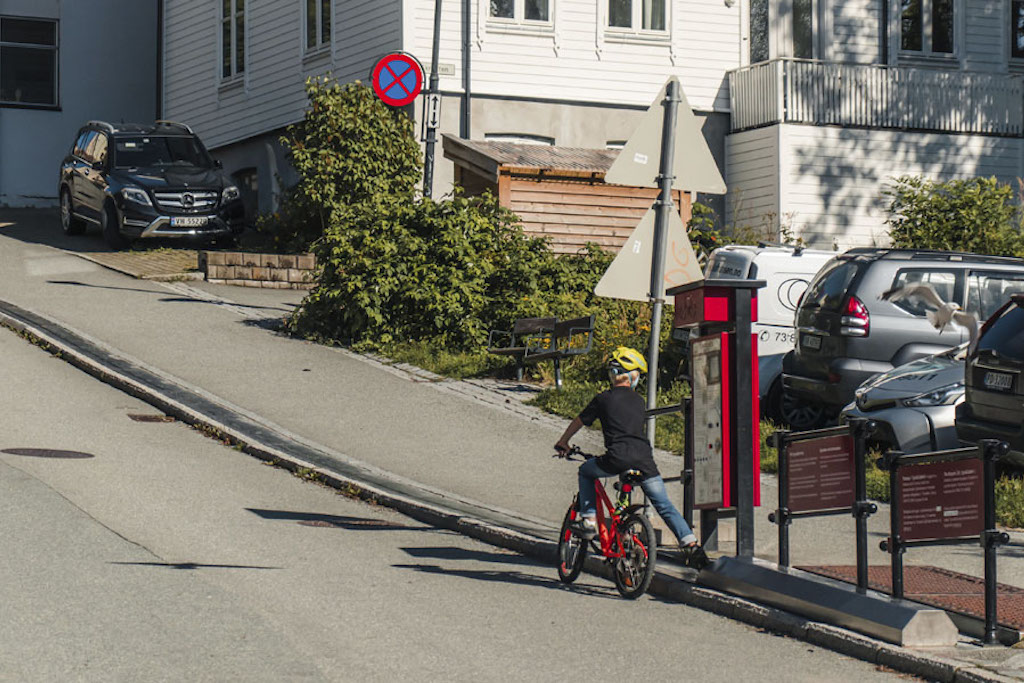
Trondheim Bicycle Lift
Here are a few North American hills that would actually benefit from a lift like Trondheim’s—places where steep grades cut through well-used bike routes and where a little assist could go a long way.
Portland, OR – Brynwood Hillclimb / Council Crest
Portland is often celebrated for its bike infrastructure, but it still has hills that test even the most experienced riders. The West Hills are particularly brutal, with gradients up to 24% on the Brynwood Hillclimb—reportedly the steepest in the state. It might actually get more people exploring west of downtown by bike.
San Francisco, CA – 17th Street or Clipper Street
San Francisco cyclists are no strangers to punishment by elevation. The 17th Street corridor through the Mission District and Clipper Street through Noe Valley are both popular but punishing routes linking neighbourhoods to Twin Peaks and the Castro. A bike lift here would be a rare piece of infrastructure that doesn’t require a full redesign—just a small, targeted solution to a very specific problem.
Montreal, QC – Avenue du Mont-Royal
Mont-Royal is one of the most iconic cycling routes in Montreal, connecting the Plateau neighbourhood to the city’s namesake mountain and park. It also features a steady, energy-sapping climb that turns into a slog at rush hour. Yes, the spandex set love the climbs, but everyday cyclists might want a little help on their way to a scenic picnic. A cyclist lift here could make the route more appealing for commuters and recreational riders alike—especially when the weather’s bad and energy levels are low.
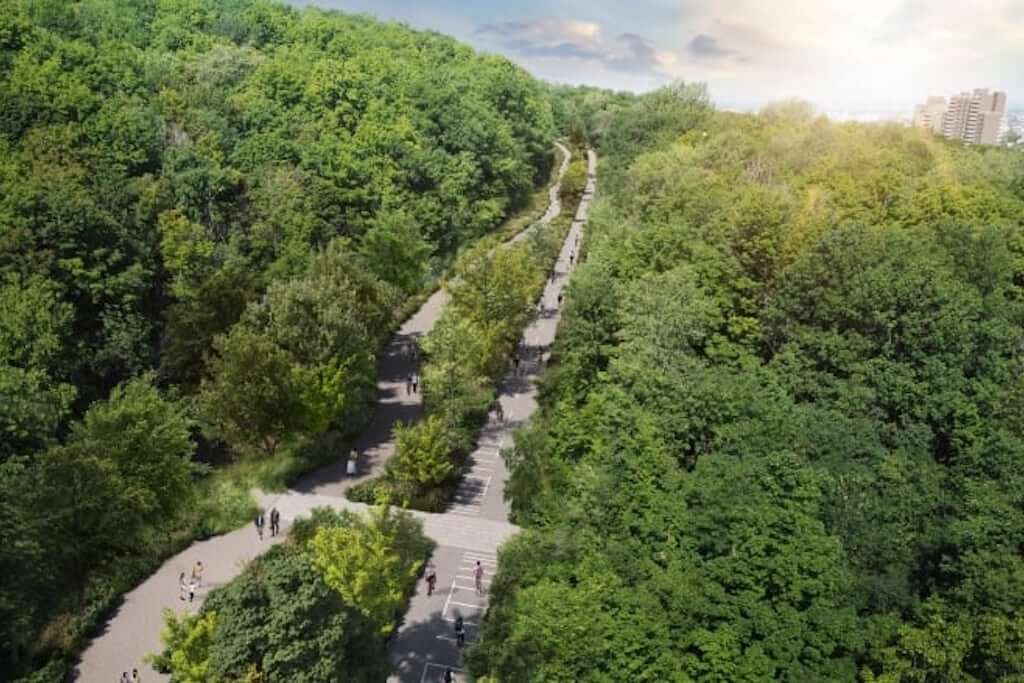
Montreal’s Mont Royal
Seattle, WA – Queen Anne Avenue
The climb up Queen Anne Hill is short but relentless, and it’s a key connection between dense residential areas and downtown. It’s already a well-known leg-burner among Seattle riders, and for many people, it’s a reason not to ride at all. A modest lift along Queen Anne Avenue could remove one of the most persistent obstacles in Seattle’s otherwise growing bike network.
Vancouver, BC – Yukon Street to 37th Avenue
Yukon Street is an important north–south bike route in Vancouver’s network, linking downtown with residential and commercial zones to the south. But it rises steeply through the middle, especially between 16th and 37th Avenue, where many cyclists end up walking their bikes. It’s a natural candidate for a Trampe-style lift—direct, well-used, and just steep enough to be a regular deterrent.
Would any of these cities actually build one? Maybe not. But the Trampe shows that when you design for real-world barriers, even something as small as a footplate in the pavement can shift how people think about moving through a city.
And for a growing number of urban cyclists, that might be all it takes to stop dreading the hill—and start riding over it.