
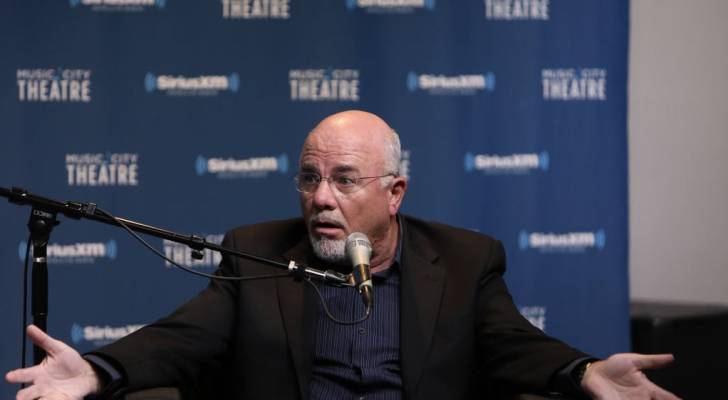
 Dave Ramsey
While the headlines have been dominated by a rollercoaster in the stock market, financial guru Dave Ramsey isn’t going doom and gloom.
In fact, the radio host believes every young North American has a shot at becoming a millionaire.
“If you’re under 40 years old and you don’t retire a millionaire, that’s no one’s fault but yours,” the 64-year-old on X, formerly known as Twitter (1).
Here’s a closer look at the math behind his exhortation.
Despite the economic challenges facing young Canadians, Ramsey believes that the average 25-year-old needs to save just a fraction of their annual income to retire at 65 with over $1 million.
However, his thesis assumes that this 25-year-old invests in “good growth stock mutual funds.” According to his calculations, diligently investing just $100 a month into such growth funds could create a $1,176,000 nest egg within 40 years.
Ramsey doesn’t mention any specific growth funds, but his calculations imply a roughly 12.85% annual growth rate. That means Ramsey’s math assumes annual returns approaching 13%, which is significantly higher than what most investors should reasonably expect over long periods.
For example, the Vanguard S&P 500 ETF (TSX:VFV) has delivered a compounded annual growth rate of 16.93% since its inception in 2012.
In fact, the S&P 500 has delivered an average annual return of 10.13% since 1957, according to Investopedia (2).
Given the long-term performance of these index funds, Ramsey’s assumption doesn’t seem unreasonable, even when you take into account the recent volatility in the stock market in response to U.S. President Donald Trump’s tariff announcements. There have been many shocks, dips, corrections and outright crashes in the past 100 years, and the market has always eventually bounced back.
Historically, the S&P 500 has returned about 10% annually before inflation, or roughly 6.5% to 7% after inflation, according to long-term market data. Canadian investors must also factor in currency fluctuations, management fees, and taxes when investing outside registered accounts.
For planning purposes, many Canadian financial planners recommend assuming 5% to 7% real returns when building long-term retirement projections.
If you want to begin your investing journey but aren’t sure where to begin, Wealthsimple Invest creates a smart investment portfolio tailored to your needs to help you achieve your financial goals.
With low fees, these expert-managed portfolios are designed to withstand market fluctuations, helping you make the most of your money.
What’s more, you can automate your monthly contributions through RRSPs and TFSAs, and Wealthsimple takes care of the little things, like asset allocation, rebalancing your portfolio, and reinvesting dividends.
Wealthsimple’s advisors are fiduciaries — meaning they are legally required to put your financial interests first.
The best part? You’ll get $25 bonus when you open your first Wealthsimple account and fund at least C$1 within 30 days.
Terms and conditions apply. Visit Wealthsimple for up-to-date terms and conditions.
Read more: Here are 5 expenses that Canadians (almost) always overpay for — and very quickly regret. How many are hurting you?
The four variables of the compound growth calculation are time, initial investment, regular investment and growth rate. Of these, the only variable you can somewhat control is regular investment.
Investing $200 or $300 a month could help you create a nest egg significantly bigger than just $1 million. Ramsey recommends setting the bar even higher at 15% of gross annual income.
“The average household income in America today is US$79,000. If you invested 15% of that (US$11,850 a year), you would retire with around US$11.6 million,” he said on X.
According to Statistics Canada, the median after-tax household income in Canada was $68,400 in 2022, but income varies sharply by age and region.
Households led by Canadians under 35 typically earn less than older households, while facing higher housing-to-income ratios — particularly in Ontario and B.C. This gap helps explain why many younger Canadians struggle to save at the levels Ramsey recommends, even when working full time.
The average household income for Canadians is C$74,200 in 2023, increasing 1.2% from $73,300 in 2022, after being adjusted for inflation (3). Following Ramsey’s rule, you would need to invest C$11,130 per year to maximize your retirement fund.
However, most Canadians are saving significantly less than Ramsey’s target. According to Statistics Canada (5), Canada’s household savings rate fell to 5.1% in Q3 2024, down from 6.2% in Q2, as higher shelter costs, food inflation and debt servicing continued to squeeze household budgets.
For younger Canadians, the challenge is even greater. StatCan data (6) shows Canadians under 35 carry the highest debt-to-income ratios of any age group, largely driven by housing costs and student loans — making Ramsey’s 15% savings target difficult for many households to reach without income growth or lifestyle trade-offs.
One common financial mistake is keeping your money in low-interest savings accounts. High-interest savings accounts in Canada can offer meaningfully better returns than traditional chequing or savings accounts, but the gap is far smaller than U.S. comparisons suggest.
As of late 2025, most major Canadian digital banks offer 2% to 3% on high-interest savings accounts, compared with near-zero rates at many big-bank savings accounts.
For example, open a personal account with EQ Bank and in just a few minutes you get access to the best features of a chequing account combined with a high-interest savings rate.
When you fund your account and set up a direct deposit, you can earn 2.75% on every dollar deposited into the account.
The account has $0 monthly fees and no minimum balances. Plus, you can withdraw from any ATM in Canada — for free.
Amid the ongoing market volatility and escalating tensions between the U.S. and Canada, it’s crucial to protect your portfolio against risks.
Diversifying your investments across multiple asset classes — such as stocks, bonds and ETFs — can help you significantly hedge against market risk.
Opening a discount brokerage account with CIBC Investor’s Edge can help you diversify your portfolio without having to pay exorbitant commissions on trades.
Plus, you don’t have to pay any account or maintenance fees for RRSPs with a balance of over C$25,000, and TFSAs and non-registered accounts with a balance higher than C$10,000.
CIBC Investor’s Edge charges a discounted commission rate of C$4.95 per trade for active traders making over 150 trades in a quarter.
If you open your CIBC Investor’s Edge account before Sept. 30, you can get up to 100 free equity trades and over $200 in cash back.
Homeownership can be a key stepping stone to reaching millionaire status by retirement. Once you’ve decided on the kind of house you want to purchase, shop around and compare mortgage rates offered by reputable lenders near you through Loans Canada.
Here’s how it works: Select the kind of loan you want to get and submit an application, and Loans Canada will sort through its network and display the best possible offers for you.
Those who want to refinance their existing mortgage can compare refinancing rates offered by leading lenders through Loans Canada.
Refinancing your home loan through Loans Canada could help you pay off your mortgage early in two ways. By securing a lower interest rate, you can either maintain your current monthly payment while more of it goes toward the principal, or you can opt for a shorter loan term to accelerate your path to homeownership.
The best part? You can apply for a mortgage or refinance loans even with poor credit — and it’s 100% free.
A key limitation of Ramsey’s framing is inflation. A $1 million portfolio in 2055 will not provide the same purchasing power as $1 million today.
Using the Bank of Canada’s long-term inflation target of 2%, $1 million today would need to grow to roughly $1.8 million in 30 years just to maintain equivalent buying power. For younger Canadians, this means the real goal isn’t becoming a “paper millionaire,” but building enough inflation-adjusted income to support retirement living costs.
We rely only on vetted sources and credible third-party reporting. For details, see our editorial ethics and guidelines.
X: @daveramsey (1); Investopedia (2); Statistics Canada (3; Trading Economics (4); Statistics Canada (5); Statistics Canada (6)
This article provides information only and should not be construed as advice. It is provided without warranty of any kind.