
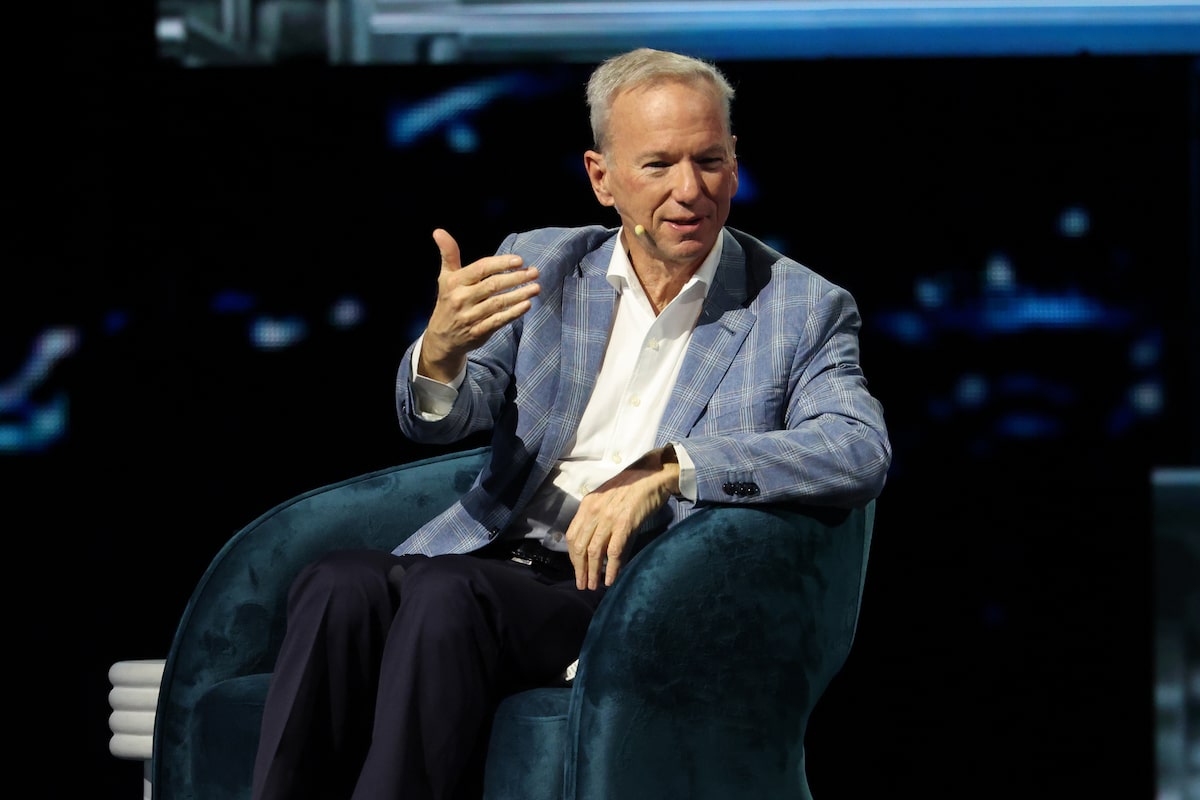
Eric Schmidt, former CEO of Google, at the America Business Forum at Miami’s Kaseya Center in November. Schmidt has issued a warning about the dangers of AI.Alexander Tamargo/Getty Images
The dire warnings about AI keep coming.
Eric Schmidt, former chief executive of Google, says that within a few years, millions of independent AI agents working together “will develop their own language.” And “we won’t understand what they’re doing.” They will have escaped human control.
The University of Montreal computer scientist and AI pioneer Yoshua Bengio told The Guardian this week that AI models were showing signs of self-preservation, the capacity to evade guardrails and to inflict harm on humans. Without controls, he said, AI systems will be free to operate like hostile extraterrestrials.
“I always thought AI was going to be way smarter than humans and an existential risk. And that’s turning out to be true,” Elon Musk says.
In 2026, it’s a good bet demagogic disruptor Donald Trump will again be wreaking havoc on almost a daily basis. But as the technological tsunami that is AI continues to be unleashed, it makes his undoing of norms look small by comparison.
Opinion: 2026 economic forecast: M&A, AI, EVs, (and other acronyms)
How artificial intelligence is helping urban planners design smarter, more livable cities
Canadians and their politicians have been transfixed by what Mr. Trump is doing. We mull it over daily. But AI, by comparison, is getting scant attention. Though media coverage has intensified, in parliamentary debates AI is rarely mentioned. Prime Minister Mark Carney has been preoccupied with other files. He did appoint an AI Minister, Evan Solomon, this past spring, but little has been heard from him.
The relative silence is disturbing in light of the dangers we hear of the biggest and fastest technology revolution of all time. So is the seeming reluctance to impose a strict regulatory regime over AI.
The European Union, with its AI Act, has brought in a strong regulatory package to lessen the dangers. China has brought in rigorous regulatory measures. It favours global AI governance via an international organization.
Justin Trudeau’s government introduced the Artificial Intelligence and Data Act. It would have provided a regulatory framework, but it died a year ago when Parliament was prorogued.
Mr. Solomon ran a national consultation process on AI in the fall and promises comprehensive legislation this year. But he has signalled a less regulated, more market-friendly approach. It’s in keeping with the government’s desire to stimulate economic growth independent of the U.S. “We need to be competitive on the world stage,” Mr. Solomon said in June. To do so, Canada will need to “champion” its AI winners.
Hopefully there will be winners. Fears of AI-spawned unemployment are rife, with firms like Microsoft releasing studies showing the jobs believed to be most at risk as a result of the AI revolution.
In the U.S., Mr. Trump has rolled out the red carpet for Big Tech billionaires to develop AI at breakneck speed, damn the torpedoes. He is meeting resistance in some states demanding their own rights to police AI.
A reason strong AI regulation does not appear to be a pressing concern in Ottawa is the lack of public pressure. AI has the potential to work wonders in fields such as medicine, and many see the pluses as outweighing the risks. Polls show concern over AI is far down the list of pressing-issue priorities for Canadians. Meanwhile, the advent of robots replacing workers continues apace, alongside the threat of autonomous AI agents gaining control of weapons systems and so many other potentially negative impacts.
In Ottawa, there is no champion leading the charge against AI on the opposition benches. In the U.S., Senator Bernie Sanders is calling for a moratorium on data-centre construction. He points to the belief that AI and robots will eventually replace jobs and says, “Well, I’ve got a simple question. If there are no jobs and humans won’t be needed for most things, how do people get an income to feed their families?”
In the past, new technologies have not, as feared by Luddites, led to great job losses. But many worry that AI will be different.
Conservative Party Leader Pierre Poilievre fears the prospect of machines gaining too much control. “How is meaning going to come across in our lives,” he said, “when if somewhere down the road a lot of what we do that gives us meaning is replaced by machines that do it for us?” He added, “These are things I think about a lot and I don’t have all the answers on them.”
Nobody has the answers. But judging from the frightening warnings of experts in the field, one thing is clear. Failure to impose strict regulatory controls over AI development is courting disaster.