
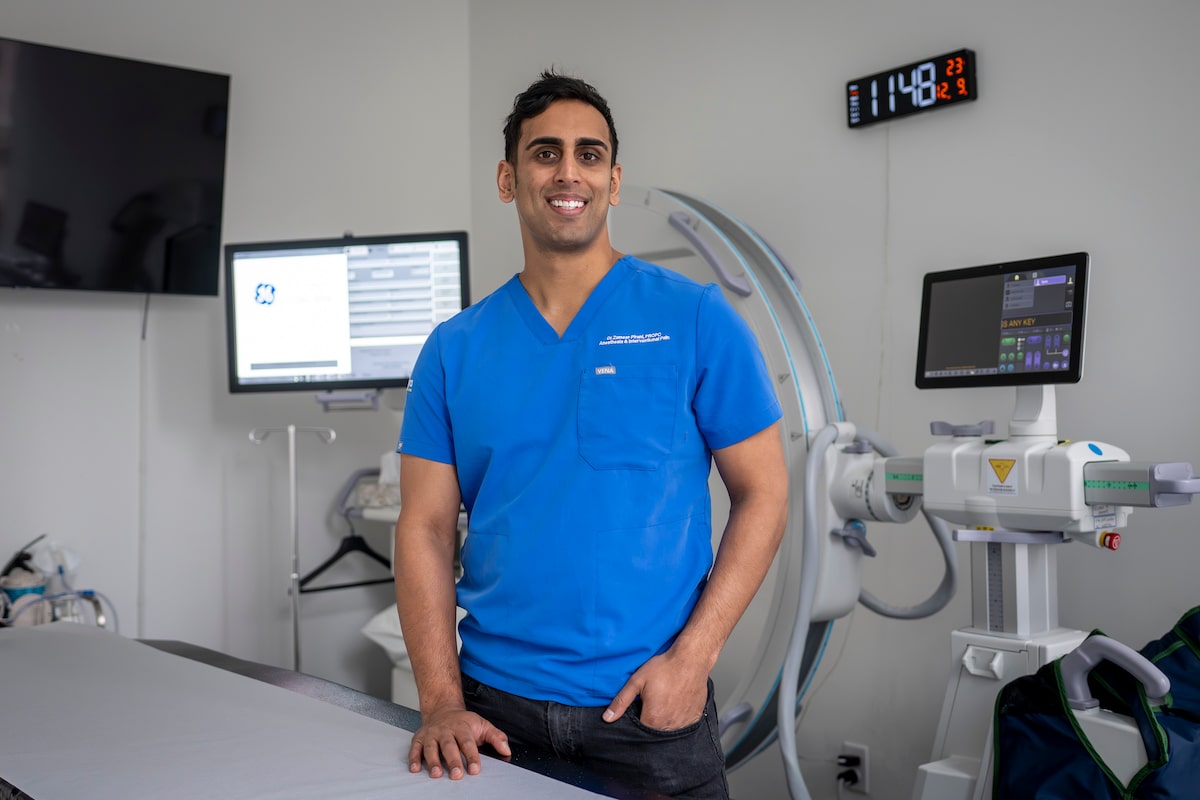
Physician Zameer Pirani at the Afiya Spine & Pain Institute in Toronto in December. The clinic offers treatments designed to allow patients with chronic pain to be seen only once or twice a year.EDUARDO LIMA/The Globe and Mail
When physician Zameer Pirani teaches medical students how to treat patients with chronic pain, he ends his lectures by raising three red flags. He says the aspiring family doctors should watch out for patients who make weekly visits to pain clinics, who get frequent steroid injections and who, despite all that, are not getting better.
“You’re actually harming a patient by doing things like that,” he said.
That kind of treatment for chronic pain has also attracted scrutiny as a drain on health resources. The Ontario Auditor-General reported in December that excessive injections for chronic pain were costing the province’s health system an estimated $100-million a year, with 10 physicians billing nearly $60-million between them last year.
Dr. Pirani believes he has a better way. The clinic he co-founded – the Afiya Spine & Pain Institute – offers treatments that mean he will ideally see a patient only once or twice a year once the underlying causes of their pain have been stabilized.
In addition to giving patients a better quality of life, it also means he’s able to have far more patients on his roster, increasing the efficiency of the health care system and leading to fewer billings per person.
“I would get paid a lot more money to do weekly injections on someone, but I don’t think that’s right,” he said. “And none of the doctors here think that’s right. That’s not why we do medicine.”
Instead, he focuses on procedures such as radiofrequency ablation (RFA), in which instruments guided by special X-ray imaging generate concentrated blasts of heat that disable nerves. It provides pain relief that can last six months to a year. But it requires specialists like Dr. Pirani to do them, and specialized equipment.
He also encourages physiotherapy and improvements to diet and exercise to reduce discomfort.
Generics of Ozempic and Wegovy expected to lower insurance costs for employers and workers
Opinion: An urgent prescription for our ailing Canadian health care system
The road to opening Afiya’s first location wasn’t easy. After Dr. Pirani finished medical school in Ireland, he did a residency in anesthesia at Western University in London, Ont., and a fellowship in pain medicine at the University of British Columbia.
After coming back to Ontario to be closer to family, he wanted to focus on treating patients with chronic pain. But when he knocked on the doors of academic institutions, they didn’t have room for him. He did some work at community clinics but didn’t feel they were treating chronic pain appropriately.
So, he connected with another doctor in his professional network – Ahilraj Siva – and they decided to start their own practice. He needed bank financing for equipment such as an X-ray machine that cost $200,000. But he found the banks were, at first, skeptical because his business plan didn’t match what they were used to.
“The banks were like, ‘You guys just started your careers. No way you’re going to make this work,’” Dr. Pirani said.
After revisions to his business plan and further negotiations, he got financing and opened a clinic in downtown Toronto in 2023 while continuing to work as an anesthesiologist at the Scarborough Health Network.
The early days were challenging. He was one of the clinic’s few doctors and would sometimes finish a 12- or 24-hour shift at the hospital, come to the clinic, sleep a few hours, and then start seeing patients. “I would come here just because I had to pay the staff, right? So, I would see as many patients as I could.”
He said 95 per cent of their procedures are billed to the Ontario Health Insurance Plan.
And although his clinics are not equipped to help patients with addictions, he said a benefit of treating chronic pain is to reduce dependence on painkillers.
“I always tell them, you know, if you’ve been on opioids for two, three, four, five, six years, the opioid is not doing what it’s supposed to be doing,” Dr. Pirani said. “It’s not treating your pain. It’s preventing you from having withdrawals from addiction.”
Within two years, Afiya’s Toronto location had 13 physicians on its register and had seen 5,000 patients – and was looking to expand.
In April, the team opened a clinic in Hamilton, in partnership with Eugene Maida, medical director of the Michael G. DeGroote Pain Clinic at McMaster University.
Dr. Pirani’s clinic focuses on procedures such as radiofrequency ablation, which provides pain relief that can last six months to a year.EDUARDO LIMA/The Globe and Mail
Dr. Pirani said that after the first clinic’s success, getting financing again was a different experience. “For the second location, every bank wanted to lend us money,” he said with a laugh.
By December, the Hamilton clinic was seeing 300 to 350 patients a week, and Dr. Pirani said they have the capacity to see double that.
One of those patients is 69-year-old Michael Doucet, who drives in from London for treatment. Mr. Doucet said his experiences with chronic pain began after a car accident in 2003 that left him with shattered bones in his leg and hip. He said he struggled through 14 more months of work at an auto plant so he could qualify for his pension.
In the years that followed, he tried different things to alleviate the pain. He used opioids for about a decade before quitting. Around 2012, he flew down to Mexico for private stem-cell therapy that worked for a time.
But in 2019, he got rear-ended while driving. “That opened everything up again,” he said.
He paid out of pocket for a hip replacement in 2021. The pain got so bad that last year he started the process of applying for a medically assisted death.
Then one of Mr. Doucet’s neighbours suggested he reach out to Dr. Pirani, who the neighbour had taught during his residency.
Mr. Doucet said his treatment at Afiya since May has greatly increased his quality of life and made it easier to spend time with his daughter and two grandchildren. “I enjoy things more in life now than I used to,” he said.
Dr. Pirani said he hopes to continue to expand his practices and provide more opportunities to physicians who have specialized in pain management. He recently signed an agreement-in-principle with the Scarborough Health Network to partner on a pain clinic there, with the support of donors.
He said medical school was difficult, but running a business and trying to correct deficiencies in the health system has been a whole other level. “This is one of the most gratifying things I’ve done,” he said.