
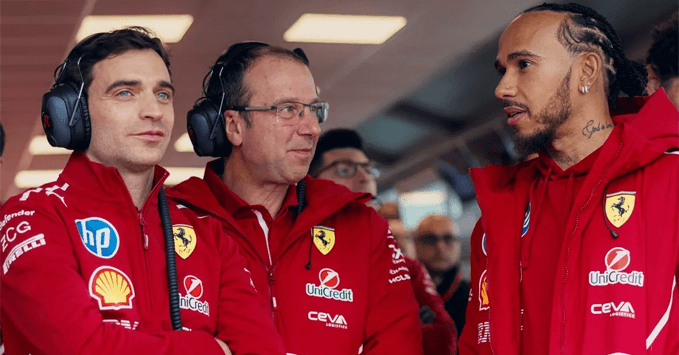
Encouraging and promising news is emerging for Ferrari’s 2026 Formula 1 project, signaling a potential turning point in the technical philosophy of the historic Italian team. Loic Serra, the French engineer who has become Ferrari’s technical director, has introduced an innovative way of thinking that shifts the team’s focus away from concentrating solely on the raw power of the car towards prioritizing the overall efficiency and effectiveness of the car as a complete and integrated system. This strategic philosophy, which emphasizes the holistic performance of the vehicle rather than just individual components, has been carefully adopted, formally approved, and fully implemented by Ferrari’s experienced engineers and aerodynamicists at the Maranello headquarters in the development and conceptualization of the 2026 car. This approach represents a bold and decisive move, intended to address and overcome the challenges presented by the new technical and aerodynamic regulations that will govern the 2026 Formula 1 season.
Ferrari places trust in Loic Serra: understanding the rationale
Loic Serra is currently serving as Ferrari’s technical director. When the French engineer initially arrived in Maranello, his assigned responsibilities were somewhat different from those he holds today. This is confirmed by the fact that his current role, which now involves overseeing the entirety of Ferrari’s technical operations, was initially covered on an interim basis by team principal Frederic Vasseur. Following repeated unsuccessful attempts to recruit a top-level engineer from a competing team—a strategy Ferrari had pursued to strengthen its technical department—the Italian team ultimately decided to adjust its plans and entrusted Loic Serra with a more prominent and decisive role in shaping the car and guiding the team’s technical direction.
The French engineer’s journey at Ferrari, now extending over one year and two months, has not yet produced the standout results that some observers may have anticipated upon his arrival. However, it is essential to note that the infamous Ferrari SF-25, a car that struggled with competitiveness throughout the 2025 season, was not designed under Loic Serra’s mandate. This fact provides a clear context for why Ferrari’s leadership decided to extend their full trust to the French engineer, acknowledging that the challenges of the 2025 season were not entirely reflective of his abilities. Even though Serra’s contributions in the 2025 campaign did not fully convince analysts and insiders regarding tire management and performance optimization, his expertise and past accomplishments make him an entirely logical choice for leading Ferrari’s efforts into the 2026 regulatory era.
Loic Serra’s technical career is extensive and impressive. He spent 15 highly productive years at Michelin where he developed an in-depth understanding of tire dynamics and material behavior. Following his time at Michelin, he moved to Mercedes, where he assumed a crucial role within the Brackley-based team, focusing primarily on vehicle dynamics and suspension behavior. His tenure at Mercedes was distinguished, and he earned recognition for his contributions to the team’s success during that period. However, with the 2025 Ferrari SF-25, issues related to tire performance persisted throughout the season. These challenges were undeniable and clearly impacted the team’s ability to achieve optimal results on the track.
It is also important to highlight that, as a fundamental characteristic, Ferrari initially struggled to activate and maintain its tires within the correct performance window. Implementing significant changes to address this was far from straightforward, especially given that the majority of technical resources, as expected, were already allocated to the development of the 2026 car. Considering this context, it is clear that relying on Loic Serra as the technical director responsible for the new regulatory cycle is a sound and well-reasoned decision.
F1 2026, Ferrari: Serra’s confirmation of a technical approach driven by creativity and innovation
In recent weeks, Ferrari has communicated and highlighted several key principles in the engineering of its latest aero-mechanical package for the 2026 Formula 1 season. Among these principles is the critical necessity to ensure that the car has the ability to utilize tires in the most effective manner possible. Maximizing tire performance is no small task, but it is an absolute requirement given that the tires remain the only direct point of contact between the car and the track. The effectiveness of this contact directly influences grip, stability, and overall race performance.
Much of the car’s inherent potential remains untapped, and unlocking this potential has been a primary focus for the engineering team under Serra’s guidance. One significant area of development has been the flexibility of the front suspension. By improving the suspension’s ability to adapt to dynamic camber changes, Ferrari can better manage tire behavior during various track conditions. The precise control of camber and suspension movement allows engineers to optimize both grip and stability, which is essential for maximizing lap times and race pace over a variety of circuits.
Recently, Loic Serra described the so-called grey areas within the technical regulations not as loopholes but as opportunities. These regulatory nuances provide engineers with creative freedom to explore new solutions within the framework of the rules. The work on suspension flexibility is a direct example of this philosophy. Engineers achieve controlled flexibility by strategically layering carbon fiber in the suspension components, arranging fibers to produce anisotropic properties that allow deformation under specific loads while remaining fully compliant with FIA static tests.
This method enables suspension arms to pass rigorous FIA inspections while still allowing controlled deformation when the applied forces differ from the nominal directions prescribed by the regulations. In this regard, foresight and long-term vision are indispensable. Ferrari’s lack of such strategic vision was evident in 2025, and Loic Serra’s approach is a clear attempt to rectify this by anticipating future technical challenges and opportunities.
Loic Serra: the logical framework for Ferrari’s 2026 car
Moving forward in Formula 1 requires the ability to learn from past mistakes, particularly after a season that could be characterized as a technical disaster. While previous setbacks are certainly difficult, they provide invaluable experience that allows engineers to make informed corrections for the future. For instance, Ferrari’s decision to implement a pull-rod front suspension in 2025 was initially promoted as a move to open a new design path. In practice, however, the car struggled to deliver competitive performance.
Even in light of these challenges, Loic Serra deserves the benefit of the doubt, especially considering that other inherent flaws in the SF-25 contributed significantly to the disruption of the team’s technical plans. The exploration of 2026 regulations presents a markedly different landscape. The essential principle for success is to focus on technical dynamics that offer the potential for further development and performance optimization.
A useful comparison can be made with the Ferrari F1-75, the team’s 2022 car. The F1-75 was highly competitive in the early stages of the championship, particularly during the first five races. However, its technical characteristics were relatively limited in terms of potential development, which prompted Ferrari to completely revise its design philosophy in subsequent seasons. Serra’s team has carefully considered this historical lesson to ensure that Ferrari’s 2026 car benefits from a forward-looking, performance-oriented technical philosophy. Frederic Vasseur has emphasized that the performance curve of 2026 cars will be steep, and Ferrari is conducting a thorough and detailed analysis to anticipate these scenarios and maximize its chances of success.
F1 2026, Ferrari: avoiding mistakes through a precise technical and strategic approach
Finally, integrating all these technical directions and principles is an exceptionally complex task unless engineers are willing to embrace bold and innovative thinking. Creative approaches that are aggressive in their conception can backfire if they are not supported by empirical data and rigorous testing. This balance between innovation and verification is where Ferrari’s engineering expertise must shine.
Rob Marshall, McLaren’s technical director since January 1, 2024, has dramatically transformed the team’s approach to Formula 1. According to Andrea Stella, Marshall, originally from Red Bull, brought a significant portion of Red Bull’s engineering DNA to Woking, particularly in the way new projects and associated risks are managed. This mindset emphasizes careful identification, assessment, and mitigation of technical threats in ambitious engineering projects.
From 2026, Ferrari intends to implement a similar strategic and operational mindset. The team aims to adopt methods for identifying, evaluating, managing, and mitigating potential risks and challenges inherent in developing a competitive Formula 1 car under the new regulations. The key question remains whether Ferrari, under the technical leadership of Loic Serra, will be able to match the success of McLaren, Red Bull, and other top teams in executing this strategy effectively.
By emphasizing a comprehensive understanding of tire dynamics, vehicle aerodynamics, and suspension flexibility, Ferrari hopes to regain a competitive edge and demonstrate that the technical philosophy introduced by Loic Serra can translate into tangible on-track results. With the 2026 season approaching, all eyes will be on Maranello to see whether the historic Scuderia Ferrari can translate innovative technical thinking into sustained race performance and championship contention.
Jan 1, 2026Luca Marini
Let other Scuderia Fans know about us


