
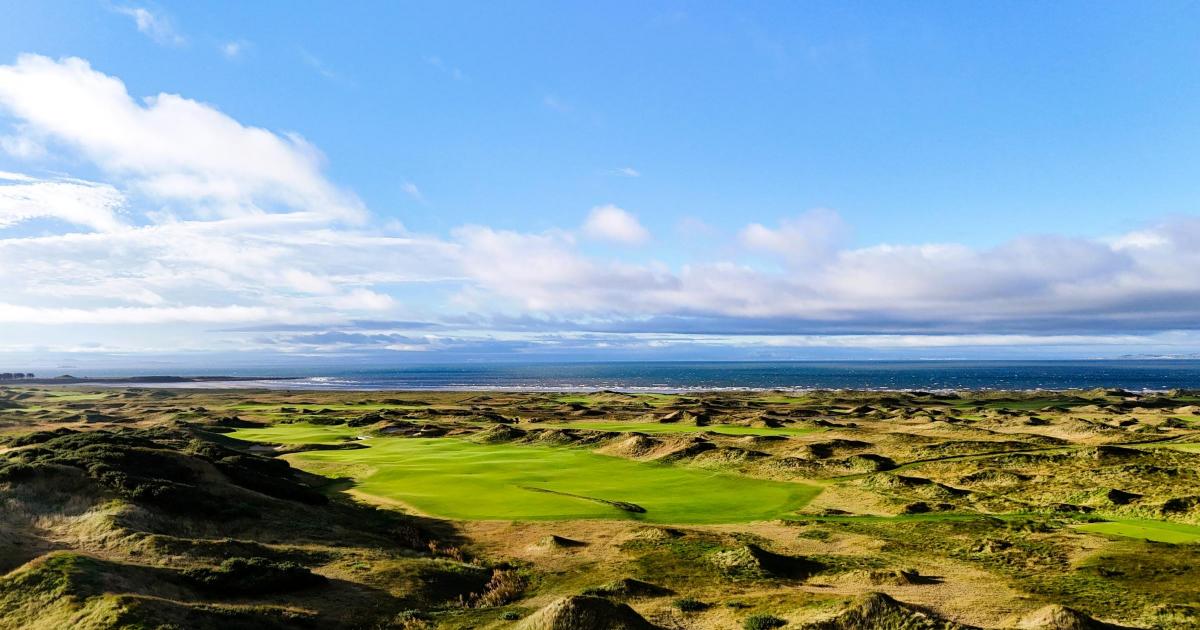
Like all premium pay-and-play venues in Scotland, most of Dumbarnie’s customers – about 80% – come from overseas. Green fees for visitors run from £265 to £350 per round, with Scottish residents paying between £132 and £157.
The expansion of five-star golf across Scotland has drawn criticism from some who maintain that “ordinary” players are being priced out. The recent marked shift towards the high-end experience also brings into question whether the market is nearing saturation, but Mr Scott believes there is still plenty of scope for growth in premium golf tourism.
Like a number of high-end courses, Dumbarnie offers a preferred rate for Scottish golfers, yet some still say it’s cost-prohibitive. What’s your response to that?
What many golfers do not appreciate are the extra costs involved with delivering a high-end golf experience.
We have a team in our golf operations of around 25 people. Their job is to assist golfers with a very warm welcome to our property, help with club hire and trolleys, and give guests an orientation of our facilities. We have starters and on busy days there are two course marshals to ensure that the speed of play is to a level that keeps everyone happy.
We offer complimentary balls on our driving range and have another team member there to ensure everything is running smoothly. Another costly and big difference between ourselves and a regular members’ club is the size of our agronomy and maintenance team. We have 20 full-time team members who undertake jobs on the course that present the links in a five-star way every day that we are open.
It’s like comparing the looks and performance of a showroom Bentley versus a lower-performing and poorer-presented model of car, or comparing the brilliant service of a five-star hotel against that of a guest house. Both provide a service, but in a completely different way.
With more venues opening to serve this market, is there sufficient demand to sustain this business model?
With over 30 million golfers playing in North America, I think the overseas demand for great golfing experiences will only grow if we keep building new quality golf courses and accommodation. We see many repeat guests, as once a golfer has experienced the great welcome, the people, food, whisky, tartan, culture and of course the wonderful golf courses, it’s hard not to want to come back to the Mecca of golf, and that is Scotland.
You have held a number of management positions at highly-regarded facilities throughout Scotland – what attracted you to Dumbarnie Links?
Leading a team that I could hand-pick so I could create the culture from the very first day. I have six heads of department, five of whom have been with me from the start. The other one has now been here for more than four year. This suggests they enjoy working here.
How’s business at the moment?
Bookings are looking very good, with a nice increase in business on the books, versus the same time last year.
What’s coming up in 2026?
We re-open on Friday April 3 and we’re making some modest changes to the course again, fine-tuning Clive Clark’s design but always with his agreement. I always enjoy our opening day as it’s great to have guests on our links and for us to create lasting memories for them.
Ryann O’Toole was the winner at the 2021 Trust Golf Women’s Scottish Open held at Dumbarnie Links (Image: Malcolm MacKenzie/PA)
I also enjoy welcoming back our Clive, our chairman and course designer, and his wife Linda. They come in July and it’s always terrific to get his feedback on the operation, and discuss possible “tweaks” for next winter, when we close again.
In June, we will once again be welcoming the GB&I Walker Cup squad for two days of practice on our links prior to the matches in Lahinch, Ireland, in the autumn.
What’s been the response to last winter’s changes to the 10th hole?
The feedback from the changes we made to the 10th has been nothing but positive.
The 10th hole tee shot requires the golfer to hit over the rise of the fairway, and after around 250 yards the fairway dips so the golfer can’t see where the ball ends up.
When playing downwind, the bigger hitters were hitting it so far that some balls were running out and into a small burn that ran across the width of the fairway. We felt this was unfair, and so we asked permission from SEPA to pipe the burn under the fairway. This was a lengthy process but once we had permission we undertook the work, and the results have been first class.
David Scott has been the general manager of Dumbarnie Links since it opened in 2020 (Image: Contributed)
What is planned at the 5th and 18th, and why is work necessary at a relatively new golf course?
The 5th is a beautiful hole meandering right to left, and it asks the golfer a question on the tee: do they play down the thinner fairway on the left of a large group of bunkers, or down the right, to a much wider fairway – a classic “risk and reward” design. The benefit to playing left is a much shorter approach shot, and so worth the risk if the golfer is quite a straight hitter.
We decided to lower a couple of the small hillocks just off the left edge of the green because if a golfer has successfully hit down the left fairway when there is a back left pin location, the view from the left side was obscured a little too much.
Our last hole, doglegs from left to right with the bigger hitters taking on the tiger line over two large bunkers. We lowered the ground above the bunkers so that golfers could see more of the foreground behind the bunkers.
What else is in the pipeline?
Every year we will look at any minor improvements we can make to help enhance the guest’s experience. This applies to the guest’s arrival, our provision inside the clubhouse, onto the range and then on the golf course.
We have no immediate plans to make the clubhouse any bigger, or add any other facilities. Over the last two winters, we have added a bespoke meet and greet building named The Welcome Barn and a well-positioned halfway house beside the 9th tee known as The Wee Barn, which offers home-made soup, great pies and of course a pint of Tennents or a golfers saviour, some Irn Bru. Earlier this year we built toilets on our back 9 and we named them The Wee House.