
After saving an injured cygnet with angel wing syndrome, longtime conservation volunteer reminds us true stewardship begins with letting wildlife stay wild
Donna Lewis stands in the cold morning light at the edge of the Aurora Community Arboretum, watching the swans move through the water like white boats.
She has watched them for nearly 20 years. She knows their habits, their health, and often their dangers.
“It’s one of the few good news stories,” she says. “Humans almost decimated them. And humans also brought them back.”
Lewis has lived in Aurora for 24 years, but her work with trumpeter swans began long before that. She met the late Harry Lumsden, the biologist who reintroduced the species to Ontario, back in 2010. The meeting changed her life.
“Harry knew he needed a succession plan,” she says. “He was very scientific. I could speak to people. I could pull at heartstrings when it mattered.”
Lewis is now a board member of Trumpeter Swan Conservation Ontario, president of Garden Aurora, and a regular partner of Hillary House Museum. “I stay busy,” she says. “But it’s good work.”
Last fall, Lewis made headlines for capturing an injured cygnet suffering from angel wing syndrome — its flight feathers twisted outwards, its future collapsing with them.
“You only have one good chance to grab them,” she says. “If you hesitate, you lose them.”
On her fifth attempt, crouched by the water with dried whole corn for bait, the young swan drifted close enough. She reached fast, catching the bird by the neck, folding its wings tight against her body.
“There’s an adrenaline rush,” she says. “First thing, get the wings next to its body. Then keep the feet away from yours. You lift, and you hold it in a bear hug. You don’t think twice.”
The cygnet was rushed to Shades of Hope Wildlife Refuge in Pefferlaw. Its wing could not be fully repaired, but the story did not end there. Another young swan with a damaged wing arrived days later. Both were taken in by Aspen Wildlife Sanctuary near Ottawa as educational animals.
“They’re in a moose enclosure now,” Lewis says. “Water, swamp, bugs — everything they need. They seem quite happy.”
Lewis has seen the cause of angel wing too many times. It is almost always human interference.
“When people try to be kind and helpful and feed the swans bread or crackers, basically they kill the swan with kindness,” she says.
Each handful of bread seems harmless. But 50 handfuls from 50 people in one weekend is not. Poor nutrition warps the wing. A swan that cannot fly cannot survive.
“I don’t encourage feeding at all,” she says firmly. “Observe, don’t interact. Let them stay wild.”
Lewis speaks often about what ordinary residents can do.
“Pick up litter. Plant native plants. Use lead-free fishing gear for the anglers in your life. Don’t leave line in the water,” she says. Three cygnets died this year tangled in fishing line. Others suffered lead poisoning after swallowing lost fishing weights.
“Everything is connected,” she says. “Planting one native plant in your yard helps the insects. The insects feed the birds. The birds strengthen the ecosystem. You can love swans by doing something as simple as that.”
Trumpeter Swan Conservation Ontario is a small charity run entirely by volunteers. Lewis is one of the organization’s most visible faces, both for her fieldwork and for her public outreach. The organization has launched its 2026 trumpeter swan calendar and residents can order through the group’s Facebook page, where a link to the order form is available.
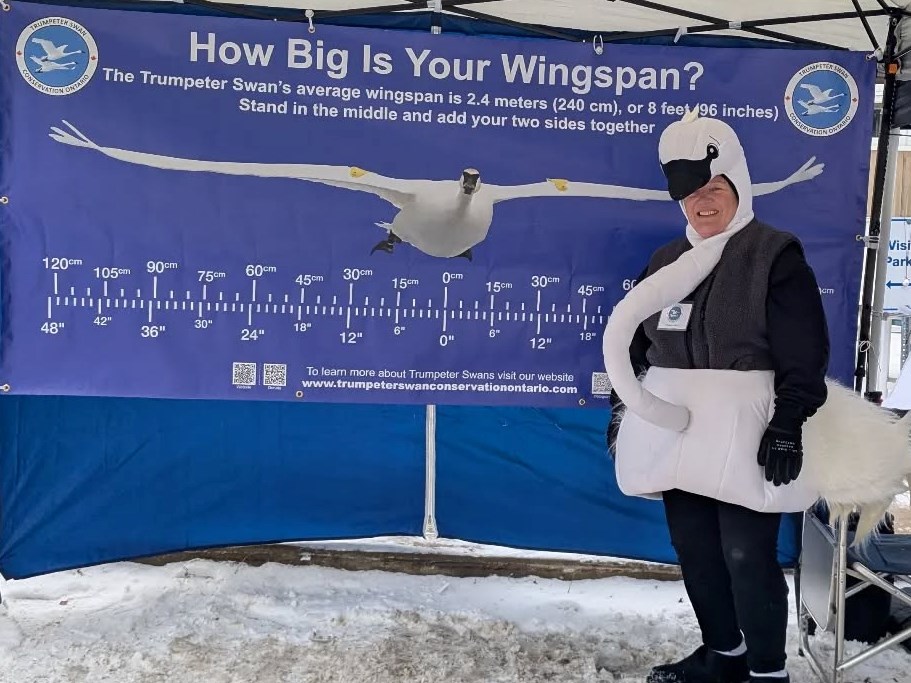
“You can even compare your wingspan to a trumpeter swan’s,” she says, smiling. “It’s a good way to get people talking.”
She pauses, looking out toward the pond where the swans raise their young.
“I wish everyone loved wildlife as much as we do,” she says. “Some species speak to us more than others. For me, it’s the swans. They brought me into their world. And once you understand one part of the environment, you start to understand the whole thing.”
She says it simply, like someone laying down a truth that will outlast her:
“We’re all interconnected.”