
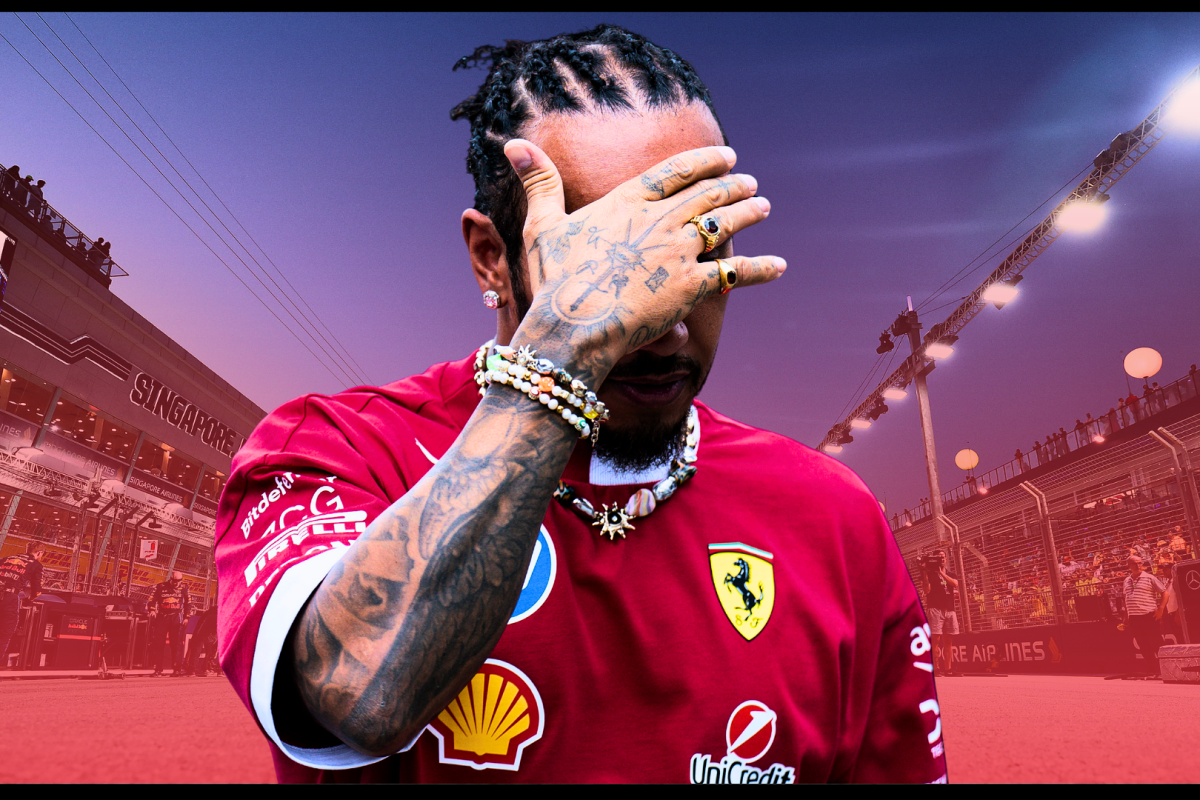
No one will have been more glad to see the back of the ground effect era in F1 than Lewis Hamilton.
The new regulations in 2022 ushered in ground-effect aerodynamics, and with it, the end of Mercedes dominance after they struggled to master the fresh concept.
Alongside Mercedes’ fall from grace, the ground effect era has also catalysed the decline of Lewis Hamilton, whose switch to Ferrari was supposed to banish the demons of years gone by and restore him to competitive glory. Well, that didn’t happen did it?
His former boss at Mercedes, Toto Wolff, has tried to dissect Hamilton’s downwards spiral at Ferrari, linking the ground effect cars and his driving style to his struggles.
Reflecting on Hamilton’s first season, however, Ferrari team principal Fred Vasseur suggested that it was the new environment that contributed to the champion’s woes – and why he was outclassed by team-mate Charles Leclerc by 86 points in the 2025 drivers’ standings.
So, surely 2026 will be better for Hamilton! No more ground effect cars. A completely new set of regulations, and a year under his belt at Ferrari, which means this year the Brit should be more comfortable behind the wheel of a car more suited to his talents.
However, a car compatible with Lewis Hamilton’s abilities doesn’t necessarily translate into title winning machinery. Yes, Ferrari need to do all they can to develop a fast car, but Hamilton also needs to make changes to adapt to the requirements of the 2026 regulations.
Hamilton’s 2026 challenge
The 2026 cars will have a narrower chassis and wheels, with the wheelbase reduced by 200mm (to 3400mm) and the width by 100mm (to 1900mm), all of which will translate into less grip and downforce.
Speaking to the media at the 2025 Belgian Grand Prix, Hamilton’s team-mate Charles Leclerc emphasised the challenge of the new ruleset and how drivers will need to adapt to these changes.
“As drivers, there will be a lot of things we’ll have to forget from whatever we’ve learned in our career, to start again from a blank page,” he explained.
“And that’s a little bit strange because having done this sport since I’m four years old, to be having to erase some things of my muscle memory would be a little bit strange. But it’s part of the game. And in itself, it’s a challenge to try and reinvent the rules and find some performance in other things. So, yeah, I’m looking forward to the challenge, but it’s very different.”
Esteban Ocon has even claimed that the change is so big it is comparable to a switch to rally. All of which suggests one main thing. The 2026 cars will reward teams and drivers who adapt best.
Ferrari have been working since April last year to master these new aerodynamic and power unit changes – with reports circulating about their ambitious steel alloy cylinder – but even if they build a decent car, it can still be difficult to drive.
While Max Verstappen won the most races last season in the RB21, the likes of Liam Lawson and Yuki Tsunoda found the car challenging to handle, with the Dutchman adapting easier to the instability at the rear end.
Which leads me onto Hamilton’s major problem. His inability to drive a tricky car fast.
Yes, you could apply the caveat that 2025 was his first season at Ferrari, but the fact remains Leclerc was the quicker driver last year and could adapt to the SF-25’s shortcomings better. None us should have been surprised by this, after all Leclerc has practically spent his entire career at Ferrari, and compared to the 40-year-old Hamilton, is a relatively young driver in the prime of his career.
The chance of success for Hamilton in 2026 hinges on how well he can adapt and change, not just his driving style to suit the new cars, but also the modern demands of an F1 driver.
A key tool in a modern driver’s kit is simulator work, with young drivers such as the likes of Ollie Bearman, Isack Hadjar and Kimi Antonelli all entering F1 having done significant work on the sim. Understanding of the 2026 cars from the sim will be beneficial ahead of testing in Barcelona, particularly as they have never been driven before.
According to Ralf Schumacher, in conversation with Sport1: “Behind the scenes, you hear that he [Hamilton] doesn’t like simulators. And he’s still looking for that old driving feel. That tells me it’s not just age, but also a mental thing. He’s no longer willing to open up.”
If Schumacher’s insight is true, then this a huge problem for Hamilton heading into 2026. His rivals will be gathering as much experience as they can on the simulator heading into next year, and if Hamilton doesn’t want to be left behind, he will have to do the same.
Furthermore, if Hamilton is looking for a return to an ‘old feeling’ in the car, then he may be embarking on a fool’s errand in 2026. Schumacher continued: “Fred Vasseur now hopes that he’ll embrace the package more next year. I think the chances are slim. The car is becoming more twitchy, Leclerc can handle that, Hamilton needs stability at the rear.”
Of course, simulator work is no substitute for that real feeling in the car, something Hamilton will be entirely focused on when testing begins, but there is another demand that could impact his 2026 season.
The calendar once again boasts a gruelling a 24-race schedule, with the current winter break significantly shorter because of the new regulations. Not a lot of time to rest and recharge.
Adapting to the energy levels needed to contest such a challenging and long season, in brand new cars nonetheless, will be also crucial, with Hamilton a busier man than most on the F1 grid.
The above is only the tip of the iceberg as to what is to come in 2026, and so far the new regulations could be a change too far for the seven-time world champion.
Adapting will be integral to rediscovering the form of old for Hamilton, but a huge question marks remains going into 2026; does Hamilton still have the ability, and the energy, to adapt to this challenge? Only time will tell…
READ MORE: Lewis Hamilton’s major weakness could end F1 career
Related