
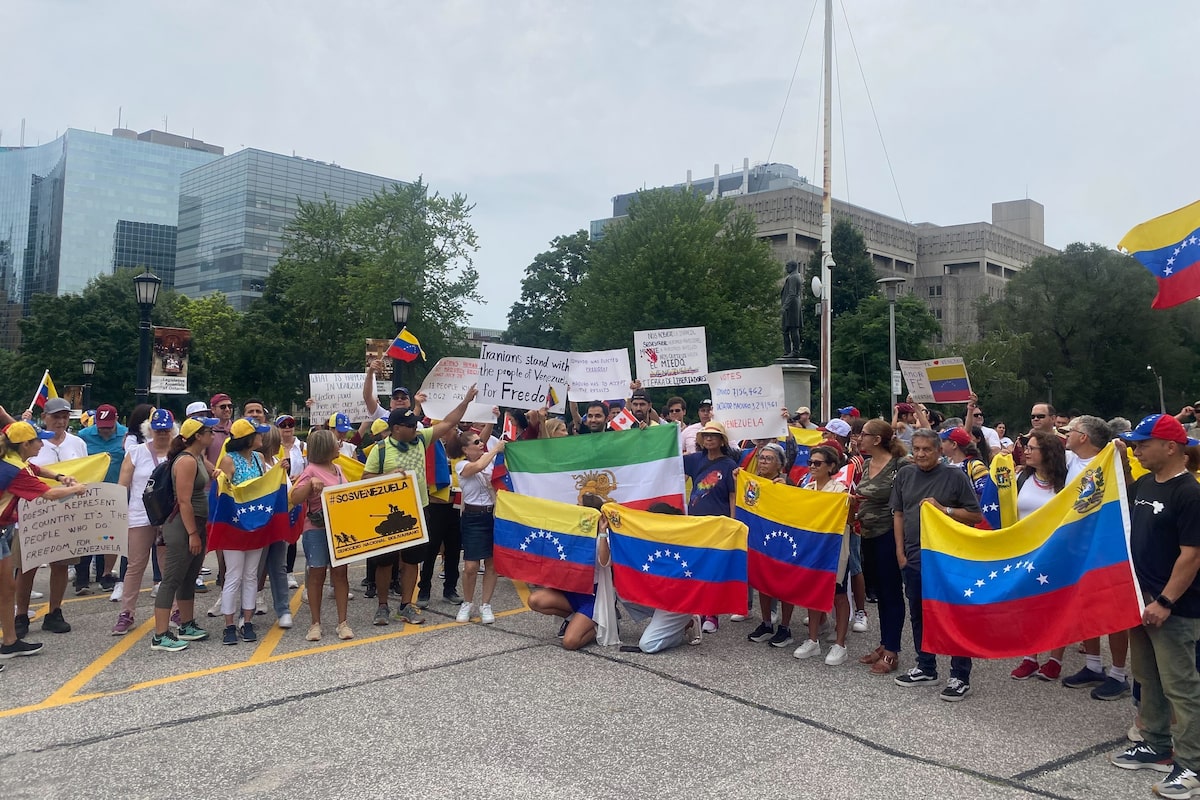
Demonstrators protesting the Venezuelan election results at Queen’s Park in Toronto in August of 2024. People who fled Venezuela say they have complicated feelings about news of President Nicolás Maduro’s capture by U.S. forces.Sheila Reid/The Canadian Press
The tears started flowing as soon as Eddy Ramirez checked her phone on Saturday morning.
Her screen showed images of explosions in Venezuela, the country she’d left 13 years ago to study in Canada, where she eventually earned a law degree and established an immigration law firm.
She had longed to return home to her family, but her mother urged her to stay away from the country’s tumultuous politics, crumbling health-care system and spiralling economy under President Nicolás Maduro. Outside Venezuela, she joined a diaspora of roughly eight million people who have left the country since 2014, the largest exodus in recent Latin American history, according to the UN.
Trump says U.S. will ‘run’ Venezuela after capturing Maduro in military strike
Carney hails ouster of Maduro in Venezuela but calls for respect for international law
Now, the video playing before her signalled the start of a U.S. attack on Venezuela and an end to the Maduro regime. Her eyes welled up before she could process the news. Were they tears of joy or sadness? She couldn’t tell.
“It was a weird mix,” she said in a phone interview. “No one likes to see their home country being bombed. It’s not what we want for the place we love.”
The U.S. military strike focused on the capital of Caracas early Saturday morning. Forces overwhelmed Mr. Maduro’s compound and captured the president along with his wife, Cilia Flores. They are being transported to New York to face criminal charges, U.S. authorities said.
Venezuelans living across Canada echoed Ms. Ramierez’s complicated feelings on Saturday morning, as they kept an eye on televisions and social media feeds for the latest updates on a U.S. attack that has been characterized as both a liberation and a coup.
The 2021 Census recorded 28,395 people in Canada with Venezuelan roots. That number has only surged in recent years as people have fled the Maduro regime. In 2025, Venezuelan citizens represented the third-largest source of asylum claimants processed at Canada Border Services Agency land border ports, behind the U.S. and Haiti.
“Their health system is broken, you can’t find medicine or food, salaries are no good – they have many reasons for coming,” said Ernesto Gudino, a volunteer with the Venezuelan Canadian Association of Calgary, which started in 2000 to promote Venezuelan culture but soon branched into English classes and integration programs to help with the many new arrivals.
Like Mr. Gudino, who immigrated in 2007 during the reign of Hugo Chavez, many were oil and gas workers drawn to Alberta’s familiar job market. He called the U.S. military strike “excellent” and hopes it will return the country to days of soaring oil, gas and electricity exports paying for world-class universities and decent health care.
The path to prosperity remains unclear, but Venezuelan-Canadians told The Globe they are more hopeful with the U.S. in charge than Mr. Maduro, whose 13 years in power followed an equally long rule by Chavez.
President Donald Trump said on Saturday that the U.S. will “run” Venezuela until a “proper” transition of power can be arranged and that U.S. oil companies will be heavily involved in rebuilding the country’s oil infrastructure.
“We all have hope that things will go okay after 20-something years of nightmare,” said Alfonso Viscido, a 35-year-old Venezuelan-Canadian who fled the country about a decade ago. “The country was basically kidnapped. I hope all Canadians open their eyes and understand that things that happened there was not only a political thing, it was a humanitarian crisis as well.”
He said that while he knows some don’t like Mr. Trump, he believes what he did in Venezuela was a good call. “We applaud him and welcome that decision,” he said
Mr. Viscido’s parents, along with many other family members, remain in Venezuela. His parents weren’t too affected by the strikes, but his grandmother, who lives close to a military base, heard the attacks.
“She was a bit shaken,” he said, adding, “They thought they were going to die because of the amount of bombs that were dropped.”
Everyone is fine now, Mr. Viscido said, adding that his family remains cautiously optimistic. “I’ll say that they’re cautiously happy. They’re not 100 per cent happy yet, but most of the fear is gone from people.”
Not everyone is so optimistic. Cristina Pulido-Vielma worked as a journalist in Venezuela but left for Canada after a disputed 2004 recall referendum allowed Hugo Chavez to remain in power.
Since coming to Canada, she says she’s opposed the Venezuelan regime through demonstrations and petitions, always with a goal of seeing democracy restored at home. The American toppling of Mr. Maduro does not constitute democracy, she said.
“That conflicts me today, because it’s a strike against our sovereignty,” said Ms. Pulido-Vielma, a Toronto-area language interpreter. “From the American perspective, it’s an unauthorized war act.”
Several close Maduro associates apparently remain in the country, and the government has called on citizens to “mobilize and defeat this imperialist aggression.” Many countries condemned the attack, which a spokesman for UN Secretary-General Antonio Guterres called “a dangerous precedent.”
Ms. Ramirez, who eventually determined that she was crying tears of joy when she read confirmation that Mr. Maduro was gone, says she shares some uneasiness about President’s Trump’s methods and intentions.
“I know he’s not doing this because he loves us and wants to bring us back home,” she said. “I’m not naive. But I would invite people to hear us, to read us, to understand why a country of people is cheering for this to happen.”