
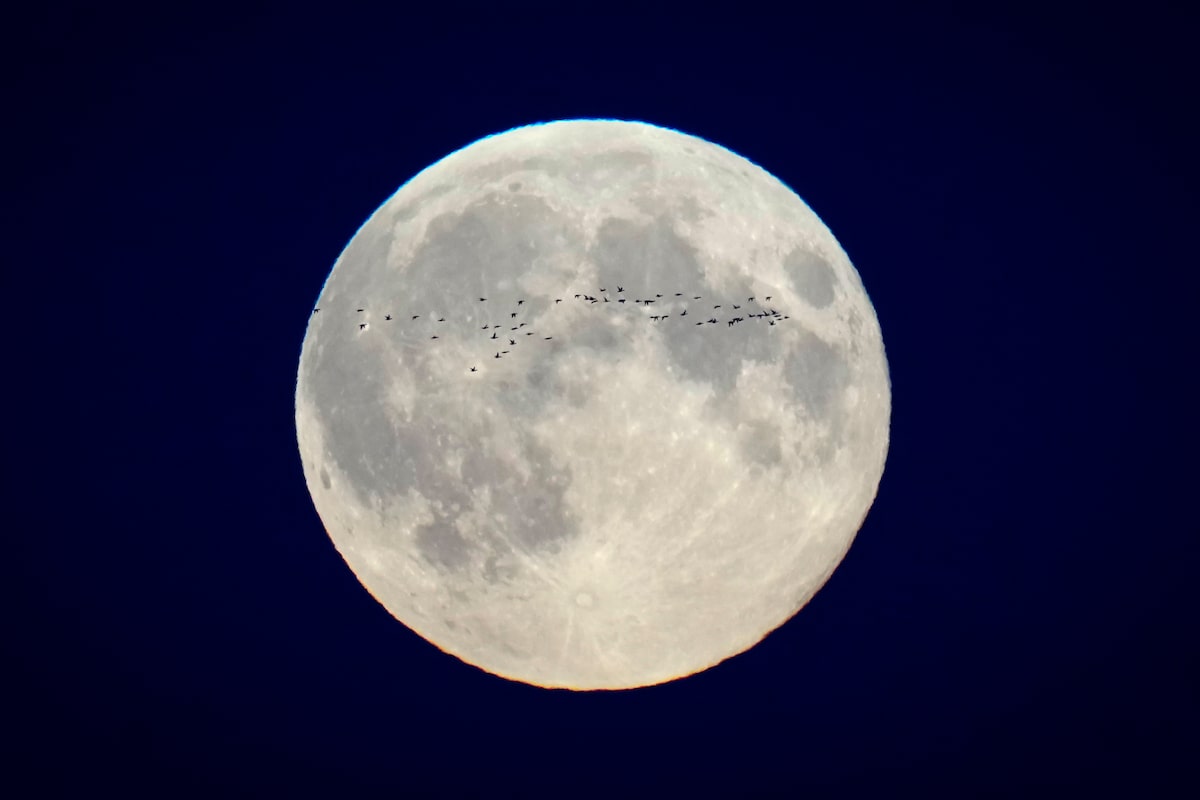
A flock of birds fly in front of the full moon over the city centre in Tallinn, Estonia, in 2024. This year, a SpaceX rocket will carry 4G network to the moon.Sergei Grits/The Associated Press
Gus Carlson is a U.S.-based columnist for The Globe and Mail.
The human colonization of other planets has long been a staple of science fiction. But so far it has remained just that – a futuristic flight of fancy.
Last week, the idea of earthlings living on other worlds took a giant leap toward reality.
NASA and Nokia, the Finnish telecom, announced a partnership to put a 4G cellular communications network on the moon, a key building block in the push to make long-term human habitation on other planets possible.
Some time this year, a SpaceX rocket will carry a simple 4G network to the moon. It will be situated at the south pole and remote-controlled from Earth.
Opinion: Does Canada have the national will to own our future in the cosmos?
This is not simply an outer space version of expanding text and streaming service to a new neighbourhood for convenience. Scientists say a communications system is foundational to colonization, along with water and power.
They are eager to use the moon as a communications test platform for further exploration, particularly Mars, the most likely planet for human colonization.
NASA believes its new system will not only revolutionize astronaut communications – which are still rooted in old-school radio technology – it will also accelerate and improve the collection and management of high-resolution video and science data critical to colonization.
It could also be the precursor to an interstellar internet comparable to what we have on Earth, enabling space colonists to use smartphones to access information and apps from outer space.
Among the most critical tasks is the search on the lunar surface for ice, which can create breathable oxygen and fuel used to explore other planets.
Scientists capture crackling sounds from Mars that could be lightning
“A future lunar economy will critically depend on communication technologies to collect and analyze data, share information and maintain and control operations,” said Thierry Klein, the president of Bell Labs Solutions Research, the Nokia unit spearheading the project, in a CNN interview.
“This includes sustaining a semi-permanent or permanent human presence on the moon, as well as automated robotic operations for transportation, resource mining, mineral processing and scientific data collection,” he said.
Civilian space travel has made great strides, with Elon Musk’s SpaceX and Jeff Bezos’s Blue Origin having flown successful excursions carrying tourists and cargo over the past three years.
These efforts have proved civilian space travel can be done safely, if expensively, but now these adventurers need somewhere to go – and perhaps stay.
Mr. Musk has predicted that we could see the first colonists in outer space by mid-century – ambitious, yes, but the NASA-Nokia deal is an important piece of the puzzle and may make the timeline more realistic.
The convergence of these factors and the technological advances driving them have made the idea of colonization tantalizingly plausible. The big question remains: Why bother?
Dreamers, of course, would say it is humankind’s destiny to achieve what the imaginations of the great science-fiction writers have created.
Cynics would say we have no choice. The fact that we have mistreated our own planet makes it imperative that we find the next places for future generations to survive and thrive.
Those opposed to the idea might suggest that we should be devoting our time, money and technological know-how to solve the problems we have here at home, rather than pursuing the crazy dreams of the likes of Gene Roddenberry and Rod Serling, which, even if achievable, are still decades away.
NASA launches satellite on mission to detect water on the moon
And seriously, if colonization happens, does everyone in outer space really need a smartphone so they can access whatever future social-media platforms exist? Haven’t we learned anything about the inanity of current apps such as TikTok and Instagram yet?
To be fair, NASA says its experiments in the extreme conditions on the moon are expected to provide important data for the use of 4G in remote places on Earth, where communications are nonexistent, as well as improving emergency services in such areas. So there may be some near-term, close-to-home benefits to the far-off testing.
Despite the hurdles, including ongoing skepticism of such efforts by some earthlings, outer space colonization seems inevitable. And it’s not just because we now have the technology to get us to new worlds and enable us to stay there.
Humankind is wired to explore and conquer the unknown. And if, as science fiction suggests, space is our final frontier, there is an increasingly good chance we will find ways to make it so.