
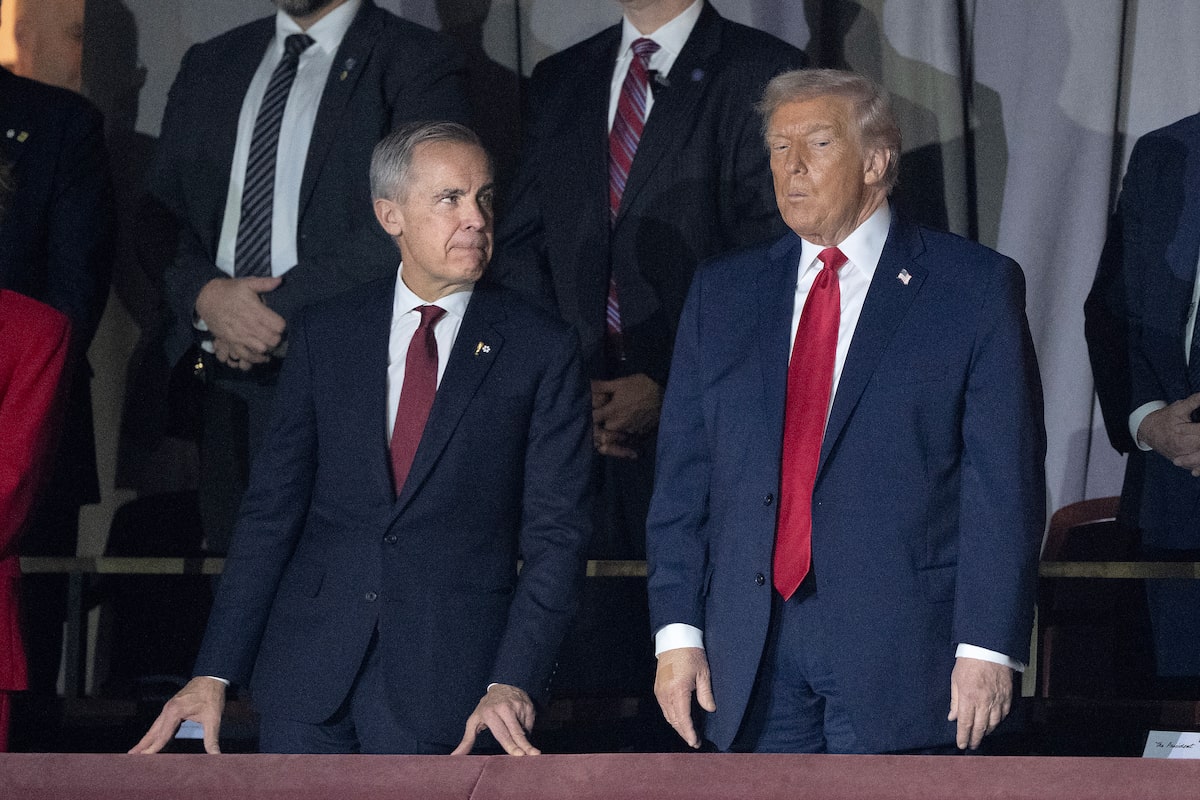
Prime Minister Mark Carney and U.S. President Donald Trump wait for the FIFA World Cup draw to begin at the Kennedy Center, in Washington, on Dec. 5, 2025.Adrian Wyld/The Canadian Press
It should have been clear in November, 2024, when Donald Trump won reelection that Canada needed to act with urgency to end the drift of (especially) the last decade, during which the federal government dangerously neglected the basics of safeguarding national sovereignty.
The alarm bells were seemingly heeded last spring, when Mr. Trump launched his trade war and started greedily eyeing Canada as the 51st state. Against the odds, the Liberals won reelection under Mark Carney on the promise of an elbows-up response to Mr. Trump’s provocations.
But that promised response has not materialized, despite other worrying developments. In November, the U.S. administration published a National Security Strategy that would dramatically curtail the sovereignty of any Western Hemisphere country, Canada included.
Then came the U.S. military strike on Venezuela on Saturday. Any thought that Canada could simply wait out Mr. Trump’s term in the White House ended this weekend.
There has been no shortage of rhetoric from Prime Minister Mark Carney about the need to expand Canada’s military capacity and to end economic stagnation. What has been lacking for more than a year is action commensurate to the national emergency in which Canada finds itself.
Carney hails ouster of Maduro in Venezuela but calls for respect for international law
The conundrum that Canada faces is that there is no immediate fix to today’s emergency. It will take years to build a new pipeline, and years to fully rebuild Canada’s military. Which is why there is not a moment more to lose.
The Liberals have talked about doubling non-U.S. exports over the coming decade. But what will happen this year? This month? The Liberals have talked about increasing Canada’s military spending to five per cent of GDP by 2035. What steps will be taken in 2026? The Liberals have signed a memorandum with Alberta that sets the stage for an oil pipeline to the Pacific. It’s a solid first step, but when will the next one come?
The right answer, the only answer, must be immediately, for the three herculean tasks of diversifying Canada’s exports, revitalizing the domestic economy and rebuilding this country’s military capacity.
The single biggest step that Ottawa can take in diversifying exports is to ensure a new bitumen pipeline to the West Coast is constructed. The economic logic was unassailable before the U.S. seized Venezuela’s Nicolás Maduro. Now, the United States is vowing to ramp up Venezuelan crude production, which would swell supplies of heavy oil for U.S. refiners – driving down prices for Alberta producers. The immediate response must be to green-light additional capacity for the Ottawa-owned Trans Mountain pipeline. The company has said it intends to boost capacity over the next five years. That timeline needs to be accelerated to start this year.
What the U.S. attack on Venezuela could mean for oil and Canadian crude exports
More important, Ottawa must work with Alberta to secure a private proponent in the coming months for a new oil pipeline, underpinned by a commitment that all regulatory approvals will be granted in under two years.
There will need to be consultation and accommodation with Indigenous communities to fulfill Ottawa’s constitutional duty. But the Liberal government must make it clear in those talks (and to any obstructionist premier) that the only question to be discussed is how a pipeline will be built.
The same kind of leadership is needed for the forging of a national economy. The promise of internal free trade has devolved, yet again, into inter-provincial squabbling. The federal government needs to step in to ensure that internal trade barriers are dismantled speedily and permanently.
Opinion: A Venezuelan oil reset is an economic risk Canada cannot ignore
Ottawa already has the only tool it needs, in the form of its very deep pockets. Federal funds should be made contingent on provinces and territories tearing down trade barriers.
On national defence, the Carney government has taken some initial measures to boost military capacity. But the announcements last year of an increase in defence spending and procurement reform are, at most, an overdue first step.
Recruitment needs to quicken, now. Procurement delays need to end, now. Any minister who attempts to detour spending into regional pork-barrelling should be booted from cabinet. Any staff officer who gets in the way of ending the bureaucratic snarls of procurement must be cashiered.
In June, former U.S. ambassador Kelly Craft told a Toronto business audience that if Canada doesn’t like being called a 51st state, it should stop acting like one. Those may be hard words for Canadians to hear, but they underscore the seriousness of the moment, and the urgency of action.