
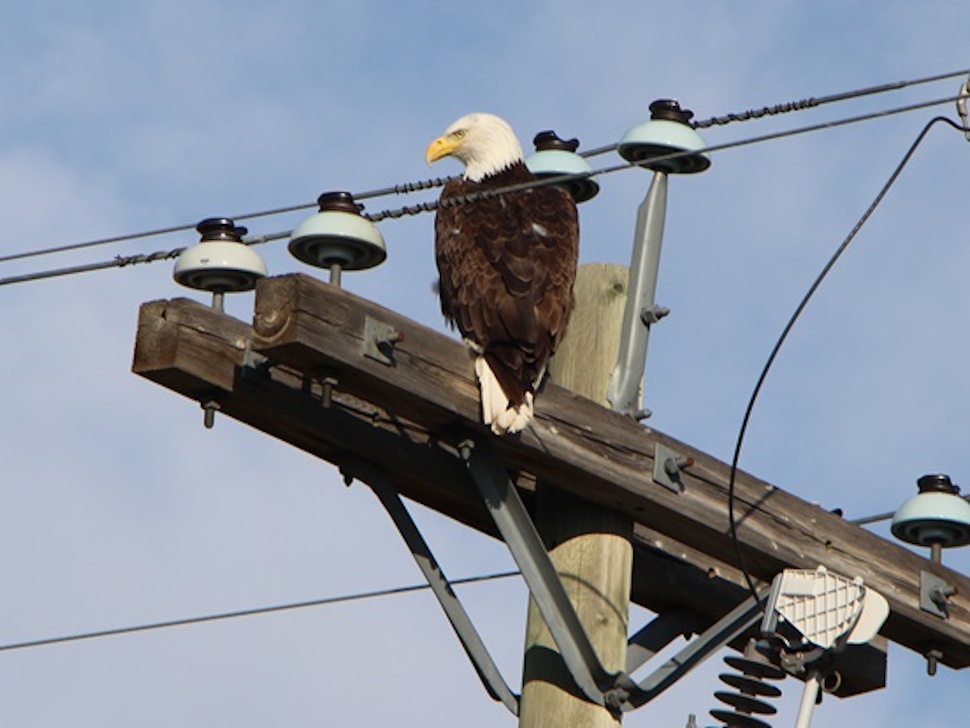
Bald eagles are becoming an increasingly familiar sight across Manitoba, and the reasons behind their return point to decades of environmental change and recovery.
Norm Gregoire, Community Liaison for Species at Risk with Shared Legacy, explains the trend has been building for years, not just recently.
“The bald eagle is definitely a North American conservation success story,” he notes. “We have made some choices decades ago that first negatively affected the bald eagle, and then we sort of tried to reverse those effects, and now we’re sort of reaping the rewards of having more bald eagles around.”
What changed for bald eagles
Gregoire says the single biggest factor behind the population rebound is the banning of a widely used pesticide called DDT, which dates back to the 1970’s.
He explains the chemical had devastating long-term effects on birds of prey.
“That was a pesticide that was used with long-term effects on birds of prey, eggs, it would essentially make the eggshells thin, and they would break; the chicks wouldn’t even be born,” he adds. “These birds of prey that are at the top of the food chain, like the bald eagle, they start to decline pretty dramatically,” Gregoire adds.
Once DDT was banned, the recovery began, though not overnight.
“The eagle population started slowly but surely, creeping up in numbers,” continues Gregoire.
A slow but steady recovery
The pace of that rebound is tied to the bald eagle’s biology.
Gregoire remarks that these birds live long lives and do not reproduce quickly.
“It’s a bit of a slow process,” he remarks. “They can live, 20, 25 years in the wild, and they’re monogamous, meaning that there’s going to be a male and female that are generally going to be pair-bonded for their life.”
That slow growth means it has taken decades to see noticeable increases, but the results are now becoming visible across the province.
Where Manitobans are spotting them
Gregoire mentions that winter sightings often depend on access to food.
“If there’s any open water still on any of the big lakes or any rivers or anything like that, that would hold any fish or other wildlife, then that’s a really good place to see them,” he mentions.
Bald eagles are also showing up in agricultural areas across southern Manitoba.
“There might be things like hog barns or poultry farming going on,” he says. “Sometimes bald eagles can be, cagey and hang around there for additional food sources as well as roadkill,” Gregoire says.
Their scavenging habits mean drivers may even spot them near highways.
“Anywhere where there’s something that looks like a white-tailed deer that’s been struck on the highway, look up in the trees, and there may be a bald eagle around,” he adds.
Staying through the winter
More bald eagles are also choosing to remain in Manitoba year-round.
“We are starting to see trends where more and more are staying in the winter,” Gregoire continues. “The bald eagle is actually pretty well adapted for a cold climate.”
He notes that larger populations may be spreading out rather than heading south.
“That could be just a general trend of having a larger population,” Gregoire remarks.
A sign of a healthy ecosystem
Beyond their striking appearance, bald eagles play an important ecological role.
“When you’re seeing a lot of bald eagles around, it means that we overall have a healthier ecosystem that can support them,” he mentions. “When you see a tall predator like an eagle in greater numbers that shows that we are doing something right when it comes to the environment.”
Gregoire also confirms the birds are protected in Canada and best appreciated from a distance.
“They’re a beautiful animal just to watch,” Gregoire says.